

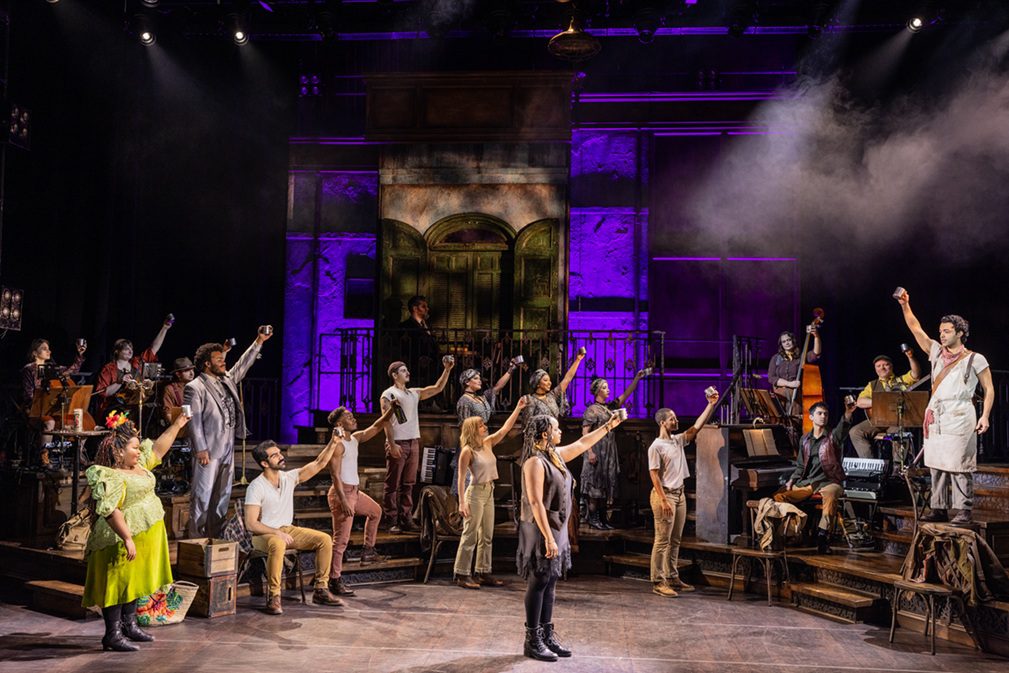
SALT LAKE CITY — Hadestown is back as part of this season’s Broadway at the Eccles series, and there is a reason this show has won eight Tony Awards. Hadestown is spellbinding and is more relevant today than when it first opened on Broadway in 2019. With music, lyrics and book by Anaïs Mitchell, Hadestown is the brilliantly retold myth of Orpheus, who travels to the underworld to rescue Eurydice. Their tragic love story is interwoven with that of Hades and Persephone and set to New Orleans style jazz. These ancient myths are timeless—retold again and again across millenia, and Hadestown does so with adept storytelling by both Mitchell and director Keenan Tyler Oliphant (based on original Broadway direction by Rachel Chavkin).
Direction and Design
There is no discernable preshow soundtrack as the audience settles in before a unit set. When the cast enters, they do so all at once, bringing the stage to life for the story about to be told. Hermes, played capably by Rudy Foster, playfully interacts with the cast and begins with introductions, making it clear that we are all embarking together on a storytelling adventure—a sad story, to which we all know the ending, but we’re going to tell it anyway.
The set, designed by Rachel Hauck is fixed with tight spacing—risers and stairs flank either side. Lovely detailed latticework on the front of the platforms and stairs with a railed balcony in front of French doors center evoke the architecture of New Orleans. The orchestra (except the drummer) is on stage the whole time, which leans into the presentational, story-telling nature of the show. Famously, Hadestown is a Trombonist dream—an instrument that usually takes a back seat, leads the way, and Haik Demirchian is up to the task. The entire seven piece orchestra has the power of a much larger ensemble.
The main center stage acting space is not large, and Oliphant’s staging and T. Oliver Reid’s Choreography (based on the original Broadway choreography by David Neuman) make good use of all space, up and down the set. I do miss the prior tour convention of physically going down into the belly of the set to evoke exodus to Hadestown. This production takes an up and over the stage right stairs route to the underworld, with lots of stage fog. It works ok, but is lacking that descension element that really pulls you into the underworld.
Lighting design by Bradley King is powerful—swinging lights, and head lamps in the underground evoke a dark and sinister feel. The dramatic down spotlights in Little Bird effectively introduce the audience to the seductive character of Hades. In Act II as we fully descend into the underworld, floodlights momentarily blind the audience, drawing us in. At the climax as Orpheus makes his ascent out of the depths, lights sweep across the house, pulling the audience into the hero’s journey.
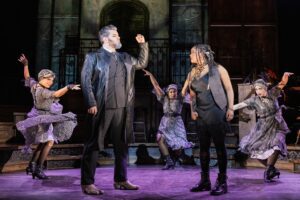
Reid’s choreography is excellent, especially with the small Chorus. Small, tight movements of just a shoulder, or arm speak volumes in the underworld work segments. Hades and Persphone’s dance at the climax is fierce and beautiful. The echo between this couple and the younger Orpheus and Eurydice is vivid and leans into Orpheus’s vain hopefulness for a different ending.
Acting
Casting by Whitley Theatrical, is impeccable. Hadestown is naturally gritty and eclectic, so there is no need to gather a homogenous and visually typical cast, and previous productions have certainly run the gamut of racially diverse casting, but what this production really adds, is expansive physical diversity. I rarely comment on actors physical appearance because it’s not usually relevant, but I found the choice to cast outside of “typical” appearances so engaging and supportive of the storytelling that it’s worth mentioning.
Even within this relatively small cast, in addition to a broad ethnic make-up, there is such a range of everyday body types, from height, to curves, to gender expression, that the show physically speaks to a broad audience and creates visual interest that supports the narrative. In an era where the term diversity has been maligned, it’s so refreshing and heartening to see a company lean unapologetically into the notion that talent doesn’t have a body type. This cast exudes talent and skill, and appearance enhances the storytelling in interesting ways.
For example, Namisa Mdlalose Bizana is delightful as Persephone. Her short, but robust and curvy stature strikingly counterbalances the tall, large presence of Nickolaus Colón as her husband, Hades. Similarly, Eurydice is often cast as a spritely, petite figure, so seeing Kamara’s tall, solid build in the role is a refreshing visual change. Her soulful and rich vocals combined with her physical appearance, makes her grounded and pragmatic character an apropos counterpoint to the physically lithe, vocally soaring and idealistic character of Jose Contreras’s Orpheus. The five member chorus also blends striking vocal harmonies with an array of physical types, from the higher registers and petite forms of Erin McMillen and Bryan Chan, to the brawny presence and sound of Ryann Farhadi’s deep toned vocals.
Foster’s Hermes is delightful throughout, in demeanor, movement, humor, and presence. He riffs beautifully in Road to Hell and Gathering Storm where he dances with a black parasol as in a New Orleans funeral march. At first Contreras’s Orpheus seems timid in voice and manner, which is perhaps by design, because as the show progresses, Contreras really settles into his element—his soaring falsetto truly seeming to bring the world into tune again. Similarly, there were moments in the first half that I wanted Bizana to throw more sass as Persephone, but when we get to the second half, opening with “Our Lady of the Underground”, Bizana comes fully into her character. The ever-present fates, played by Gia Keddy, Miriam Navarette and Jayna Wescoatt, hold their own with skilled vocal harmonies that push and pull the story forward.
Context and Conclusion
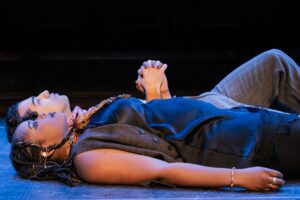
Songs like “Why We Build the Wall” and “If It’s True” hit differently right now—themes of Hades’ authoritarian rule and the workers’ desire to be free from the weight and constraints of that rule really hit home. Orpheus’s line “it is not for the few to tell the many what is true” is particularly poignant in a world flirting dangerously with authoritarianism. Just before the finale, Hermes stops the show, and with his back to the audience, speaks to Orpheus, prostrate with grief at his loss, about the cyclical nature of hope and loss. This simple tableau is breathtaking.
The finale, which is a reprise of the first song, Road to Hell, brings us home—back to the beginning. Hermes sings about why we tell sad songs again and again, and why we continue to try again and again to change things, full of hope like Orpheus, and simultaneously aware of the reality. But we tell it anyway. This production encompasses the nature of humanity, theatre and storytelling; the hope and tragedy—it is a narrative that digs deep and flies high all at the same time, balancing humanity somewhere in between. If you can, see it again and again.

MORE INFO: HADESTOWN is currently playing at George S. and Dolores Dore Eccles Theatre (131 Main Street, Salt Lake City, UT 84111) through March 29. Performances are held at 7:00 PM on Wednesday and Thursday, 7:30 on Friday and Saturday, and 1:00 on Saturday and Sunday. Tickets for Hadestown typically range from $64 to $149. For the most up-to-date schedule, performance details, and official ticketing, visit the Salt Lake County Arts website: https://www.saltlakecountyarts.org/events/hadestown/