

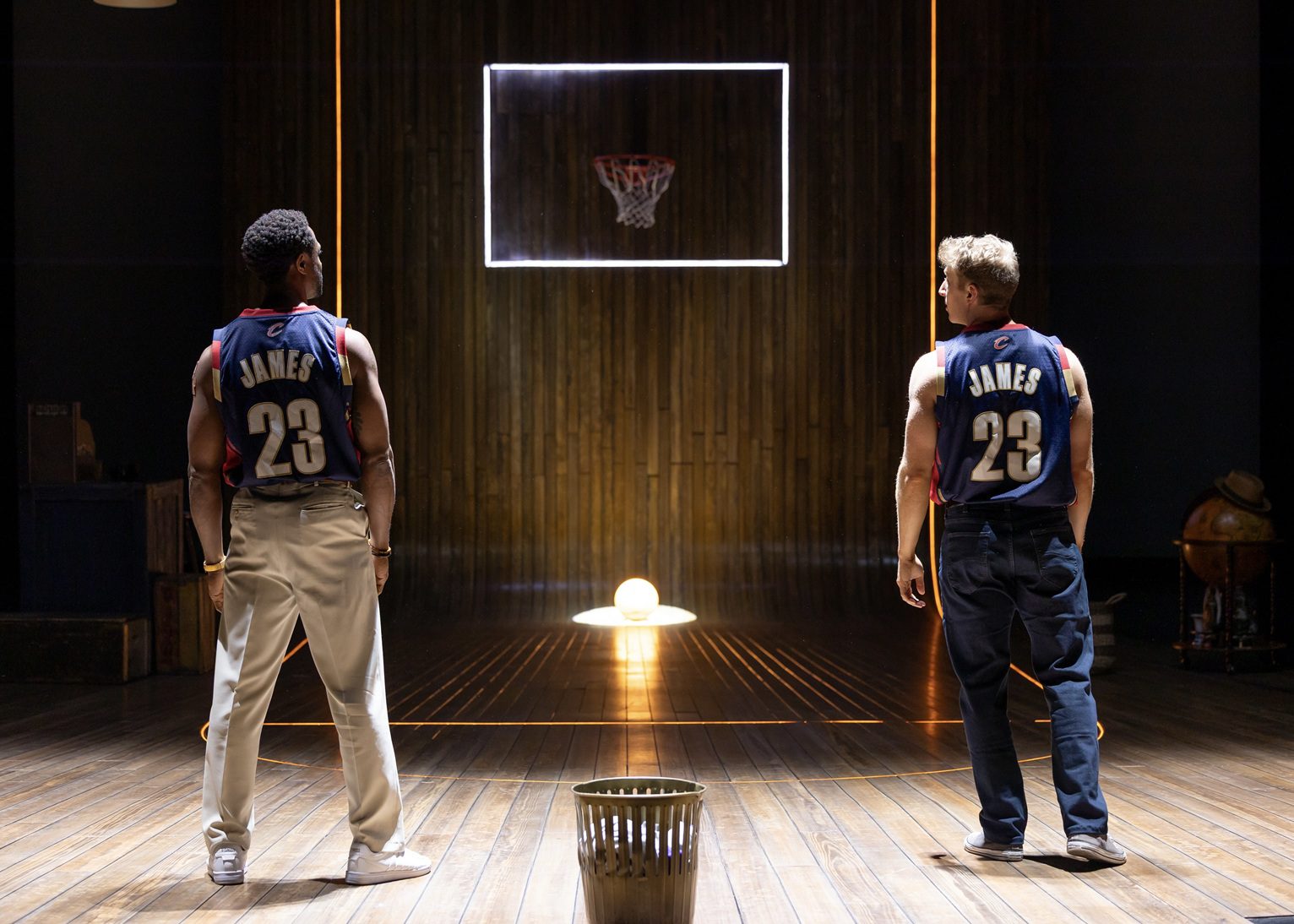
SALT LAKE CITY — For three decades, student audiences rattled the rafters of the Einar Nielsen Fieldhouse cheering on their basketball team. In 1944, Utah won the basketball national title behind Utah native Wat Misaka, the first non-white player in what would become the NBA. In 1959, the fieldhouse was home to what the U’s athletics call the greatest game ever played as #6 Utah defeated #2 Ohio State. This past weekend, Pioneer Theatre Company helped bring the rock back to the fieldhouse in the Meldrum Theatre from the two-man play King James by Rajiv Joseph. The play is two acts of two scenes each – fittingly four quarters – and for the second time this year, I saw a play from PTC that dealt with modern manhood in a way that felt deeply personal and authentic. Swish.
Pregame
The lobby display was fantastic. A Space Jam uniformed LeBron James cutout was the first sight in the space, there was a basketball hoop offering fans the chance to shoot free throws for free concessions if they went 3/3. The usual preshow announcement felt more like the lead in to an NBA game and I whooped when I was told to in a way that would be more fitting at the Delta Center than the Meldrum. Whoops. However, the focus of a game ready atmosphere gave me buy-in from the jump. I appreciated the fusion of these spaces.

First Quarter
The stage is set as a wine bar converted from a cathedral. Eli Mayer plays Matt, whose opening sequence shows him repeatedly trying and failing to make a paper ball into a garbage can. Matt is a bummed out Cleveland Cavaliers fan whose financial failings are leading him to sell the last 19 games of his season ticket package during LeBron James’ rookie season. He’s met by a friend of a friend named Shawn, played by Khiry Walker, an aspiring writer who is negotiating to buy the tickets and the two have a very guy-coded conversation as they banter about basketball, the tickets, their mutual friend, and other banal things. I loved it.
Walker and Mayer have great chemistry and through their woven conversation, the core issues of fandom, money woes, and the novelty of seeing LeBron in real time. Throughout the play, I was impressed in the ways the two navigated their relative ups and downs with a mix of banter, the banal, and sometimes brute force. The pair moved well in sharing the space, and the shifts in who had the upper hand felt like a scored game. At the end of the scene the tickets are sold, but they go together.
Second Quarter
The second quarter shows Matt and Shawn drunkenly discussing The Decision from LeBron James. I lived in Ohio when this happened. You could feel it in the air, and by and large, I think the two actors brought the appropriate gravity to the scene. Their discussions felt natural, and Heidi Bruce was a solid basketball consultant in making the dialogue flow and, later, their game play feel on point. If an assistant basketball consultant is ever needed, sign me up.
What I was impressed by in this scene was subtle lighting shifts. Walker and Mayer are on stage the entire play. Marcella Barbeau’s plot and design allowed for subtle shifts that drew the audiences eye, set tone and isolated moments. Shawn makes a major revelation in this scene, and as the impact of it dawns on Matt, you see the pool of light he’s in shrink to put him under more of a spotlight. Moments like this elevated the whole play.

Third Quarter
After halftime, (I went on-of-three on free throws and got a PTC mini basketball for my troubles), the story showed more contrast. This was evident in costuming from K.L. Alberts where Matt was thriving financially and is dressed like bottle service was a personality trait. By contrast, Shawn is now in shorts and an antique’s shop polo from Matt’s parents shop. If clothes make the man, they certainly do through much of this play in telling the story of each character’s ups and downs and the power dynamics they feel from one another.
This is the scene where Walker really takes over the play as Shawn. The fervent and unrelenting demand that throw away comments from Matt be answered with answers about their racist undertones were powerful. Walker moved with subtext but spoke with reality in this part of King James.
Miriam Laube’s direction really empowers this scene. It starts with disagreement about LeBron’s return to Cleveland and their different takes. Men’s arguments are often hard to tell when it’s banter and when conflict has bubbled up. This was the highest stakes scene so the banter was tamped down, and the conflict was way up. Racial undertones quickly became overtones with the dramatic irony of Matt not hearing or seeing himself at times. T
Fourth Quarter
The play concludes with a dramatic reversal of fortune, which the design elements support. The conflict, which centers on the iconic words, “BLOCKED BY JAMES!” shows is case in point for what this play is about. Men’s relationships often center the trivial and push real world conflicts to the exterior at their expense. This sense of normalcy is what gives the play life and depth. It’s a well written script that any man who subscribes to The Athletic will feel personally tied to.
I loved how the tension gets cut in the end through subtext. Walker and Mayer are able to convey through tone and body language what the next stage of their relationship will be. I appreciate how often this play shows instead of tells and works hard to ensure that is clear both from the audience and within the world of the play.
Post-Game
This show is not for all audiences. Plentiful profanity colors the piece. While the script’s exposition frames the major King James milestones, the profundity and stakes are a little diminished when audiences don’t have memories of events like The Decision or Cavs-Warriors Game 7. It’s not inaccessible by any means, but the global context is clearer when the two-man relationship of the play has that support.
Just like Two Pianos, Four Hands earlier this year, this is the kind of play that asks good questions about masculinity, purpose, and what relationships are built on. This is a play I want to go back and see five times, with the five most important men in my life. It reflects back the reality of sports being so often a key thread through men’s relationships. The script is excellent, and the performances elevated and personalized the conflict. Especially during March Madness, King James is a slam dunk.

MORE INFO: KING JAMES is currently playing at Pioneer Theatre Company (300 S 1400 E, Salt Lake City, UT 84112) in the Meldrum Theatre as part of Pioneer Theatre Company’s 2025–2026 season. Performances are held at 7:30 PM on select evenings, with some 2:00 PM matinees on Saturdays and Sundays through April 5, 2026. Tickets for King James typically range from $30 to $65. For the most up-to-date schedule, performance details, and official ticketing, visit the Pioneer Theatre Company website: https://pioneertheatre.org/