

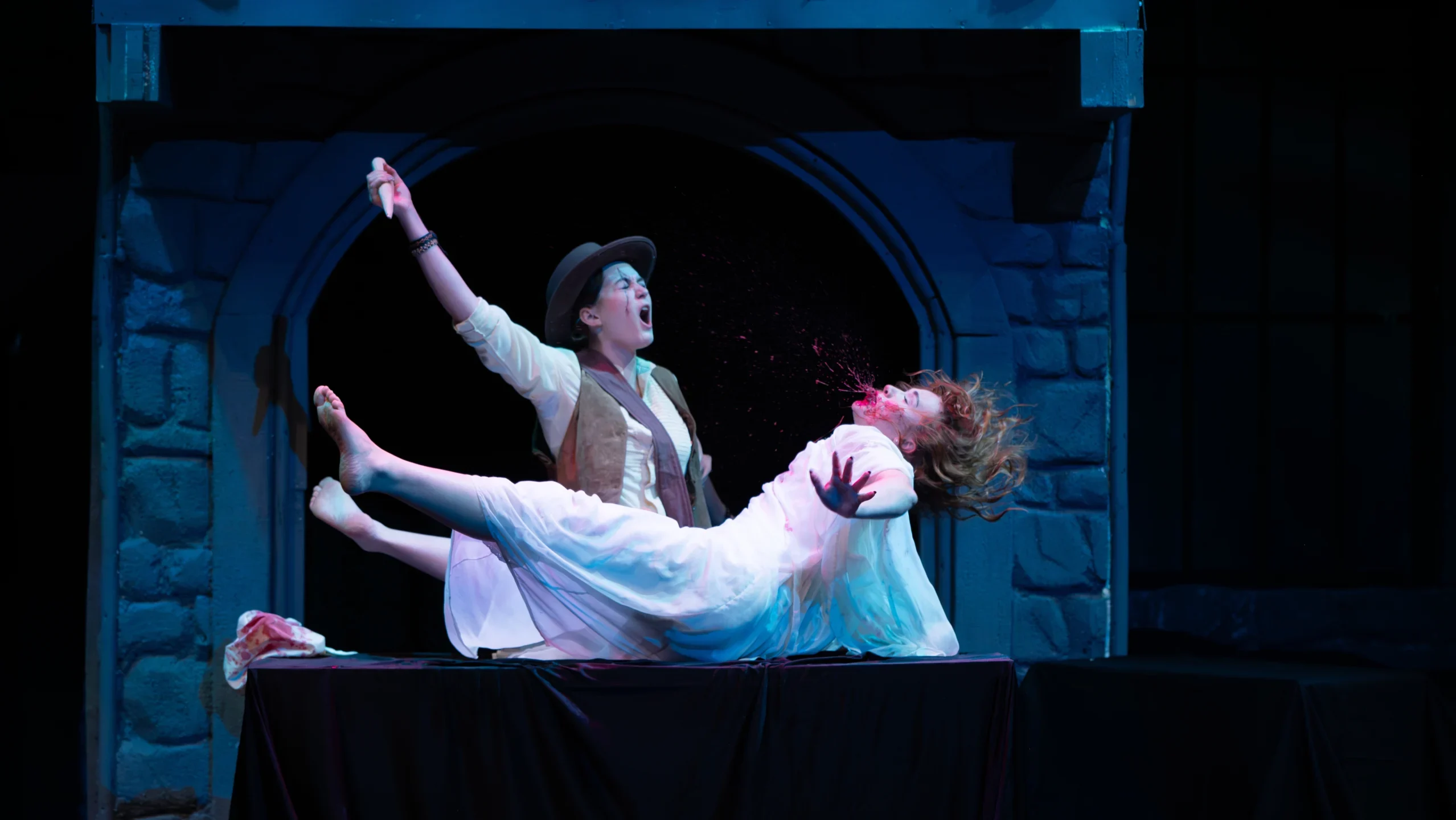
LOGAN — One of my favorite aspects of theatre as a storytelling medium is its innate ability to lean into abstract symbolism. While film is generally literal and “real” (even within fantasy or science fiction), theatre carries an inherent sense of play and imagination that audiences and actors alike share during the course of a show. As a result, theatre often proves more flexible and agile than film in its capacity to experiment. Directed by Paul Mitri, Utah State University’s production of Kate Hamill’s Dracula: A Feminist Revenge Fantasy embraces that flexibility, taking a well-known story and dragging it (perhaps kicking and screaming) into a reckoning with patriarchy and religion.
There are some small spoilers for the plot in this review, so if you prefer to go in blind (and it’s worth being surprised), you can stop here knowing this: I loved it.
PLOT
The title alone will likely signal who may not enjoy this show as much as I did. Hamill’s Dracula makes significant changes to the source material, placing the women at the center of the story. The novel’s basic plot points are largely intact: Jonathan Harker (well played by Niko Barlow) bids farewell to Mina (Avery Burt) before leaving for business in Transylvania. There, he encounters Dracula (the charismatic Riley Kyle Thompson) and his wives (Grace Owen and Aleena Hiatt, both suitably sultry). Dracula bites Jonathan, who falls ill before returning to England with Dracula in tow, seeking fresh (virginal) victims.
At home, Mina—Jonathan’s pregnant wife rather than his fiancée—spends time with her friend Lucy (Ariana Whatcott) before Lucy’s marriage to Dr. George Seward (Jonah Newton, who transforms well from misogynist to advocate). Seward oversees a “very kind” asylum, currently housing Renfield (an out-of-favor, not-quite bride of Dracula, played marvelously by Esther Barnes), desperate to regain her “Father’s” favor. After Lucy is attacked by Dracula, Dr. Van Helsing (reimagined as a rough-and-tumble American cowgirl, played with enthusiasm by Emily Alvey-Despain) arrives just in time to help form a plan to stop him and his entranced followers.
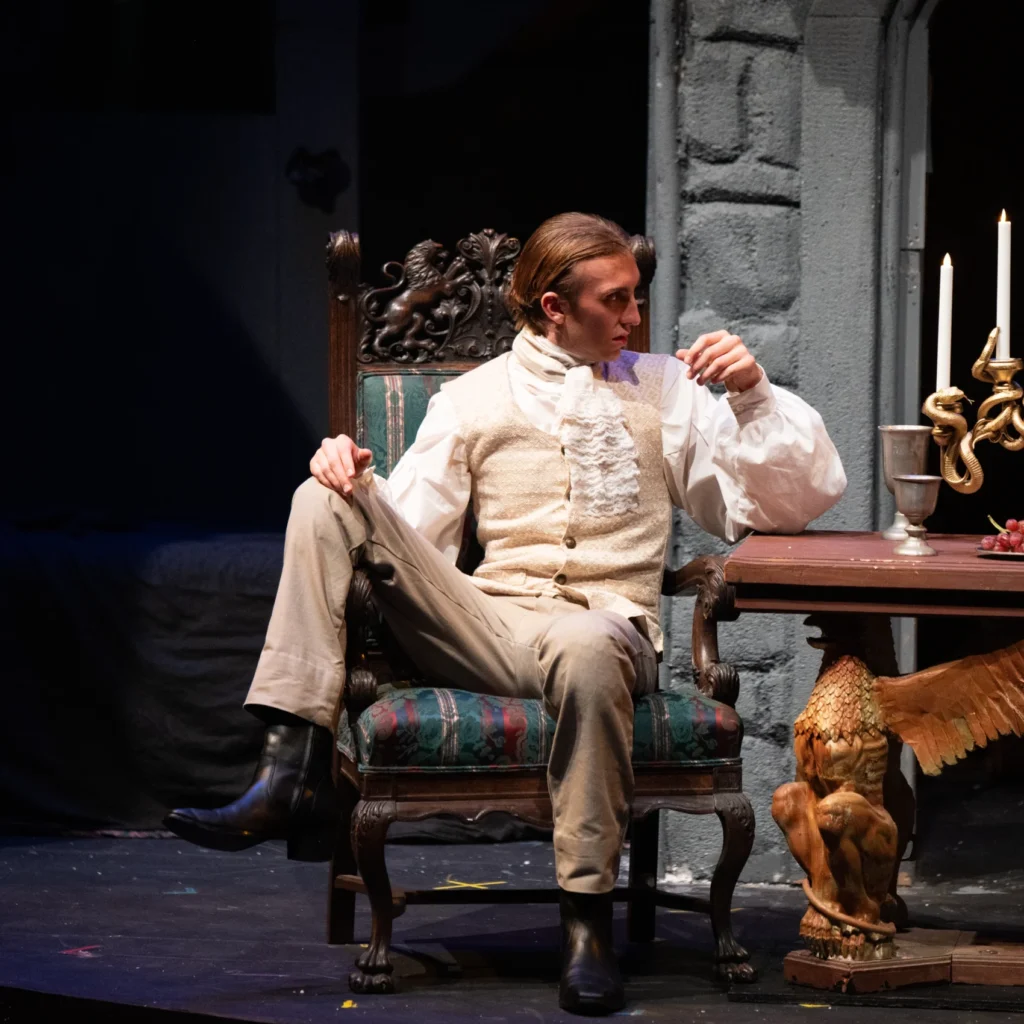
Throughout the show, Hamill asks audiences to consider the toxic masculinity of Dracula and the other male characters: How do such traits form? How do they impact women—and men? How do you stop the spread of that influence, described as a kind of parasite? More importantly: what does that mean for us? The result is a captivating story that kept the opening-night audience enthralled.
STANDOUT PERFORMANCES
The play begins, as requested by the playwright, with Renfield in her cell—muttering, pacing, and carrying on in a way so focused and intentional that Barnes immediately captured my attention. Renfield’s manic obsession with Dracula and mystical, poetic dialogue felt distinct and motivated. Her ultimate confrontation with Dracula, and his rejection of her years of devotion, was devastating. Barnes’s performance alone is worth the price of admission.
I was initially less sure of Burt’s Mina, who seemed a touch subdued in her farewell to Jonathan. But as the show continued, it became clear that the gradual unfolding of Mina’s strength was the point. Burt’s careful pacing of this transformation—from reserved wife to formidable vampire hunter—was enormously satisfying. She is the true protagonist of the production, and it is easy to root for her.
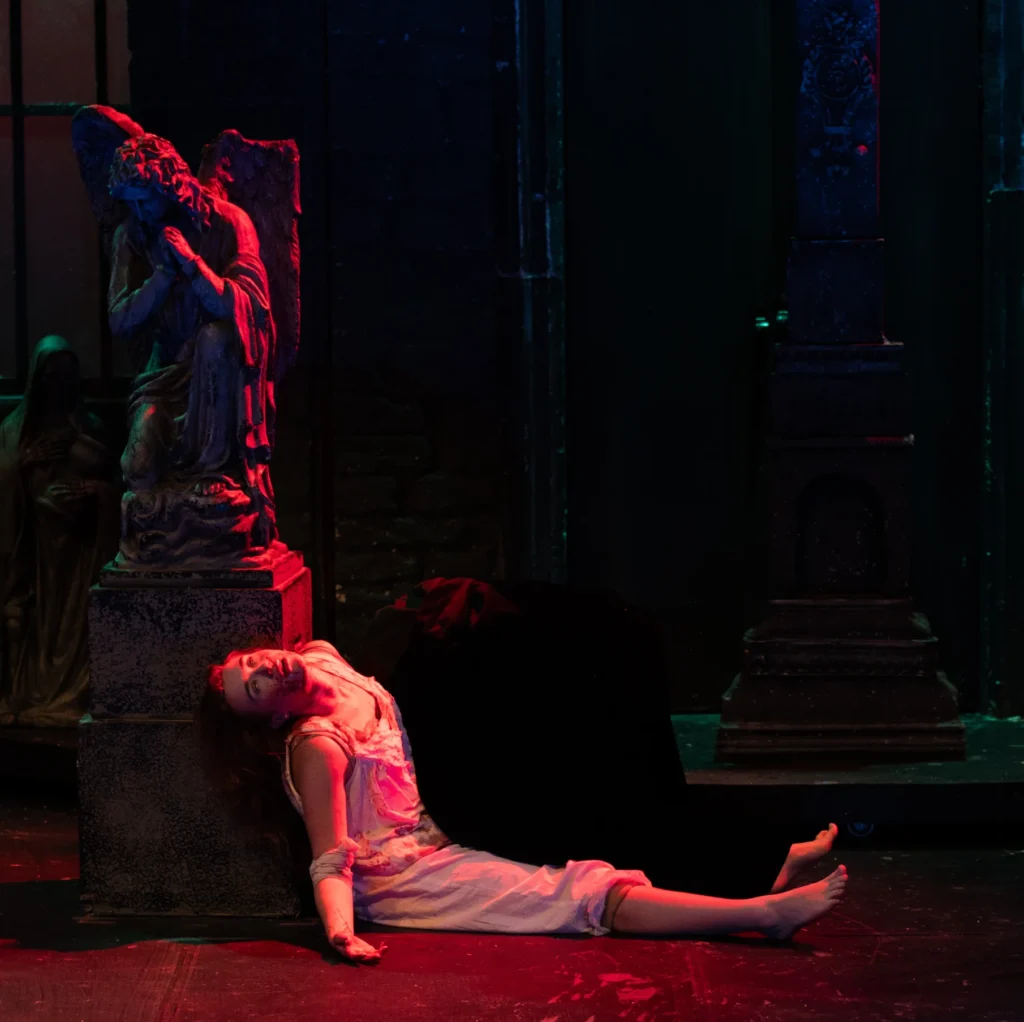
Two of the most dynamic performances came from Alvey-Despain’s Van Helsing and Whatcott’s Lucy. Alvey-Despain’s entrance is suitably rowdy and brazen, bringing humor that nicely lightens some of the play’s heaviness. As Lucy, Whatcott undertakes one of the night’s most demanding physical arcs. Watching her transformation from anxious fiancée into one of Dracula’s brides was genuinely disturbing. Her commitment and range were deeply impressive.
The strength of the entire cast—supported by Paul Mitri’s excellent direction, much-needed intimacy direction from Stephanie White, and impressive dialect coaching from USU faculty—makes this a must-see for fans of the genre and lovers of theatre.
TECHNICAL ELEMENTS
The production’s technical elements were somewhat uneven. The costumes (designed by Chloe Satern and Rosalind Leichty) are effective and well-executed, and the unit set (designed by Dennis Hassan) is wonderfully flexible, fluidly creating the show’s many locations. The sound design (Kelsey Koga), however, was less consistent. The underscoring was strong, but some ambient effects—crows, bat wings, or moments when Dracula spoke through other characters—were far too loud and sounded recorded rather than organic. Isolating certain effects to localized speakers instead of the full sound system, and smoothing some of the fades, would have made them feel more natural. Likewise, a few fight sequences with Dracula could have been enhanced with added sound effects to heighten the illusion of his power.
CONTENT CONSIDERATIONS
Before attending, note that the show includes disturbing material. In addition to some infrequent minor cursing, there is frequent blood (often spurting), depictions of murder and suicide, violence against women, and generally intense scenes. While I don’t consider myself particularly prudish, I was curious how the show would play to a mixed audience. The opening-night crowd, which appeared largely over 18, responded enthusiastically—nearly all were on their feet at the end.
FINAL THOUGHTS
Hamill’s strength as a playwright lies in challenging assumptions about well-known stories. Here, the destructive effects of toxic masculinity are on full display: from Jonathan’s and Lucy’s assaults to the abusive religious overtones in Renfield’s devotion. Van Helsing’s final conversation with Mina drives the point home: no one is ever truly safe from its effects. This is a thought-provoking and satisfying production that rejects the vampire genre’s history of fetishizing violence against women. Instead, it offers a timely message.
As Van Helsing tells Mina in the final scene: “I want to believe those creatures are parasites; I don’t want to think—that it is a natural evolution of the worst parts of human nature. That any—all men could turn dangerous if given too much power.” It’s a potent closing statement for an excellent production. I left the theatre already texting friends who would love it. See it before it flies off—you won’t regret it.
[box] Dracula: A Feminist Revenge Fantasy plays September 30th – October 3rd at 7:30pm and October 4th at 1:00pm at the Morgan Theatre in the Chase Fine Arts Center on the campus of Utah State University. Tickets are $18-23. For more information, please visit https://utahstateaggies.evenue.net/events/T1 [/box]