
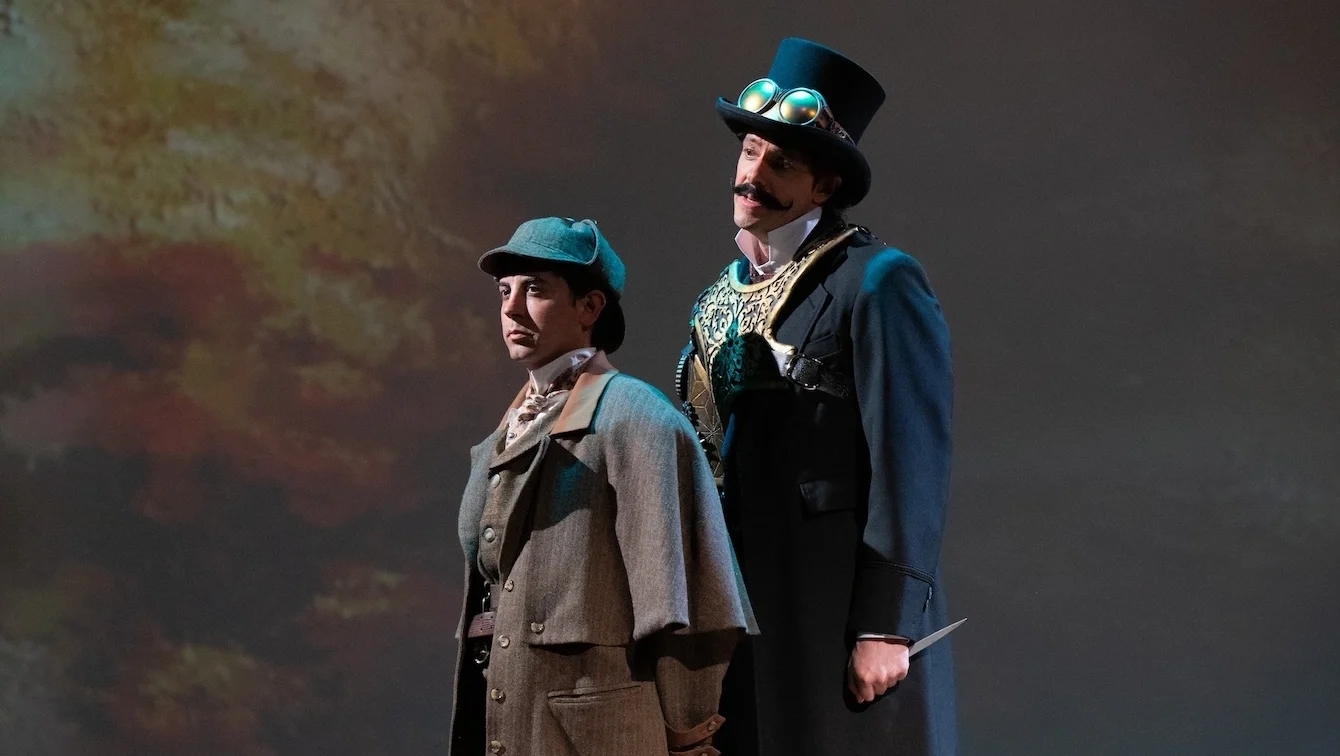
LOGAN — Lyric Repertory Company’s production of Sherlock Holmes: The Final Adventure by Steven Dietz is a visually imaginative take on the world’s most famous detective. With a smart script adapted from William Gillette and Arthur Conan Doyle’s original play, this production brings Holmes’s final case to vivid life with a bold steampunk flair and a cast that understands the high stakes and theatrical possibilities of the genre.
Directed with confident style by Paul T. Mitri, the production is anything but dry. A sense of impending urgency begins before the lights even dim to start the show, as an ominous ticking sounds through the house while patrons find their seats and look at the set full of clockwork gear motifs. We are drawn into a stylized Victorian London, filled with danger, shadowy figures, and moments of sly humor from the moment the first swirling fog projection bleeds across the scrim. The steampunk aesthetic—a blend of 19th-century silhouettes with stylized mechanical touches—gives this world of Sherlock Holmes a heightened sense of danger and eccentricity that plays beautifully with the tone of the script.
Leading the production is Stefan Espinosa as the legendary detective. Espinosa captures Holmes’s razor-sharp intellect, emotional reserve, and flair for the dramatic with striking precision. In a role that too easily tips toward the cold or the insufferably arrogant, Espinosa strikes just the right balance—playing Holmes as brilliant, occasionally maddening, and endearingly likable despite his flaws. That delicate thread is perhaps best seen in the scenes with Irene Adler, played with poise and spark by Kelsey Crotz. The chemistry between Espinosa and Crotz crackles, particularly during their charged exchanges in Act II. While in Irene’s rooms, Holmes delivers his famous line, “When you have eliminated the impossible, whatever remains, however improbable, must be the truth,” it’s no mere catchphrase—it lands as a deeply personal realization and the tension between the two characters is electric and full of unresolved possibilities.
This is not to say that Irene Adler is just a romantic foil for Holmes. Crotz’s Irene is a clever strategist in her own right and one of the few people who ever outwits Sherlock. Whether sparring with Holmes through veiled flirtation or standing her ground with steely confidence, Crotz commands attention in every scene with both femininity and cunning.
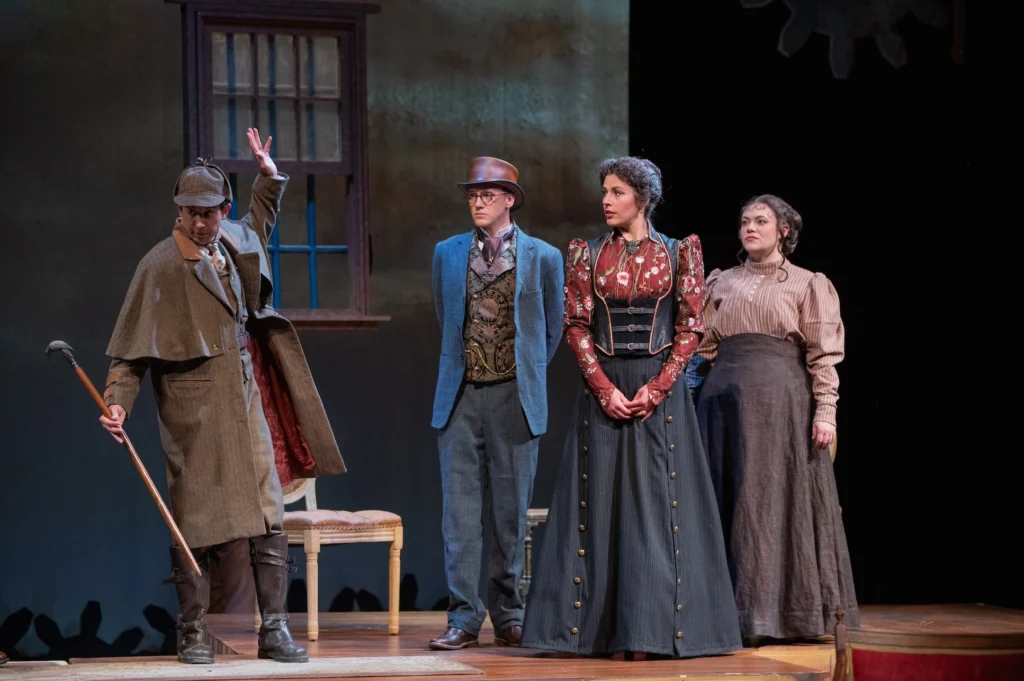
Like most Sherlock Holmes stories, this story is narrated by his everyman sidekick, Doctor Watson, played in this production by Lance Rasmussen, who makes a wonderful counterpart to Espinosa’s Holmes. Rasmussen’s Watson is grounded, loyal, and warm-hearted, but no fool. Their repartee is one of the great pleasures of the evening, with Rasmussen lending heart and humanity to Holmes’s colder calculations. The dynamic between the two feels authentic—a crucial foundation for the suspenseful twists the play has in store.
No Holmes story would be complete without a worthy villain, and Gordon Reed Dunn delivers a menacing Professor Moriarty. Moriarty’s presence looms over the action like a storm cloud, aided by some beautifully cinematic projections that give the show its delicious noir flavor. Dunn doesn’t overplay the role — he remains cool and always in control to help build suspense.
The supporting cast brings additional color and energy. Paddy Berger’s King of Bohemia is gloriously over-the-top, with a strong Germanic accent, exaggerated expressions, and a delightfully pompous air that walks the line between absurd and charming. Berger’s portrayal is cartoonish in the best possible way, adding levity without undermining the stakes.
Sydnee Fullmer and Colton Iverson play the Larrabees with a kind of slinking theatrical villainy that feels right at home in this heightened world. And then there is Jonah Newton, who plays all the remaining small roles with nimble versatility. Whether stepping in as a henchman, Clergy, Police, or Swiss Man, Newton brings clarity and humor to each character and help fill out the world of the show.
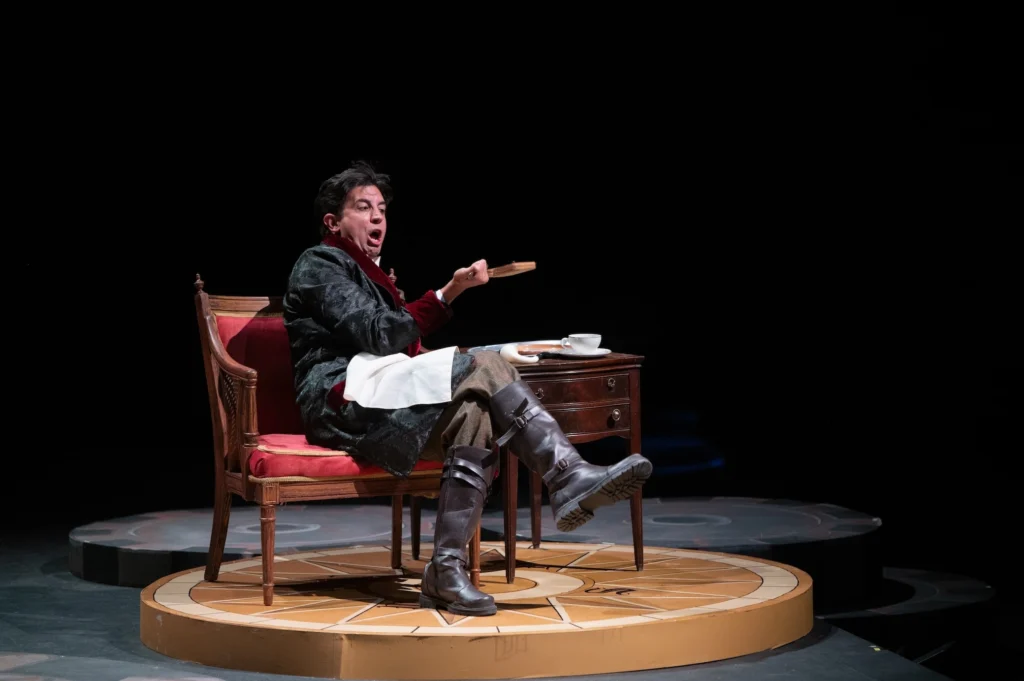
Visually, the show is feast for the eyes. Scenic designer Michelle A. Bisbee’s set cleverly balances the practical needs of a multi-location mystery with steampunk design elements. Circular platforms have the outer edges painted to look like they are gears grinding against each other. Larger platforms have industrial pipes on the sides. The pieces move on and off quickly to never slow the momentum of the show as it charges ahead.
Emma Fenstermaker’s properties add personality and specificity. I particularly loved it when Watson suddenly transformed the top of his cane to reveal it was also a small spyglass. Most impressive was Moriarty’s costume, which included a mechanical cuirass—a riveted chestplate and backplate that harnessed to his torso, from which extended a sinister mechanical arm. The articulated limb, covered in gears and clockwork joints, looked as though it had been forged in an infernal Victorian laboratory. Lydia Semler’s costume design carries the Steampunk theme by holding true to most Victorian styles, like Irene’s leg-of-mutton sleeves, while adding Steampunk flair to artfully edit the look and feel of each character into a slightly alternative history of London.
The most striking technical element is the use of projections by Joshua Legate, making a distinctly cinematic layer to the storytelling. Painting the back screen with shadow images of old London, showing the hero’s progress with a map, a la Raiders of the Lost Ark, or making Moriarty’s shadow into a 20-foot-tall leviathan looming over the scene, the projections really blend a Victorian look with a high-tech feel. Director Paul T. Mitri smartly leans into the story’s theatricality while keeping the emotional core intact. There’s no attempt to modernize the narrative or iron out its melodramatic edges. Instead, Mitri embraces the source material’s classic twists and dramatic flourishes and keeping the momentum fast to hold the audience in suspense.
It’s a testament to the entire creative team that the show feels both accessible and elevated—an old-school mystery for a modern audience. For fans of mystery, steampunk, or simply good storytelling, this production delivers. I would recommend this show for ages 12 and up because it might be difficult for younger patrons to follow the narrative and Holmes’s astounding logic, but for all other sleuths, it is a very worthwhile adventure to behold.
[box] The Lyric Repertory Company’s production of Sherlock Holmes: The Final Adventure plays various dates at 7:30 PM through July 25, 2025 at the Morgan Theatre on the campus of Utah State University. Tickets are $20-$53. The show is rated as a movie equivalent rating of PG-13. For more information, visit their website: https://www.usu.edu/lyricrep/ [/box]