

SALT LAKE CITY — Salt Lake Acting Company doesn’t need much of an introduction. Every summer, Salt Lake Acting Company stages an original summer show, written by Utahns for Utahns. These productions are satirical parodies of Utah culture and current events, and this year’s entry, The Gaslight Zone, immediately caught my attention. As a fan of “The Twilight Zone,” the title alone had me hooked. Before the house opened, I overheard audience members at the box office saying things like, “I come see [the] show here every summer,” and “I’m here all the way from Florida.”
True to its name, The Gaslight Zone blends storylines inspired by Rod Serling’s iconic television series with today’s Utah headlines. The show opens with “Broad Sterling,” played by Scotty Fletcher, delivering a Rod Serling impression entirely in silhouette. Although we can only see his shadow, it’s exactly how most people remember the legendary host. His voice is sharp and clipped with a low pitch, and we can tell he’s wearing his iconic suit and tie. Once the curtain rises, Jenny Say-Kwah appears in one of many fabulous costumes she wears throughout the evening – this one a glamorous, more revealing version of Serling’s signature suit and tie. The impression is dropped, and she welcomes the audience into the Gaslight Zone. Throughout the evening, she banters with the audience, builds anticipation for each new sketch, and serves as the show’s witty, charismatic host.

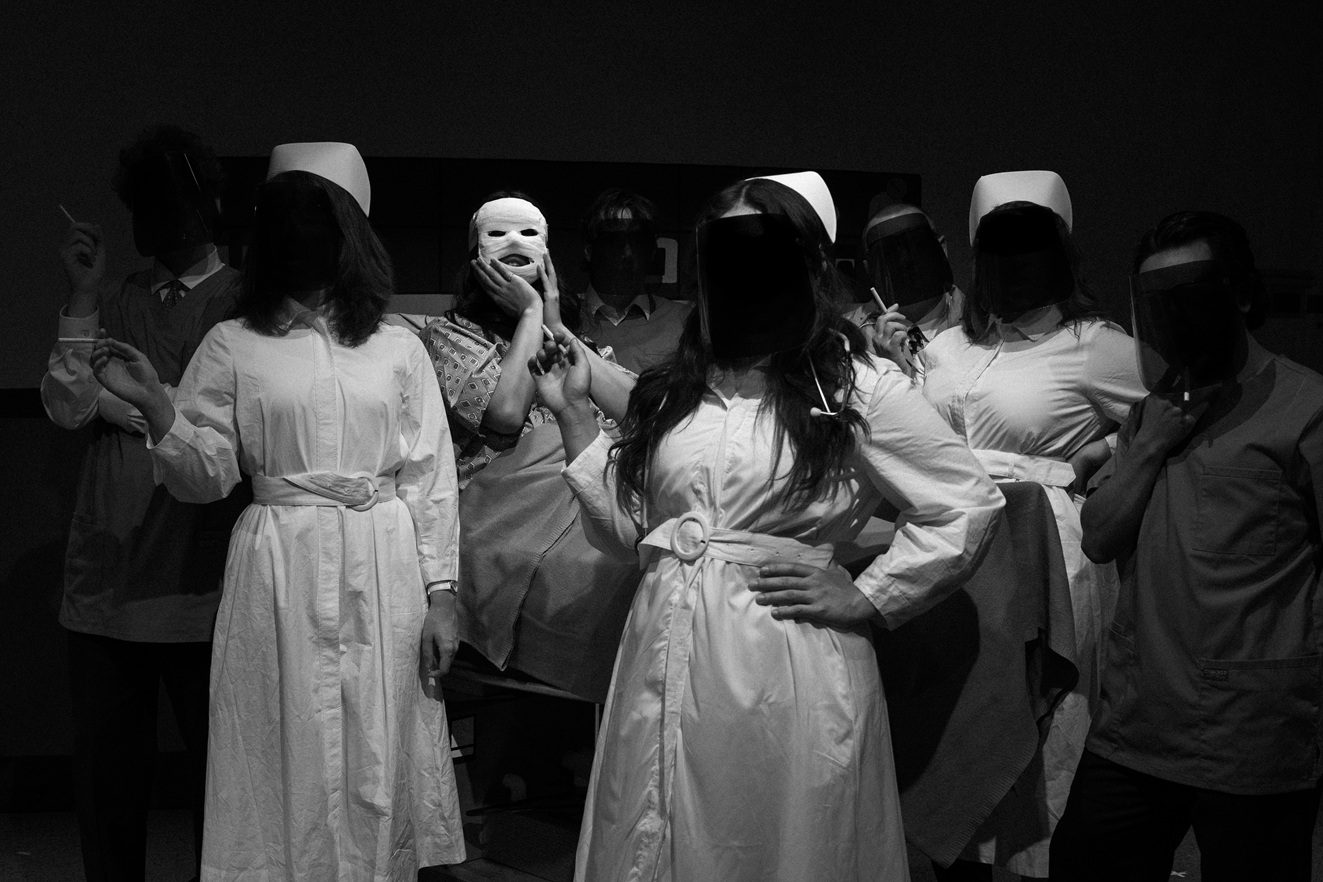
From there, the production moves through parodies of several beloved Twilight Zone episodes, including “Eye of the Beholder,” “It’s a Good Life,” and one of my personal favorites, “The Monsters Are Due on Maple Street.” Audiences do not need to know these episodes to enjoy the show. Each sketch works perfectly well on its own. Fans of the series will appreciate an extra layer of fun recognizing the familiar story beats and trying to guess which episode they will parody next.
Between sketches, vintage-style commercials play on old television screens hanging on either side of the stage. Fake advertisements for products like “Tism Free Tylenol” and promotions for the “exclusive” Chicken McNuggets at Mar-A-Largo keep the laughs going while also building the atmosphere. Videographer and editor Kenny Riches gives these segments convincing black and white coloring and subtle film grain that make them feel like broadcasts from the 1960s.
Music also plays a huge role in the show. The production mixes musical theatre standards with pop songs, all rewritten into clever parodies, with lyrics by Penelope Caywood. As a huge Cabaret fan, my favorite was easily the parody of “Willkommen,” which opens the show by introducing the cast and setting the tone for the evening. There are even nods to the choreography from Sam Mendes’ iconic production. Other musical highlights include parodies of Green Day’s “American Idiot” and Disney’s “I’ll Make a Man Out of You.”
The show moves at an incredible pace. It rarely slows down, and the only real pauses happen because the audience is still laughing. Olivia Custodio, Austin Archer, and Caywood clearly have their finger on the pulse of Utah, weaving everything from Swig drinks and impossible beauty standards to overdramatic testimonies and double standards about speaking another language into the show’s rapid-fire humor. Some of the funniest jokes are not even exaggerations! Several reminded me of conversations I have had while living in Utah, including the classic, “Where are you from? No, where are you really from?”
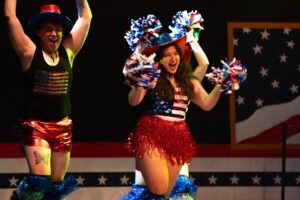
The humor also works because every performer commits wholeheartedly to the satire. Marc Nielson‘s Donald Trump impression is one of the night’s standout performances. His voice, cadence, and physical mannerisms are so accurate that it is almost uncanny. Sophie Jean White is another highlight, playing several different children throughout the evening. She perfectly captures that bratty, nasal energy through both her voice and physical comedy. She slouches, makes exaggerated faces, hides behind her “mom,” and fully embodies every character she plays. The ensemble is equally impressive, with every performer getting opportunities to shine.
Costume designer Dennis Hassan knocks it out of the park. The wardrobe is another one of the production’s greatest strengths, ranging from modest khaki skirts and blue shirts to sparkling gowns topped with enormous hats decorated with houses in the Salt Lake Avenues or covered in glittering red, white, and blue stars. Every new entrance reveals another costume that somehow tops the last.
While the show is unapologetically political, it never feels preachy. It is first and foremost a comedy, and it succeeds because it never forgets that its primary goal is to make the audience laugh. The production saves its most sincere moment for the finale, when Broad Sterling and the company perform one final song that serves as a call to action. We spent the evening escaping reality together, but eventually we all must step back into the real world. The production leaves audiences with the reminder that we all have a role in making Utah feel a little less like The Gaslight Zone.
That final number may not change the minds of the most cynical audience members, but it offers something that feels increasingly rare. It reminds people that even in a deeply conservative state, there are others who share their frustrations, hopes, and concerns. Living in Utah, especially if you belong to an ethnic, religious, or political minority, can sometimes feel isolating. I have lived here for most of my life, and I am just as guilty of believing many of the stereotypes about the state. The SLAC Summer Show pushes back against that isolation. It acknowledges how absurd the headlines have become, finds humor in them, and reminds its audience that they are not alone.
It is also worth noting that The Gaslight Zone is constantly evolving. In an interview with PBS Contact, Fletcher explained that the cast regularly receives script updates based on breaking news, sometimes even during rehearsals. The performance I attended on June 27 could look noticeably different from the version audiences see when the show closes on August 16. That flexibility keeps the material feeling fresh and allows the production to stay in conversation with whatever is happening in Utah at that moment.
A final note for anyone considering buying a ticket – I could not find an official age recommendation on the website, but I would suggest this show for adults. Much of the humor depends on understanding current events, Utah politics, and internet culture. The script also includes strong language, sexual jokes, and plenty of irreverent humor. Jenny Say-Kwah even wears an oversized hat with a profanity written across it in giant gold letters. None of it feels gratuitous or overly obscene, but this definitely is not the version of Utah theatre many people expect. The audience on the night I attended skewed older, with only a handful of people around my age. Even if some references go over your head, the comedy still lands, but knowing the memes, news stories, and cultural moments that inspired them makes the experience even funnier.
Overall, I cannot recommend this show enough, and I hope to attend future summer shows at Salt Lake Acting Company. Who knows what next year will bring?
Want to cross over to The Gaslight Zone? SLAC’s Summer Show is playing June 24-August 16 at Salt Lake Acting Company (168 West 500 North, Salt Lake City). Tickets are $20-55. For more information and specific performance dates, visit saltlakeactingcompany.org or call the box office at (801) 363-7522.
FOLLOW US ON FACEBOOK and INSTAGRAM!
If you’re a director, producer or marketing contact who would like to have us review your show, please fill out this form.
If you have comments about this article, please fill out this form.