

Editor’s Note: This article is a guest review from Utah Valley University BFA Acting Student Natalie Savage.
LONDON — During a three-week theater study abroad experience in London, I saw nearly twenty productions ranging from long-running West End favorites to brand-new works. Yet among all of them The Boy Who Harnessed the Wind remained the production that I could not stop thinking about long after the curtain call.
Adaptation
The Boy Who Harnessed the Wind written by Tim Sutton and Richy Hughes is adapted from the true story of William Kamkwamba and based on his memoir of the same title written by Bryan Mealer and William Kamkwamba as well as the subsequent film adaptation. This new musical production is playing at the SOHO theater in London through July 18, 2026. It tells the story of a young Malawian boy whose determination and ingenuity help save his village from famine.
Throughout the musical, we follow William and his desire to learn despite being unable to afford school. To a boy encountering these ideas for the first time, science feels almost like magic, and the production beautifully captures that sense of wonder and possibility. When drought threatens his community with starvation, William sets out to build a windmill from a picture he discovers in a library book. This is not, however, simply a story about innovation. It is a celebration of community, faith, resilience, and the power of education told through some of the most cohesive theatrical storytelling I have experienced in years.
One of the beauties of the story lies in its balance between specificity and universality. As audience members, we are immersed in a culture some may be unfamiliar with while still encountering deeply recognizable emotional experiences. These moments include parents trying to provide for their children, father-son relationships, daughters growing into adulthood, community support during hardship and holding onto faith when circumstances seem impossible. This was done by a cohesive vision carried out by the entire creative team for this show.
Design
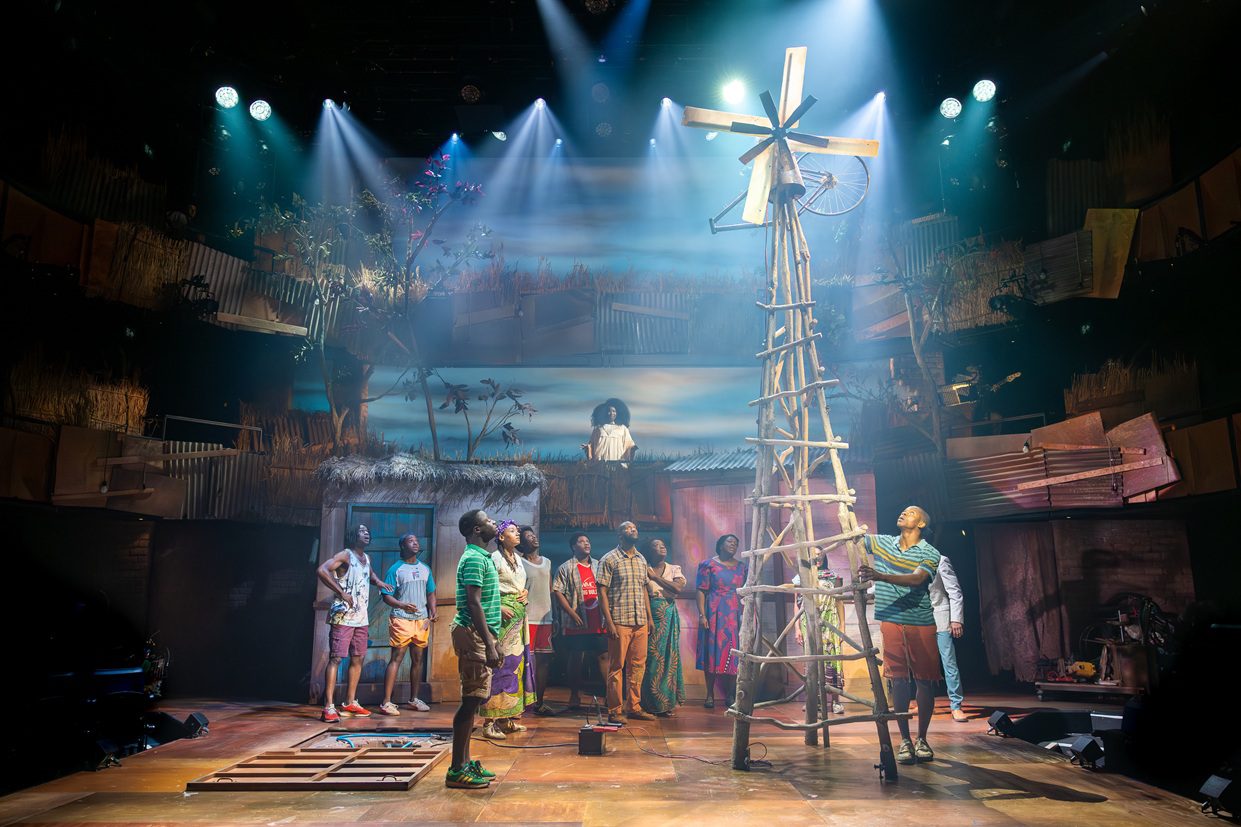
The set design for this show by Frankie Bradshaw was thoughtfully done. The SOHO Theatre is traditionally in the round but for this production they chose, wisely, to configure it into a thrust stage instead. The reconfigured thrust stage created multiple playing levels, allowing the small Soho Theatre to feel surprisingly expansive. Trap openings in the stage would reveal actual dirt beneath the stage that the actors could work in while farming which led to a very vivid and grounded experience. Two rotating platforms on either side of the stage helped create different locations. Together, these elements grounded the audience in village life while allowing the story to move effortlessly between locations.
The lighting and projection design by Oliver Fenwick helped us see Williams’ vivid imagination and mechanical thinking as he puzzled through the magic of machinery and education. It was a fun and creative way to see the visualization of his inventions and discoveries. Later on the flooding projections cascading down the stage also showed us the destruction faced by the village as crops were ruined.
Effective puppetry adds a unique kind of magic to live theatre, and this production incorporates it beautifully. From chickens populating the village to the remarkable dog puppet that befriends William, we are introduced to new characters that we love. The skill of these performers brought that magic vividly to life.
Performances
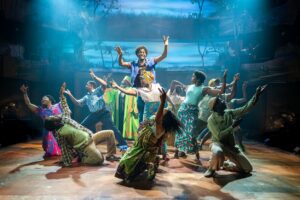
One of the production’s greatest strengths was its ensemble and community building. The story’s emphasis on faith, music, and communal storytelling requires an ensemble capable of creating a believable community, and this cast rises to that challenge beautifully. Shaka Kalokah, as the Hyena, delivered a mesmerizing physical performance that was both threatening and captivating. Dressed simply in tan with stark white markings painted across his face, Kalokoh transformed himself into a creature that was both mesmerizing and deeply unsettling. As villagers fell victim to famine, they marked their faces with the Hyena’s white paint and joined Kalokah, moving as a single predatory force. Together they created a haunting piece of choreography that visually communicated the devastating effects of famine.
Even before the performance officially began, actors wandered through the space bringing the village to life. Audience members were welcomed into the world through playful interactions and improvisation. One performer encouraged patrons to dance along with music from a radio, while another borrowed an audience member’s phone and jokingly informed the caller that its owner was about to watch a show and would call them back later before snapping a quick selfie and returning it. These moments immediately established the warmth, humor, and humanity that would become central to the production.
One of the songs that stayed with me long after the performance was “This I Know,” sung by Sifiso Mazibuko who played William’s father in the first act. While William’s journey provides the central narrative of the musical, this song reminds us that every struggle within the story affects an entire family. The song asks a question that feels universal: when you have done everything you can and it still doesn’t seem to be enough, what do you hold onto? What do you know to be true? The answer offered is not certainty, but faith. It is moments like this that allow audiences to connect so deeply with the story. While the setting may be unfamiliar to many audience members, the emotions are not.
New Work Talkback
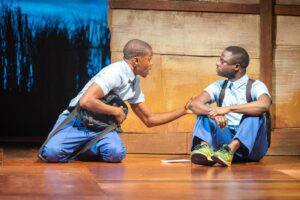
I was fortunate enough to attend a post-show talkback with writers Tim Sutton and Richy Hughes alongside William Kamkwamba himself. Hearing them discuss the development of the musical only deepened my appreciation for what they had created. Hughes shared that after first encountering William’s story, he immediately knew he wanted to bring it to the stage. Before moving forward, however, he sought advice from his close friend and Malawian artist George Sangwani Harrison. When asked whether two white writers could tell this story authentically, Harrison’s response was simple: yes, but only if the process included your Malawin best friend as the Dramaturg.
That commitment is visible throughout the production. Extensive research, collaboration, personal experiences in the country, and genuine care have shaped every aspect of the show. Sutton and Hughes specifically did not want to present Malawi through the narrow lens of hardship alone, but to give a musical that celebrates a culture rich with joy, humor, faith, creativity, and resilience. What impressed me most was that I had already felt this authenticity before hearing the creators discuss it. The production communicates these values naturally through its storytelling.
One particularly memorable story from the talkback concerned the Act Two song “You’ll See.” The writers explained that the majority of the lyrics were inspired directly by William Kamkwamba’s own words from his memoir. They took the time to not only create a beautiful and powerful song, but to make it true to the person who lived it. The song captures the determination and hope that carried him through seemingly impossible circumstances.
When asked what he would say to his younger self now, William’s answer was simple but profound: “Don’t give up. You never know the outcome. Don’t be afraid of failure.”
That sentiment serves as an appropriate conclusion not only to William’s story, but to the musical itself. We watched as young William failed, over and over, moved through obstacle after obstacle, but he never gave up.
Recommendation
The Boy Who Harnessed the Wind embodies how theatre should be. Every artistic element—acting, music, choreography, scenic design, lighting, projections, puppetry, and storytelling—works together to build a meaningful human story. The result is a production that leaves audiences inspired to never give up, enriched with knowledge of a beautiful, joyful culture, and reminded of our shared humanity.
For many American audiences, including many here in Utah, The Boy Who Harnessed the Wind offers the kind of culturally specific storytelling that expands the theatrical landscape rather than simply repeating the stories most familiar to us. One of the great strengths of theatre is its ability to expand our understanding of the world and the people in it. The Boy Who Harnessed the Wind does exactly that. While rooted in a specific place and culture, its story of faith, family, perseverance, and hope feels universal.
I hope the winds eventually carry this production across the Atlantic. Audiences here deserve the opportunity to experience not only William Kamkwamba’s remarkable story, but also the artistry, humanity, and joy that Sutton, Hughes, and their collaborators have brought to the stage. Like William’s windmill harnesses the wind, this production harnesses the power of live theater and reminds us of the extraordinary possibilities hidden within ordinary things.
MORE INFO: The Boy Who Harnessed the Wind is playing at @sohoplace (4 Soho Place, Charing Cross Road, London W1D 3BG) in its West End transfer/London premiere after its Royal Shakespeare Company run. The musical runs April 29 through July 18, 2026, with performances generally scheduled Monday through Wednesday at 7:30 PM, Thursday at 2:30 PM and 7:30 PM, Friday at 7:30 PM, and Saturday at 2:30 PM and 7:30 PM. Tickets are available from £29.50, with pricing varying by performance and seat. For current availability, accessibility information, and official ticketing, visit the @sohoplace website: https://sohoplace.org/shows/the-boy-who-harnessed-the-wind/