

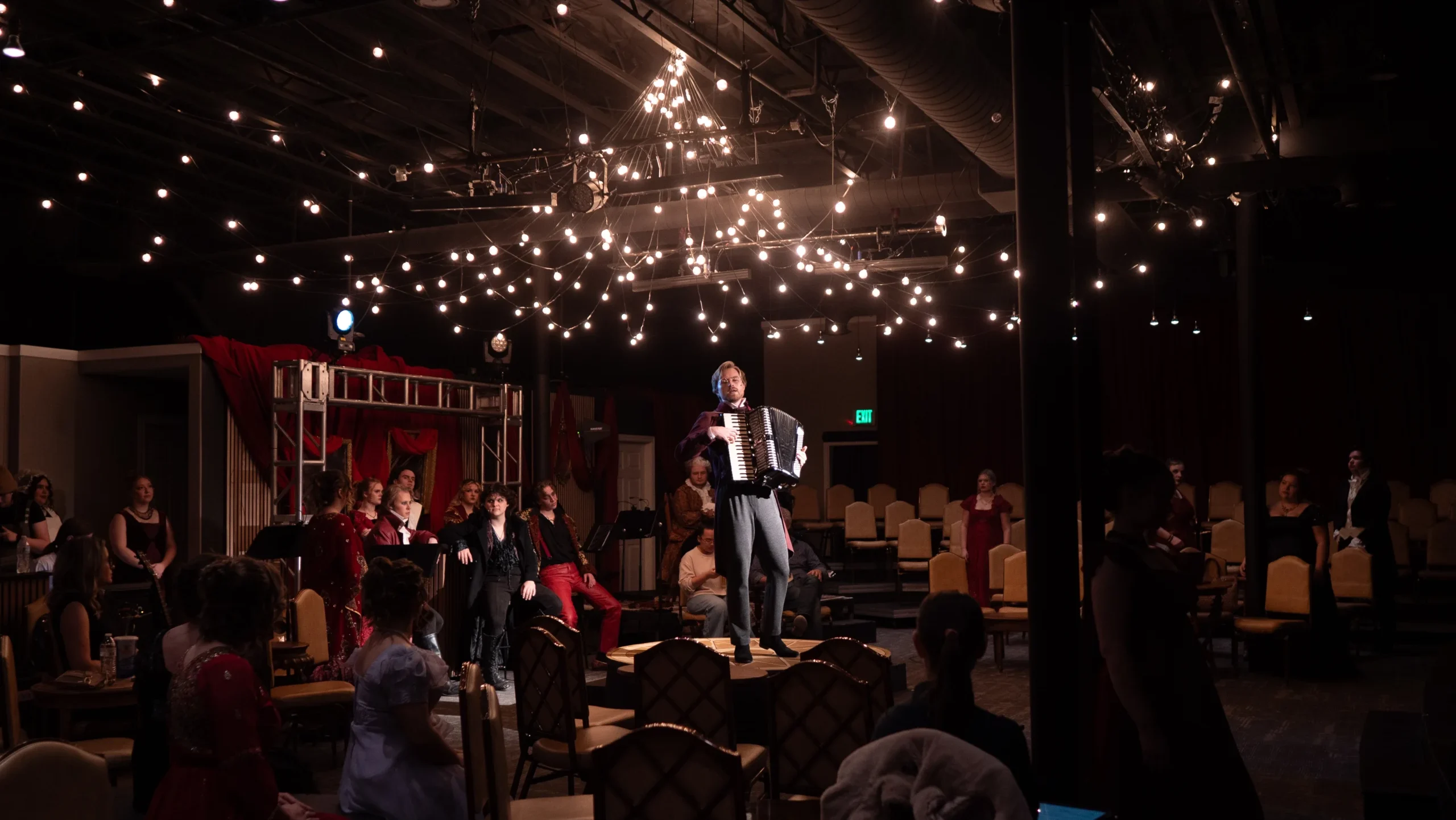
LOGAN — Tucked away in a building that improbably shares parking with a Smith’s in Logan, the Utah State University Opera Theatre has staged one of the most memorable nights of theatre I’ve experienced in years with their production of Dave Malloy’s Natasha, Pierre, and the Great Comet of 1812 (typically shortened to Great Comet) at Lionheart Hall and directed by Dallas Aksoy. Adapted from approximately 70 pages of Leo Tolstoy’s War and Peace, this Tony Award–winning musical premiered on Broadway in 2016 with Denée Benton and Josh Groban in the title roles.
Lest the sheer size of War and Peace intimidate you, Great Comet acknowledges the sprawling complexity of Tolstoy’s novel (“everyone’s got nine different names”) while narrowing its lens to a more focused storyline. As the title suggests, the musical centers on Natasha and Pierre. Natasha, recently engaged to Andrey, is left behind while her fiancé goes to fight in the Napoleonic wars. His absence and lack of communication—coupled with the cold reception of his family—leave Natasha vulnerable to the enthusiastic attention of Anatole, who treats “engaged ain’t married” as gospel and extends it to “married ain’t taken.”
While Natasha battles with her emotions and decisions, Pierre is largely separated from the action and fighting demons of his own. His unexpected inheritance of a significant fortune prior to the play lands him in a loveless marriage to Anatole’s flirtatious sister, Hélène. Pierre’s fortune only deepens his malaise. At the start of Great Comet, he is usually found with drink in hand or secluded in his library, searching for meaning.
Setting the Stage
The original production of Great Comet retrofitted its theatre to allow for an immersive experience typically only available to smaller houses. Scenic designer Audrey Allen picks up that torch here. The open seating in Lionheart Hall includes tables and risers, and tickets come with a menu of mocktails and hors d’oeuvres provided by the ensemble—a fitting Utah substitute for the bar in the original production. The orchestra (wonderfully led by Shannon Hirschi), along with roaming musicians, further fills out the space. The action unfolds throughout the hall but centers in the venue’s core, sparing the audience excessive head-craning. Director Dallas Aksoy keeps things moving and makes good use of the performance space. The sheer number of performers creates a crowded but lively atmosphere, almost as if the story emerges organically from a night out with friends.
It’s an exciting choice and largely effective, though not without trade-offs. The proximity to the orchestra meant some soloists were hard to hear, even when mic’d, which left certain plot points harder to follow. Poles in the hall also make some sightlines tricky. Even so, it is thrilling to see theatres make bold choices, and the overall impact impressed me. In particular, the staging demands grounded, real performances from the cast.
Performers Leading the Way
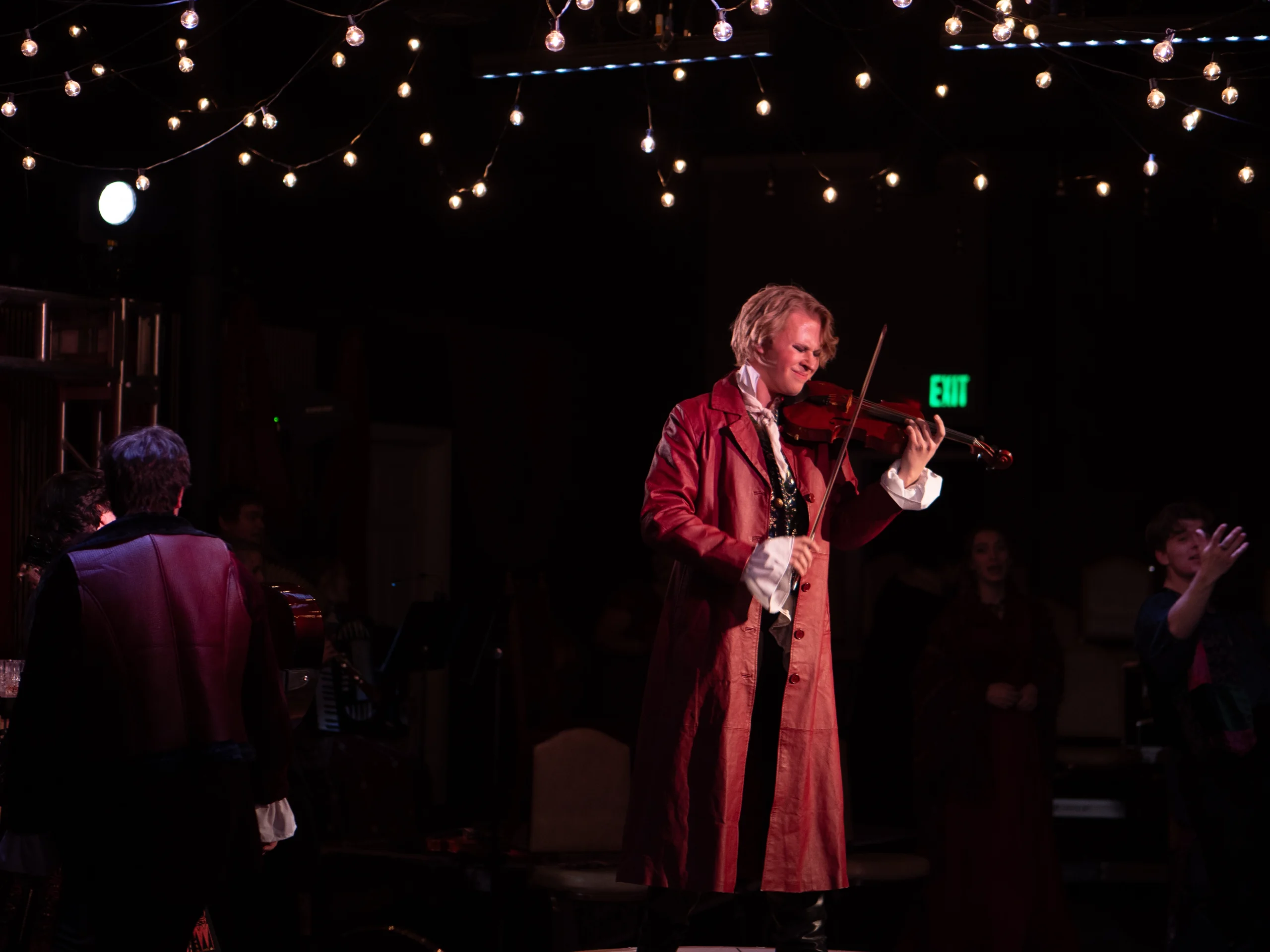
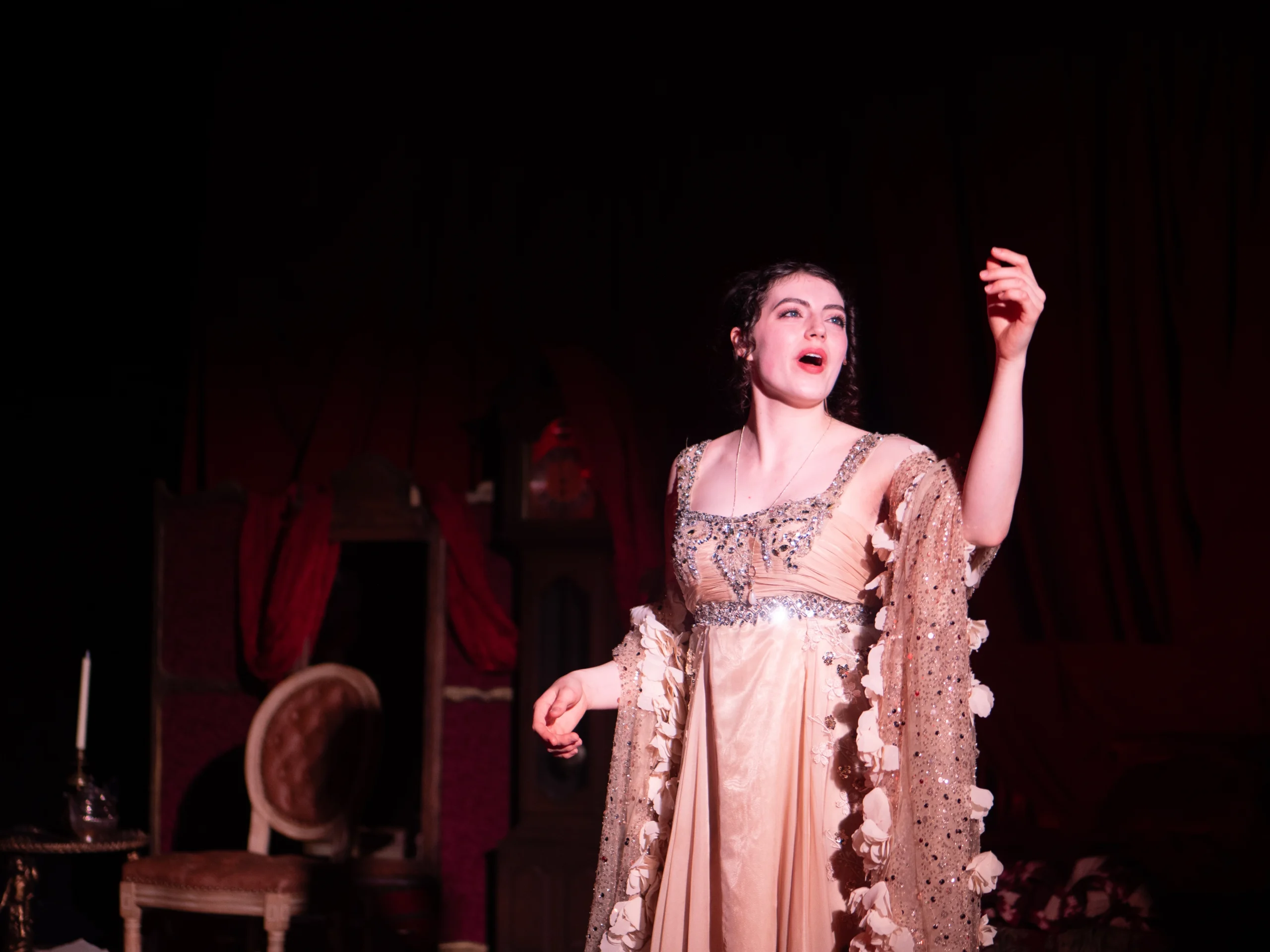
As Natasha, Auriana Smith transitions convincingly from a youthful, naive young woman to the world-weary, remorseful figure at the end of the show. A. Smith has an Anne Hathaway–like magnetic appeal, and performs with lovely vocals. Holden Smith’s Pierre is more grounded and subtle. Pierre’s perpetual outsider status among supposed friends is clear, and the final reunion of Pierre and Natasha is beautifully realized by both H. Smith and A. Smith. I was also impressed to see H. Smith take to the piano for two of his pieces (“Pierre” and “Dust and Ashes”). H. Smith is an enormously talented musician, though his acting faltered only when he played. If he channels the same emotion at the piano as he does away from it, the performance will gain even greater impact.
Lauren Garnica as Sonya, Lily Parker as Hélène, John Richardson as Anatole, and Zack Christensen as Balaga are also particularly memorable. Garnica’s performance of “Sonya Alone” is stunning. Great Comet is a demanding vocal piece, requiring both classical and musical theatre styles, and Garnica managed both with ease. Parker is saucy and electric. Richardson is dashing and dangerous, allowing the audience to see both why Natasha falls for Anatole and why she shouldn’t. Christensen bursts in with unrestrained insanity just in time to keep things from getting too serious. The entire cast deserves commendation for strong vocals. The ensemble numbers are especially effective, with “The Opera” and “Balaga” showcasing the cast’s impressive range. (“Balaga” includes some appropriately rowdy choreography by Kelley Richardson.)
Clever Costuming, Effective Lighting
Costuming, designed by Dennis Hassan, is another highlight. Hassan had a heavy lift, with nearly every performer requiring at least three costumes (and some several more). Hassan’s approach suggests the time period without aiming for exact accuracy, allowing for vibrant palettes and cleverly adapted dresses. The costumes for “The Opera” are especially exciting.
Lighting designer Megan Campbell faced challenges with what I assume are restricted capabilities compared to more traditional theatre spaces. The inclusion of string bulb lights adds a bit of magic, evoking both the circus-like energy of some scenes and the contemplative night skies of others.
Final Thoughts
As someone based in the Salt Lake Valley, it’s rare I make a trip to Logan for a show. As a fan of both Great Comet and War and Peace (Tolstoy is more approachable than you might think), I’m glad I made the drive to see this production. It’s a great accomplishment by all involved and a memorable night of theatre.
[box] Natasha, Pierre, & the Great Comet of 1812 plays at Lionheart Hall (480 North 100 East, Suite 120 in Logan). The production plays November 20-22, 2025 at 7:30 PM, with a 2:00 PM matinee on the 22nd.
Tickets are $23 for adults, $20 for seniors, free for USU students and Music & Theatre Arts faculty/staff. Seating is unassigned, so early arrival is recommended for best viewing. For more information visit https://utahstateaggies.evenue.net/events/OPERA.
[/box]