
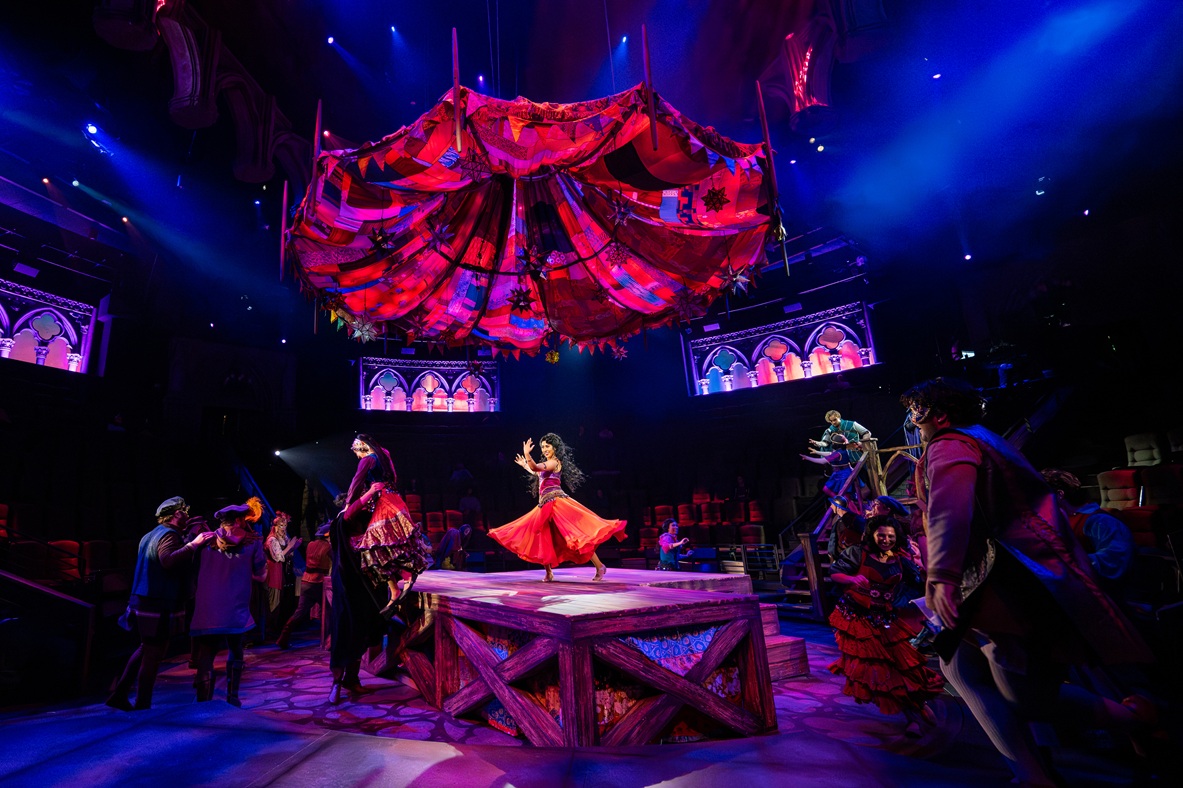
SANDY — It was a night of spectacle and awe on the Young Living Centre Stage at Hale Center Theatre‘s production of The Hunchback of Notre Dame Wednesday evening. Overall, it was an impressive production that felt true to Hale’s reputation for large musical numbers, strong casting, and spectacle-driven storytelling that leaves a lasting impression. This is not Hale’s first time staging the show, though I did not see the earlier production and cannot offer comparisons. The musical itself is based on The Hunchback of Notre-Dame by Victor Hugo, while also incorporating the memorable songs audiences recognize from the Disney animated film of the same name. With its sweeping choral moments and iconic melodies, the show offers a powerful theatrical experience that many audience members will find both familiar and moving.
Note that this production is double-cast. One cast performs Monday, Wednesday, and Friday, while another performs Tuesday, Thursday, Saturday, and alternating performances, with some actors appearing in both casts. I attended a performance by the Monday/Wednesday/Friday cast.
Leading Performances
The standout performance of the evening was by Joshua Hyrum Smith as Quasimodo. The actor’s physical embodiment of the character was remarkable—his stance, walk, head movements, hand gestures, and overall physicality felt intentional and believable. Every movement reinforced Quasimodo’s physical reality while never feeling exaggerated. Vocally, he matched that physical storytelling with strong, expressive singing that made the character emotionally compelling. I found myself consistently drawn to him and deeply invested in his journey.
Frollo was also spectacular. Preston Yates leaned fully into the character’s unsettling villainy while maintaining strong vocal and dramatic control. His portrayal captured the character’s chilling authority and inner conflict, giving the role the weight it demands.
I was admittedly somewhat underwhelmed by Angel Martinez‘s performance as Clopin and Tanya Cespedes’ role as Esmeralda. Both performers clearly fit their roles and delivered competent performances, but I hoped for a stronger stage presence that would draw the audience in more fully. A moment like “God Help the Outcasts,” which is a personal favorite of mine, felt less emotionally impactful than I expected. The performance was not poor by any means, but it left me feeling somewhat neutral rather than deeply moved.
The supporting cast, however, was consistently strong across the board. The ensemble delivered impressive performances, particularly in the choral numbers, which were among the production’s most powerful moments. Their vocal strength gave the show the sweeping impact those scenes are meant to achieve.
Scenic and Technical Elements
Nate Berton‘s scenic design was well-executed. The set effectively supported the storytelling and even became part of the story in a living way as if set pieces were characters themselves at times. The bell structures were particularly impressive, and the moving pieces throughout the set were thoughtfully designed so that each transition felt purposeful and appropriate for the scene. At times, Hale productions can risk allowing large-scale sets to overshadow the performances, but that was not the case here.
The production also included several exciting special effects that added theatrical flair without feeling overused. Moments featuring real fire created dramatic tension, while a humorous scene involving a character who had been beheaded losing his head again onstage produced audible gasps and laughter from the audience. These moments were tastefully integrated and used sparingly enough to remain impactful.
One particularly memorable sequence involved moving set pieces incorporated directly into the choreography. Watching the set physically shift as part of the staging created a dynamic visual moment that enhanced the storytelling rather than interrupting it.
Direction, Choreography, and Music
The choreography by Lindsey D. Smith was beautiful and flowed naturally alongside the production’s many technical elements. Set transitions, costume changes, and character movement all blended seamlessly into the choreography, creating a cohesive and visually engaging stage picture. There were also several symbolic moments woven throughout multiple scenes between Frollo and Quasimodo. I won’t spoil the fun with too many details, but if you like to dig into analysis and find that part of literature interesting, you will find lots to think about and work through.
David Smith‘s direction also demonstrated thoughtful decision-making throughout the show. Characterization felt intentional, blocking choices were clear and purposeful, and the overall pacing allowed both intimate moments and large musical numbers to shine.
Historical Context
The story’s historical context surrounding the Romani people is also worth a quick mention. In program notes, the theater explained their decision to retain the term “Gypsy,” which today is widely recognized as derogatory. The production keeps the term in order to remain historically accurate to the time period and to help convey the prejudice and discrimination that are central to the story’s themes. While the choice may prompt conversation among modern audiences, it reflects an attempt to present the narrative within its historical framework.
Final Recommendation
This production of The Hunchback of Notre Dame is absolutely worth seeing, whether you are a devoted theatergoer or someone new to live performance. Hale Centre Theatre consistently produces shows that appeal to a broad audience, making their work accessible to both seasoned theater lovers and casual attendees alike. While Hale productions are sometimes criticized for prioritizing spectacle and technical elements, I did not feel that balance was off in this case. The impressive sets and effects enhanced the storytelling rather than overshadowing it. Combined with strong performances and powerful musical moments, this production offers an engaging and memorable evening of theater.

MORE INFO: The Hunchback of Notre Dame runs March 9 through April 25, 2026 at Hale Centre Theatre on the Young Living Centre Stage in Sandy. Tickets currently range from about $73–$81 for adults and $36–$40 for youth, depending on seat location and performance date. For tickets and further details, see www.hct.org/