

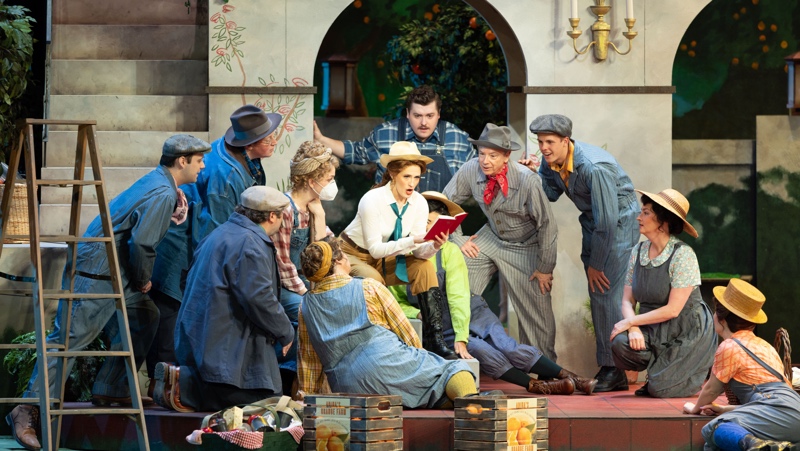
SALT LAKE CITY — Utah Opera’s latest offering is The Elixir of Love, the 1832 classic by Italian composer Gaetano Donizetti. Despite being the 13th most-performed opera in the world, it may not quite be a household name (this is the first time it has been reviewed by Utah Theatre Bloggers) — but that shouldn’t deter Utah audiences from enjoying this extremely accessible production.
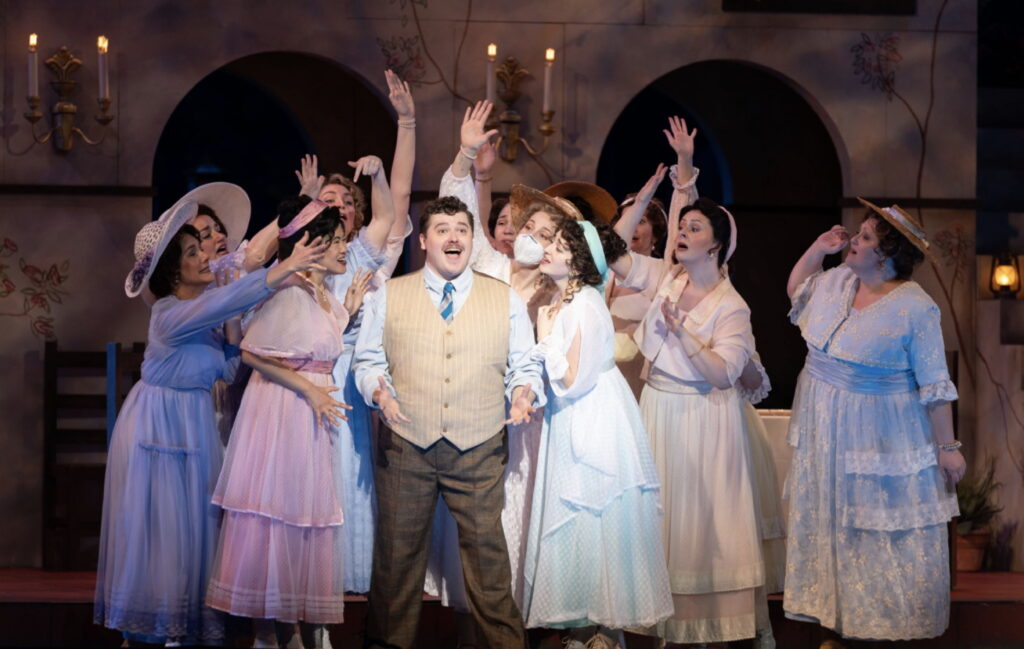
The plot involves a poor worker named Nemorino, who’s desperately in love with the wealthy beauty Adina. Trouble is, he’s coming on too strong, which annoys Adina so much that the eligible bachelorette accepts another marriage proposal just to spite him. This being an operatic comedy, it’s only a matter of time before the two get together. The production involves plenty of beautiful singing and silly humor along the way, which garnered laughs, bravos and a standing ovation by the audience on Saturday night.
Former Utah Opera resident artist Daniel O’Hearn was winning as peasant Nemorino; O’Hearn was sympathetic and likable, with good expressions and a build and mustache that fit the role. His buttery tenor voice was adept at hitting the high notes, and O’Hearn put his soul into the most famous song, “Una furtiva lagrima,” adding tenderness and sensitivity to the number. It’s a beautiful performance that anyone, opera fan or not, would enjoy.
Adina is played by Katrina Galka, who last performed with Utah Opera in their outstanding 2024 production of Thais. Like her fellow romantic lead, Galka had strong narrative storytelling in her expressions—she truly inhabited the role of an emotionally aloof flirt who enjoys having a different boyfriend every day. Late in the opera as Adina and Nemorino are finally liberated by mutual love, the opera allows the pair to soar to new heights, vocally—Galka’s “Prendi, per me sei libero”, for example, was gorgeous, and wonderfully connected the feelings of new love to the audience.
Galka’s soprano had a lovely, clear tone, and was most impressive in the gentle way she started phrases and her impressively controlled descending lines. Her ascents and high notes were also radiant, particularly in Act I’s “Chiedi all’aura lusinghiera,” where she states the advantages of being a playgirl.
The opera features one antagonist—Adina’s fiancee, Sergeant Belcore—and an antihero in Dr. Dulcamara—a quack traveling salesman who inadvertently saves the day. Alexander Birch Elliott impressed as Belcore, with a powerful baritone and a commanding delivery that fit his militant character. Like O’Hearn, Elliott was adept at getting laughs from the audience, even with a simple gesture like combing back his hair.
While Utah Opera’s production is generally very good, director Daniel Ellis’s treatment of Dulcamara’s assistant, played by Gemma Isaacson, felt like a misstep. While expanding this minor character gave the stage more action, turning her into a Charlie Chaplain-esque stooge didn’t work. The character’s constant wild gesticulations and overly large expressions were distracting and very felt out of place, and the intended humor and characterization of her has the “brains behind the operation” did not land.
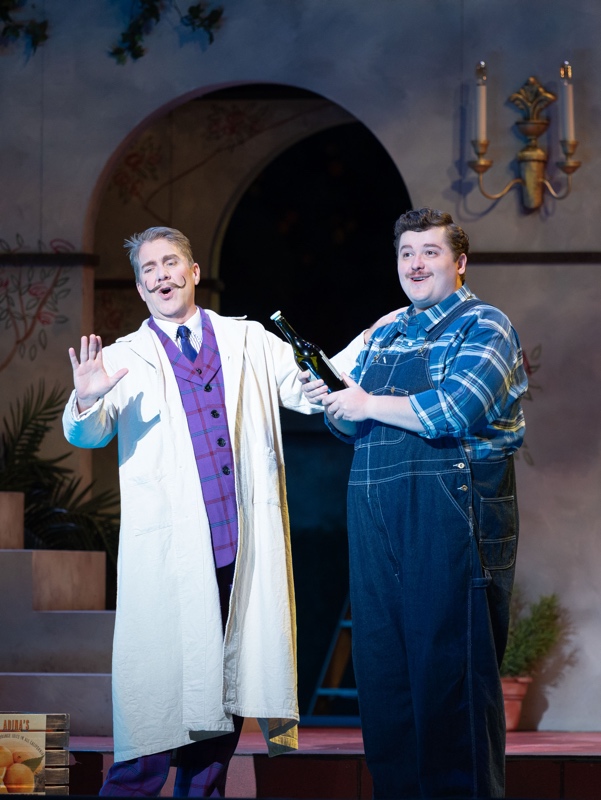
However, the production did contain many more successful humorous moments, Dulcamara (played by Daniel Belcher) raising his hands to the sky when characters shout his name like a criminal who’s just been found out; and his hauling away leftovers from a wedding banquet in a napkin.
Dulcamara claims his elixir can cure all ailments under the sun (including Nemorino’s lovesickness), which inspired the setting of the opera in 1916 California when a historic Sunkist’s advertising campaign encouraged Americans to drink orange juice for the first time. This led to a 600% rise in sales and Americans enjoy orange juice to this day. The production team led by Ellis felt this historic marketing campaign felt a lot like Dulcamara’s magic elixir as gullible Americans will buy about anything (whether products or presidents) if the seller makes the right claims (“Made in America!” the supertitles proclaim).
Orange groves permeate the set by designer Jaime Mejia, and the townsfolk are portrayed as orchard workers, wearing overalls and protective hats (the costume designer was Angela M. Kahler). Adina looked positively fetching in Act I with jodhpurs and a while blouse and blue scarf — and the military men’s dark khaki uniforms were appealing.
Several orange trees populate the stage, and the backdrop is full of groves disappearing into the distance. The set’s mission-style architecture is appealing, and lighting by Cheri Prough DeVol illustrates the yellow warmth of a bright California day. DeVol used historic California orange advertisements to inspire the lighting design. The opera places the final wedding scenes at night, leading to an eventual sunrise when the romantic leads finally get together.
Overall, Utah Opera’s production of The Elixir of Love is a light, humorous and easily digested work. It’s fluffy and airy yet includes a good deal of pathos in its final scenes, and strong vocal performances from the cast.
MORE INFO: Utah Opera’s production of Donizetti’s The Elixir of Love runs March 7 & 13 at 7:30 PM, March 9 & 11 at 7:00 PM, and a matinee March 15 at 2:00 PM in the Janet Quinney Lawson Capitol Theatre, 50 W 200 S, Salt Lake City. For tickets and more info, visit utahopera.org.