
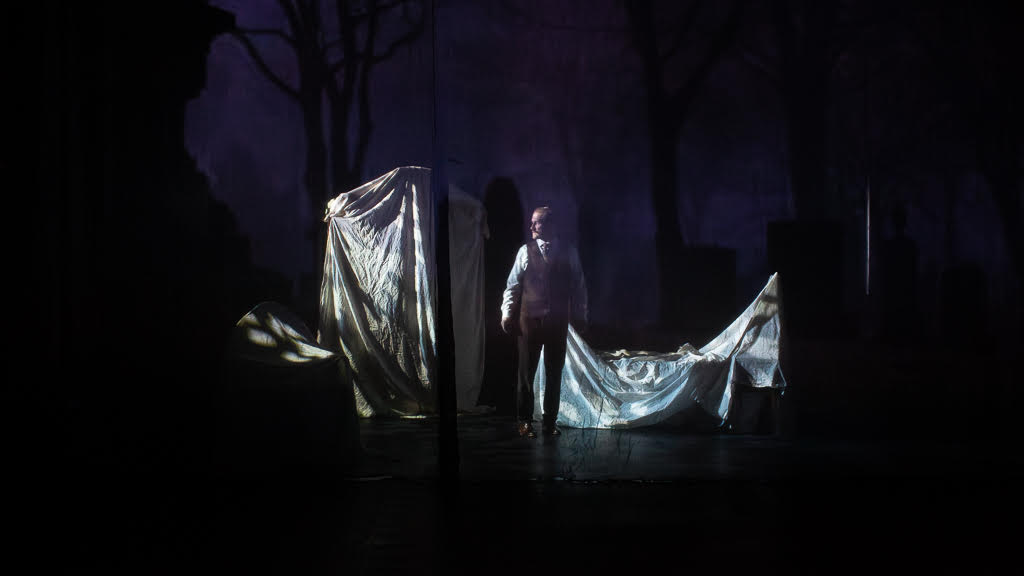
SALT LAKE CITY — At Parker Theatre, The Woman in Black returns for its second year, distilling fear to its most elemental form—sound, shadow, and imagination. Adapted for the stage by Stephen Mallatratt from Susan Hill’s 1983 gothic novel, the story transforms from page to stage by way of an alchemy of suggestion. Directed by Brinton M. Wilkins, this production honors Mallatratt’s 1987 design: a two-actor framework haunted by a third—a silent figure poised between embodiment and imagination.
“A story that must be told,” insists Arthur Kipps early in the play, and that refrain becomes its moral engine: storytelling as survival.
Mallatratt’s adaptation transforms Hill’s richly descriptive novel into a work of self-reflexive minimalism. In Hill’s prose, Kipps narrates his haunting in retrospect—a slow descent through grief and guilt. On stage, Mallatratt reframes that memory as a play within a play: an older Kipps hires a young actor to help him perform his traumatic past, hoping that by reliving it, he might finally be free.
This framing changes everything. The tale becomes as much about storytelling itself as it is about ghosts. The script opens with deceptive levity, punctuated by moments of self-aware humor—a clever tonal strategy that disarms before the dread seeps in. By mid-performance, the laughter evaporates into silence—an auditory void the production wields as skillfully as any lighting cue.
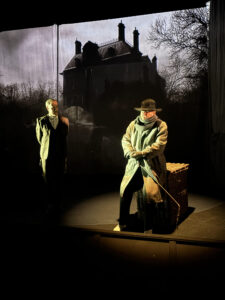
On Parker’s stage, two men—Kipps and “The Actor”—conjure a world from a few objects: a chair, a blanket, a handful of costumes, a palette of sound effects, and, most notably, a large wicker trunk. The title character—the Woman in Black—appears not as a speaking role but as an apparition, seen only by some. Mallatratt’s compression of Hill’s novel strips away most supporting characters and replaces them with theatrical grammar—sound, shadow, and silence. Where Hill’s text immerses readers in fog and memory, Mallatratt asks audiences to imagine them. The result is a study in restraint—proof that fear, when left half-seen, is far more powerful. In essence, Hill’s The Woman in Black is about what haunts us; Mallatratt’s version is about how we are haunted—by stories, by performance, and by the act of remembering itself.
Context: From Scarborough to Screen
The play began humbly in 1987 at the Stephen Joseph Theatre in Scarborough, England, where Mallatratt and Hill refined it for a small Victorian playhouse. Hill later called his approach “genius in seeing what could be done with a book that otherwise would have sunk quietly out of sight.”
That modest experiment became a phenomenon: a 34-year West End run at the Fortune Theatre (1989–2023), over 13,000 performances, and countless tours around the world. The minimalist ghost story became second only to The Mousetrap in longevity.
Its endurance inspired new retellings, including the 2012 film starring Daniel Radcliffe—a version that traded candlelight and suggestion for cinematic spectacle. By contrast, Mallatratt’s play endures through suggestion—the haunting that happens in the imagination.
Design and Atmosphere
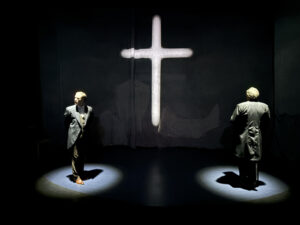
James B. Parker’s lighting sculpts emotion with chiaroscuro precision: shafts of light isolate bodies like confessions, while darkness gathers at the edges of the stage like withheld memory. The effect is painterly and psychological—shadow as dramaturgy.
Michael and Spencer Hohl’s sound design is equally measured, turning silence into punctuation. A cry from the marsh, a door creak that may or may not exist—each auditory fragment expands the story’s emotional architecture.
The set, designed in Parker’s signature minimalist style, opens with two chairs and a single yellow bulb glowing from a stand. At center sits a large wicker trunk, while a semi-transparent linen curtain hangs behind it—serving as both veil and canvas for shadows and half-seen shapes beyond. Onto it, Kristin Hafen’s projections, credited in the program as Visual Effects Manager, cast a spectral backdrop for several key scenes, layering atmosphere upon the production’s refined design.
The result is a space that feels alive, suspended between the material and the spectral—the seen and the unseen.
Actors’ Highlights
Ben Lowell (Arthur Kipps) delivers a performance of quiet precision—haunted but never hysterical. His emotional progression, from stoic professionalism to haunted surrender, anchors the play’s shifting tone.
Michael Hohl (The Actor) meets him with calibrated energy, navigating the self-reflexive frame with humor and intelligence. Together, they create the illusion that the stage itself is remembering.
Their chemistry—part mentorship, part mirror—turns the story’s recursive structure into emotional truth: to speak a ghost is to become one.
Haunted Mechanics: Theatre as Invocation
Italian theatre scholar Nicola Pasqualicchio describes the stage as “tragically exposed, proprio perché teatrale, al ritorno dei fantasmi”—“tragically exposed, precisely because it is theatrical, to the return of ghosts.” In his 2018 essay “Una forma d’orrore specificamente teatrale,” he argues that theatre “consists in the evocation of what is not present,” and therefore is structurally haunted: every performance calls forth what is absent.
What this production of The Woman in Black understands—instinctively, almost reverently—is that the play is not about jump scares but about the haunted mechanics of theatre itself: storytelling as rite, audience imagination as the medium, and the stage as a threshold where “the irruption of the supernatural” becomes theatrically possible.
Parker Theatre’s minimalist staging embodies that theory. Each flicker of light or sound cue operates as an invocation, calling forth not only Susan Hill’s ghost but the ghosts of theatre itself—those of vanished performers, forgotten technicians, and uncredited labor.
In the printed program, there is no performer credited as “The Woman in Black.” Instead, the program lists Visual Effects Manager: Kristin Hafen. Her biography ends with a telling phrase: “It’s been such a delight working with this fun group and bringing the vision to life.”
The choice is fascinating. In the original 1989 West End production, the performer playing the ghost was credited only as Vision—a wink to the audience and a gesture of concealment. Parker’s production replaces mystery with function, acknowledging the ghost’s work only through a technical title. The haunting has been bureaucratized.
Hafen’s dual role—technical artist and embodied phantom—extends Pasqualicchio’s idea of theatre as “a summoning of what is absent.” Her labor exists at the border between visibility and invisibility, performance and production. The ghost, in this version, is both technician and apparition—a literalization of theatre’s invisible labor. Yet the symbolic cost remains: to absorb embodiment into effect is to re-enact a familiar pattern, where women’s creative contributions vanish under the guise of illusion.
The Representation of Women on Stage
Mallatratt’s play offers one of the most paradoxical portrayals of womanhood in modern British theatre. The Woman in Black is both the story’s gravitational center and its great absence—wordless, voiceless, defined entirely by male narration. Two men tell her story; one woman embodies it. She is both the wound and the warning.
The result is, perhaps unintentionally, feminist in its haunting—a revenge of the repressed: the voice denied sound, the labor denied credit. In this light, Parker’s programmatic omission becomes more than oversight—it becomes part of the play’s pattern of silencing, the ethical echo that gives the haunting its moral weight.
Coda: The Ethics of Fear
The Woman in Black is, of course, a Halloween-season pleasure—a fright staged in good fun. Yet, its economy conceals a deeper question: what are the ethics of fear? When horror relies on what we cannot see or name, whose bodies and labors disappear in the process?
Parker Theatre’s production honors Mallatratt’s minimalist genius. The lighting and pacing are exemplary; Lowell and Hohl’s performances let the imagination do the work. But unless the company wishes to summon the wrath of feminist ghosts, it might consider properly crediting the woman whose body gives shape to the specter.
That omission leaves a shadow not of fiction but of oversight—proof that even in theatre, erasure can be the most haunting act of all. By the end, we understand why this tale must be told again and again: silence is never safety and every act of remembering risks summoning what we fear most.
Everyone has a ghost story.
[box] The Woman in Black plays through November 1st on Fridays at 7:30 p.m. and Saturdays at 3:30 and 7:30 p.m., with additional performances Wednesday, October 29th and Thursday, October 30th at 7:30 p.m., at Parker Theatre, 3605 S. State Street, Salt Lake City. Tickets range from $22–$31. Visit www.parkertheatre.org for more information. [/box]