

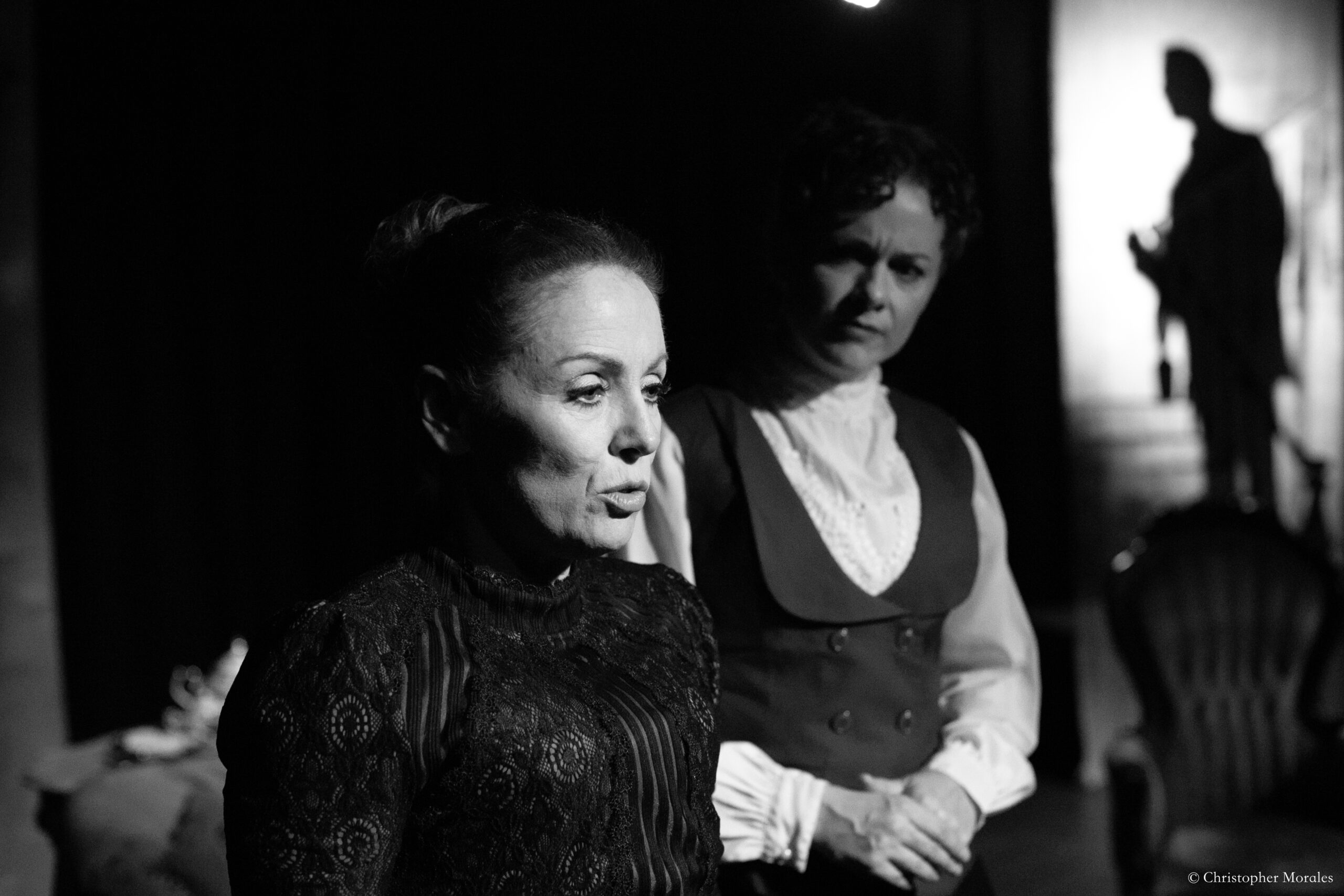
PROVO — With so much theatre in Utah’s prolific arts community, it’s always lovely, if unsurprising, to discover a new company crop up. Wandering Bark’s inaugural production, Blood Relations, performed at the Hive Collaborative, is a thrilling script centered on the story of Lizzie Borden, presumed (though acquitted) to have committed the gory murder of her parents in 1892. The Hive was established in 2018 to support grassroots artists and companies like Wandering Bark, and boasts a clean and well laid-out, intimate performing space. I was unable to find much information about the company beyond that it takes its name from a Shakespearean sonnet, where lovers are ships at sea (wandering barks) with love as their lodestar. The young company was founded by the production’s Director, David Morgan, and his wife Annadee Morgan, who plays Lizzie Borden in this production.
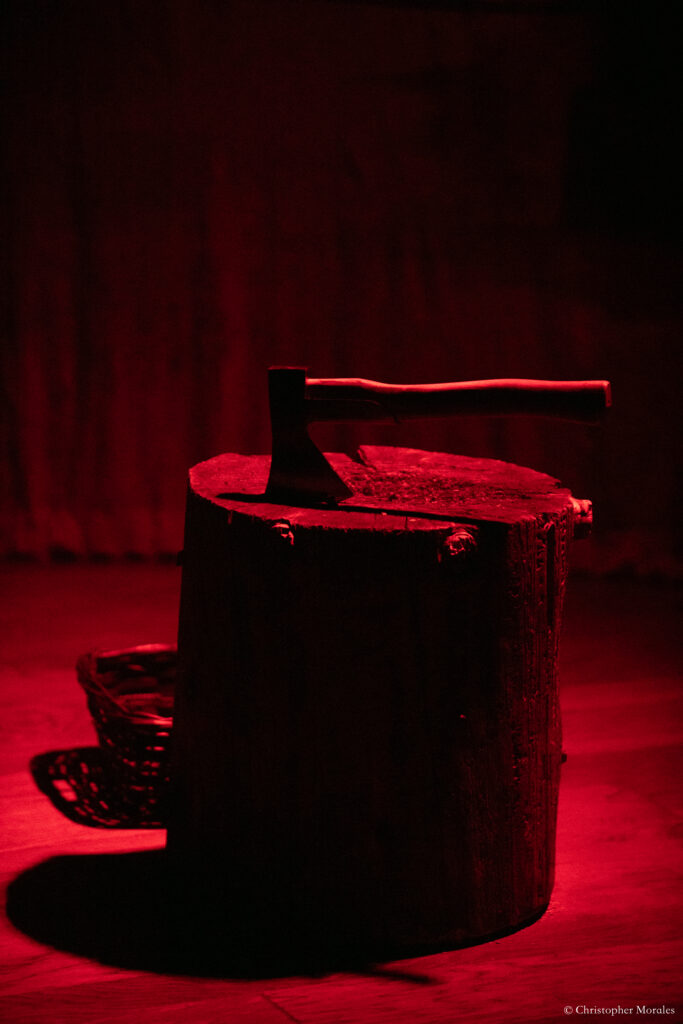
Walking into the small space, the audience is greeted with an unremarkable suggestion of a formal living and dining room from the turn of the 20th century. Scenic design by Marguerite Morgan also includes three fabric drops at the back of the stage, painted with scenes giving a bit of a Poe or Hitchcock vibe. An ominous wooden stump with ax chinks in the top, sits downstage left, ominously setting the tone for the production. From there, the production has an odd preshow moment where an actor enters the stage, starts a gramophone as the audience settles into silence, then exits, leaving the audience to wait and wonder whether the show has started. The music continues through an entire song and, just as the audience begins to chatter again, the actor walks on and stops the gramophone and exits again. If there was some greater meaning to this bit, it was lost on me, and only served as an awkward and confusing false start that doesn’t contribute to the production in any meaningful way.
The only semblance of a program is an Instagram post listing the cast and production team, and includes some short bios. I’m not so old-school to believe that the only acceptable program is physically printed on glossy paper, and am perfectly comfortable with a digital program, but I would love for that program to contain a bit more content, about why the company exists, why this play now, and was disappointed with the absence for this production.
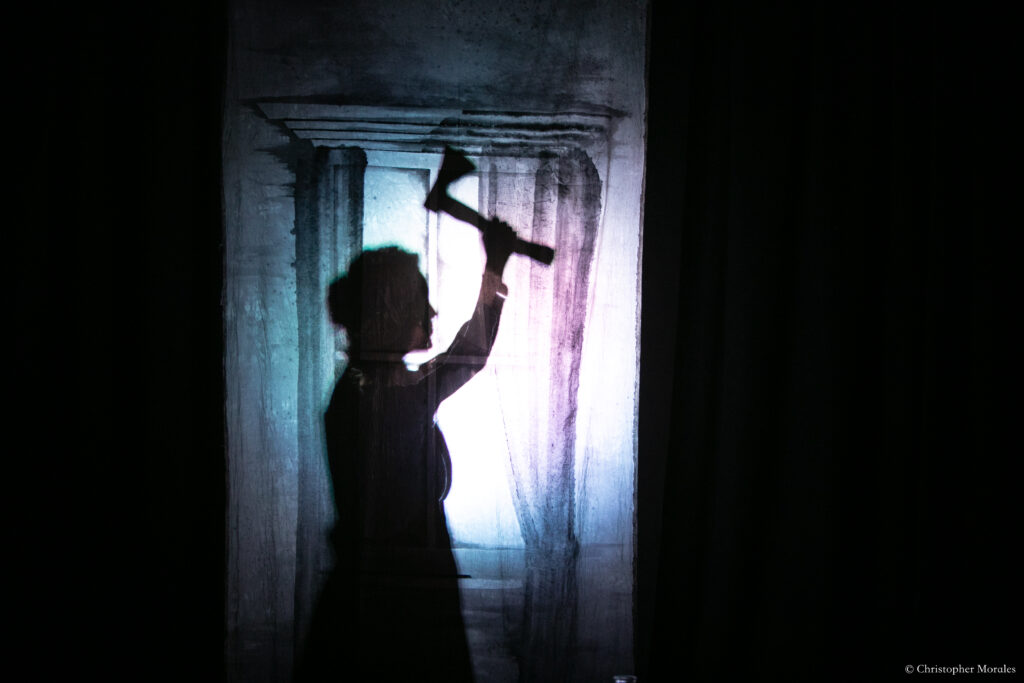
With that being said, Blood Relations does stand on its own as a well-crafted production. The script, by prolific Canadian playwright Sharon Pollock, was first produced in 1980 and is full of tight, smart dialogue that doesn’t feel stale nearly 50 years later. David Morgan’s adept directing is clear, natural, fluid, and generally well-paced. The use of the entrance from the center back of the house is initially unexpected and startling, and later somewhat disconcerting, as the younger Lizzie, played by Becca Ingram, follows her stepmother up through the audience with a hatchet. The use of the stage left fabric drop as a shadow theatre screen during the brief trial excerpts is an excellent convention. The shadows distort the speaker’s image in just the right ways, implying the distortion of the arguments in the trial itself. Morgan Gunter’s movement as Defense in the shadow segments is clearly articulated and visually effective. The rising conflict is well-managed and compelling, both in individual interactions, such as those between Young Lizzie (Ingram) and her father, Mr. Borden (played by Ben Sansom) and in the overall story arc.
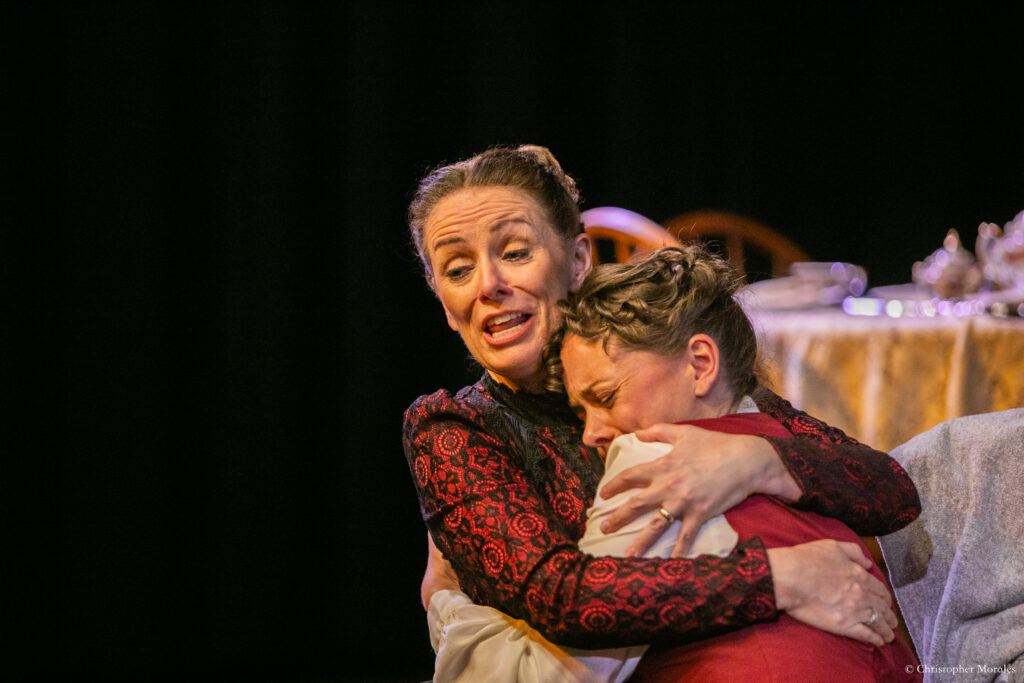
Pollock’s storytelling convention is captivating. The scene begins with the main character Lizzie talking with her un-named friend, “The Actress.” When Lizzie is pestered by her friend about whether or not she “did it,” Lizzie engages the friend to act as a young version of herself to be able to tell her story through flashback sequences. This results in Becca Ingram becoming “Young Lizzie” and Annadee Morgan as the real Lizzie to take the part of her maid, Bridget.
While this may be confusing to read, it is actually much more clear on stage. The pair expertly glide in and out of the past and present, and with the help of Gower’s lighting, the convention works quite well. It allows for engaging storytelling, in a way putting the audience in place of “The Actress” as confidant. Ingram and Morgan have excellent chemistry, suggestive of a deep friendship, both as Lizzie and “The Actress,” and reversed as Lizzie and Bridget. Morgan’s Irish dialect as Bridget is excellent and she gives a generous and strong performance. Ingram as Young Lizzie is riveting. Ingram has an incredible capacity with language and carries herself in such a way that drew me into her world. Between Ingram’s capable character development, delivery, and presence, paired with Pollock’s clever language, Lizzie Borden becomes a very sympathetic and relatable character.
Conversely, the supporting characters are written rather one dimensional. Despite this, Shawnda Moss as Mrs. Borden and Alexis Boss as Lizzie’s sister Emma are both clearly capable actors. This contrast serves to make Lizzie’s parents less likeable and more caricature-like. Additionally, this choice makes their murders, though certainly not justifiable, disturbingly more palatable.
Technical aspects of the production are well done for a small production. Sound design by Marguerite Morgan adds to the suspenseful feel of the production through low whispers during the trial segments and disturbing bird sounds later on. Lighting design by Adam Gowers is evocative, with the opening moment washing to a colorless, black and white photo effect, taking us back in time. Occasional red washes and shifts indicating changes in time and place are well-executed. There is no costume designer credited, but the costumes are worth mentioning—especially the black and blood red elements in the two leading women—as they contribute to the visual appeal of the show.
The production raises questions about the fine line between love and violence, and what exactly pushes someone from common feelings of anger, frustration, and disappointment, into the desperation and detachment that turns to violent behavior. It asks questions we’ll likely never be able to answer, about the effects of nature versus nurture in people who make the leap from everyday familial frustrations, to heinous acts of domestic violence. As Mr. Borden lay down to rest in his daughter’s presence, just before his violent death, I thought about the nature of love and trust within families and how much trust we put in our loved ones daily. Avoiding any spoilers, I found the ending to be confusing. The most sense I was able to make of it is that perhaps in some way, we are all Lizzie Borden—at those moments when we don’t feel loved, or we feel betrayed, frustrated, and angry. The only thing that (usually) separates us from her, is what we do next.
Blood Relations is a compelling and well-crafted production. It is appropriate to the season and thought provoking. Wandering Bark is definitely a company to come and see, and watch where they go next.
[box] Blood Relations plays Thursdays – Saturdays at 7:30 PM, through November 1 at the Hive Collaborative (290 W 600 S, Provo). Tickets are $15. For more information, visit thehivecollaborative.com. [/box]