
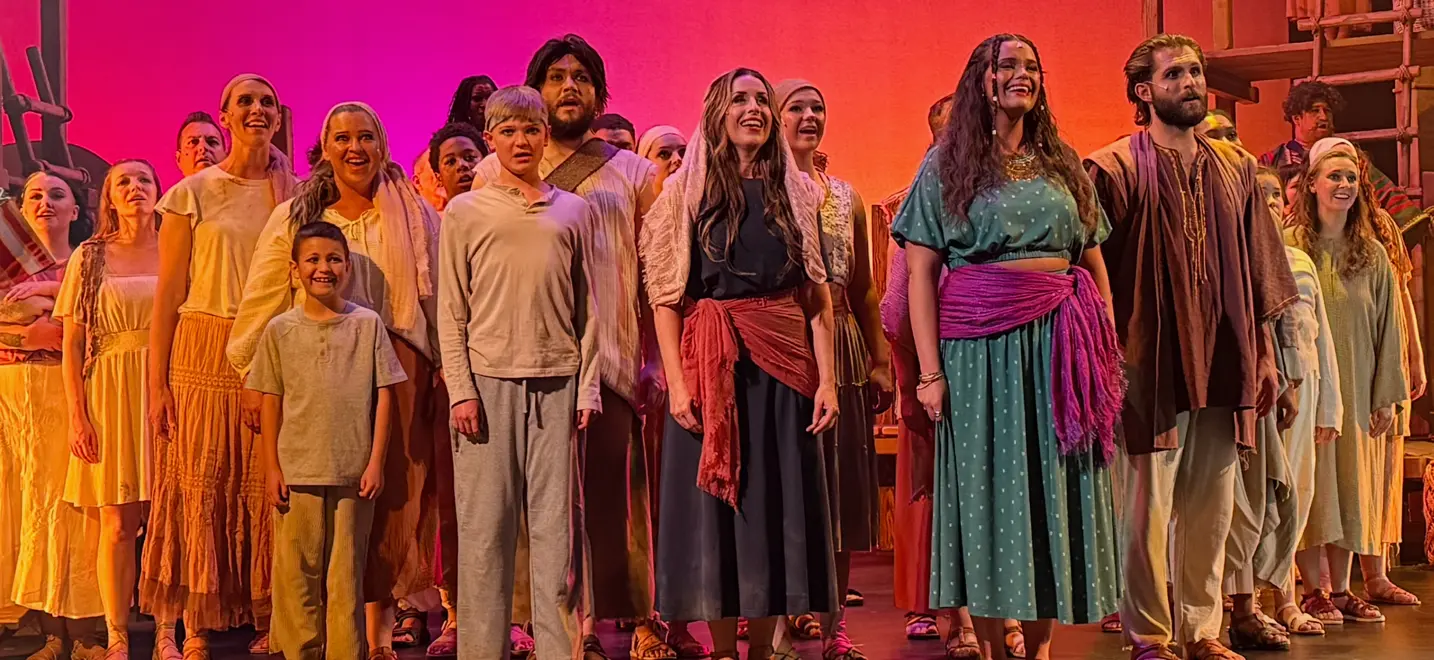
LOGAN — I’ve always enjoyed DreamWorks’ The Prince of Egypt because it powerfully retells an ancient story in a way that resonates with both adults and children. It’s the story of Moses, a Hebrew child raised as Egyptian royalty and the adopted brother of Ramses, the heir to the throne of Egypt. The stage musical builds on the original animated film with a book by Philip LaZebnik and music and lyrics by Stephen Schwartz—both of whom contributed to the original movie. Featuring beloved songs from the film alongside many new numbers, the stage adaptation deepens the story’s focus on faith, destiny, and the enduring bonds of family.
Cache Theatre Company brings that same powerful story to life on the Ellen Eccles Theatre stage, offering a heartfelt and visually arresting theatre production directed by Whitney Metz. Metz herself described the production as “a tale of identity, freedom, courage, and faith,” and the cast and crew rose to that challenge. For a community theatre production, this show shines with its ambitious scale, thoughtful blocking, and compelling performances.
Playing the central brothers are Geoffrey Seamons as Moses and Rylan Draper as Ramses, who together form the emotional heart of the production. Their relationship feels grounded and believable from the first scene, where the two jokingly spar and tease like real siblings as they ride their beautifully sculpted puppet horses. Their chemistry evolves over the production’s story from carefree camaraderie to devastating ideological opposition.
Seamons brings a sincere, introspective energy to Moses and effectively carries the emotional arc of the story. He captures the complexity of a man torn between two worlds—one of privilege and power, the other of truth and suffering. From his initial boyish confidence in the palace to his moments of anguish in the desert, Seamons never overplays the drama but allows Moses’ transformation to feel organic. His acting is especially touching in the quieter, internal moments showing the growing grief he wrestles with inside. Vocally, he handles the material well, with a clear, heartfelt delivery emphasizing Moses’ compassion and conviction. Throughout the production, Seamons’ dancing was the weakest element of his performance. However, in “Through Heaven’s Eyes” where Seamons as Moses is choreographed as struggling to learn the Hebrew dances, it favors Moses feeling out of place in the Hebrew world.
Draper, as Ramses, grows into the role. One particularly memorable detail was how Metz subtly blocked scenes to emphasize Ramses’ insecurity and feelings of inferiority. In an early moment where Queen Tuya (played regally by Daysha) and Ramses’ future wife Nefertari (Laura Robbins) negotiate his marriage, Nefertari is placed one level higher than Ramses on a platform—subtly implying his lack of authority. Then, as his father dies, making him the new Pharaoh, Ramses is blocked to seem small again, standing upstage of Nefertari, who enters already wearing a massive crown and sings to him about how “this is why he was born.” Draper did an excellent job portraying Ramses’ struggle shouldering the weight of his responsibilities and showing how even immense power is often accompanied by fear, grief, and loneliness. I loved the end of the show when Draper stood taller in Ramses’ commanding battle armor of oversized, metallic feathered pauldrons designed by Caroline Robbins. That change of silhouette, combined with Draper’s newly grounded posture, symbolized his final assumption of the weight of power and his readiness—however tragic—to carry it.
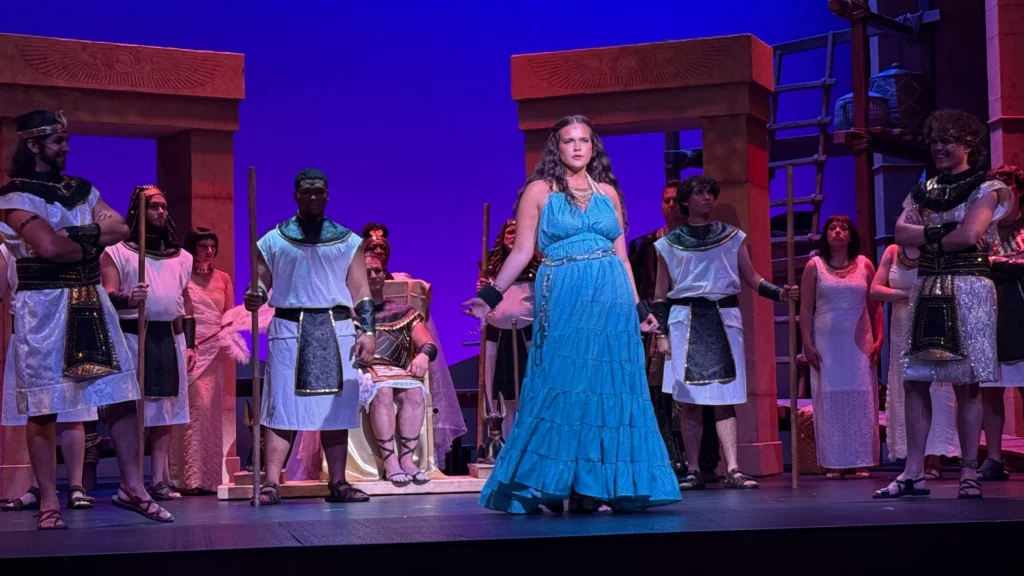
Haven Draper gives a strong performance as Tzipporah, Moses’ eventual wife. Draper’s voice is rich and full, bringing both strength and compassion to the character. Seamons and Draper share several moments of quiet chemistry grounding Moses’ transformation in something personal and human.
Sebrina Woodland as Miriam and Andrew Crumpley as Aaron round out the core Hebrew family with emotional sincerity and strong vocal performances. Miriam’s faith and gentleness contrast well against Aaron. The production’s paternal presences are the Pharaoh Seti (Michael Ricks) who has a grounded strength and the patriarch Jethro (Ricardo Ramirez) who contrasts Seti in every way as he beams with buoyant joy.
One of the most striking emotional threads woven through this production was the powerful presence of the mothers who each play a crucial role in shaping the men at the center of the story. Alexa Thompson as Yocheved, Moses’ birth mother, delivers a haunting and heartfelt performance in the opening number “Deliver Us.” Thompson’s voice carries both desperation and fierce love as she places her infant son into the river, trusting God to protect him. It’s a moment setting the tone for the entire production. Daysha brings a quiet nobility to Queen Tuya, Moses’ adoptive Egyptian mother. There’s a deep sorrow behind her eyes making her character feel complex and real. Laura Robbins as Nefertari was a powerful presence of overbearing strength to Ramses, but who crumbles at losing their son in “Heartless” with vocals making me weep. Each of these women gives the story emotional resonance and depth.
A standout technical aspect is the set design by Danny Rash. The Ellen Eccles Theatre boasts a large proscenium stage, and Rash takes full advantage of the space with towering stone pillars and wooden platforms like scaffolding at varied levels allowing for visually dynamic staging. The story’s scale fills the whole theatre, especially with lighting designer Kyle Sunderland’s use of color, shadow, and atmospheric effects.
A haunting and beautiful sequence delving into this use of shadow is the depiction of the angel of death during the plague of the firstborn. Here, a dancer dressed in flowing black and red dress glides across the stage through mist and dim lighting, silently claiming lives in a choreographed dance of sorrow. This scene, both eerie and reverent, stands out as one of the most poignant moments of the night. The way dancers moved in half-light to embrace fallen loved ones, mourning without words, was heartrending. I have to admit that I was watching this show with my own firstborn son by my side and this part had me quietly sobbing.
One of the most impactful moments comes during the Red Sea sequence. As Moses lifts his staff and the music swells, Sunderland used a lighting effect that fills the house and makes the audience feel as though the waters are parting all around them. The timing and immersion of this moment felt cinematic in its scope and was genuinely moving.
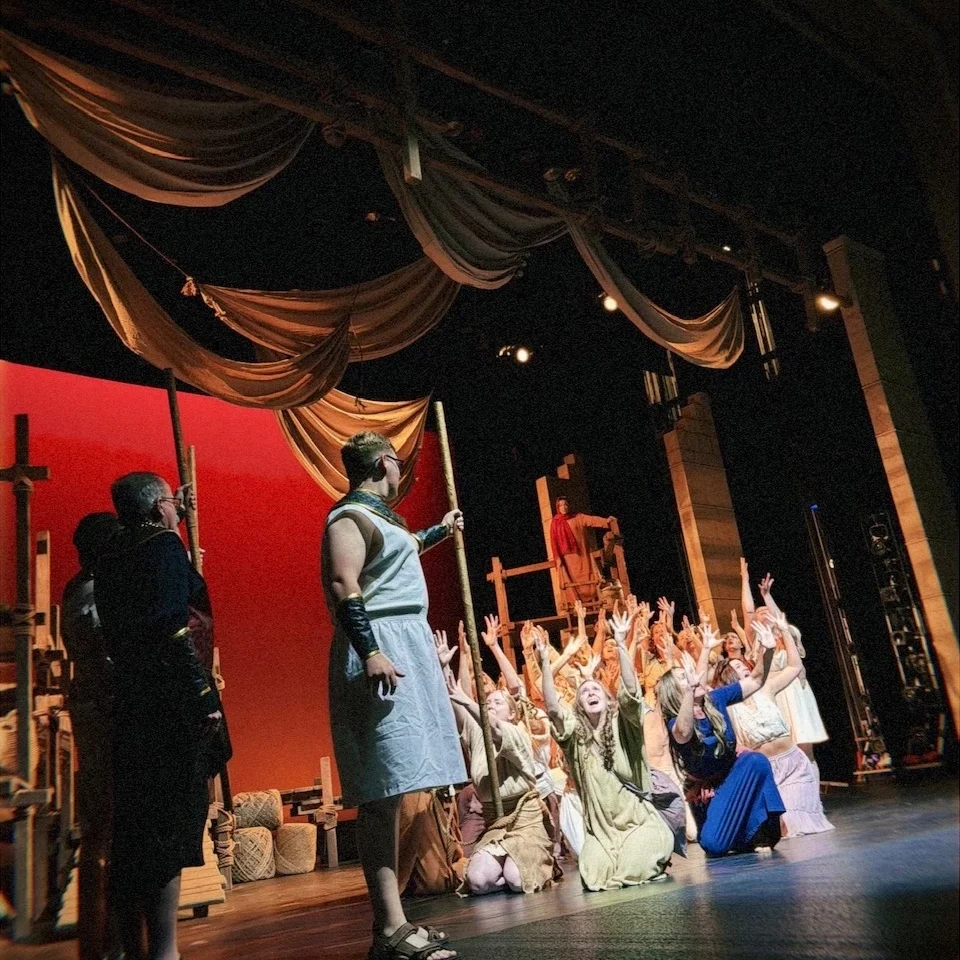
Choreographer A. Raheim White succeeds in shaping movement reflecting both the emotion and the scale of the story. The ensemble, particularly the featured group of lyrical dancers, brings visual poetry to key sequences like the symbolic number where infant Moses is carried down the river. While the choreography is largely modern and flowing, there were a few moments in group numbers like “Haggadah” where a deeper nod to cultural or traditional ethnic dance would have enriched the authenticity. Still, the dance numbers were clean and tight, and White’s choreography was overall quite thoughtful in how it spotlighted individual strengths of the dancers within the larger ensemble.
One can appreciate how much care went into the staging of each scene. The ensemble supported the action with energy and grace, without ever pulling focus from the leads. Even large group scenes felt cohesive and narratively driven.
Many fan-favorite songs remain and are executed beautifully in this show, including the powerful “Deliver Us” and the unforgettable “When You Believe.” However, this stage version places greater emphasis on Moses’ internal journey, his search for identity, and his complicated bond with his adoptive brother. The musical digs deeper into character motivations, particularly the tension between destiny and choice, and the cost of leadership. Metz’s direction leans into this emotional core and Seamons and Draper do an excellent job leaning into the humanity of the story.
With its emotional depth, visual beauty, and strong performances supported by impressive technical elements, The Prince of Egypt produced by Cache Theatre Company is a journey worth taking. Like the parting of the Red Sea, the production clears a path straight to the heart that lingers long after the final note fades.
[box] The Prince of Egypt plays at The Ellen Eccles Theater in Logan through July 19th with performances at 7:30pm plus an additional 1:30pm Saturday matinee. Tickets are $14-$35 and can be purchased at https://www.cachearts.org/ [/box]