

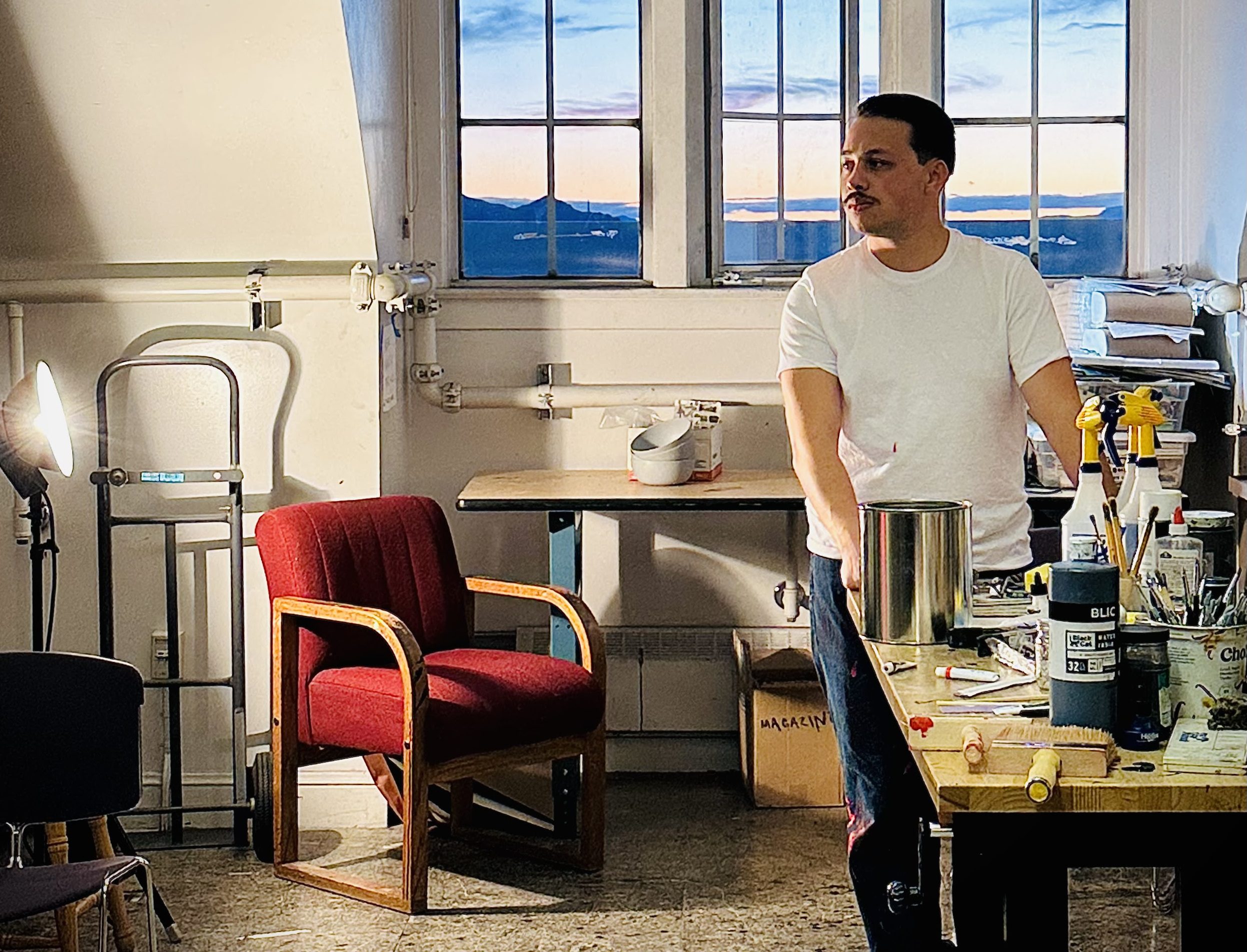
SALT LAKE CITY — In a city where there is a plethora of theatrical offerings on just about any day, seeking out small grassroots theatre productions like RED, by Lil’ Poppet Productions in collaboration with Sackerson, Co., and directed by talented local playwright and director Morag Shepherd, is worthwhile. Written in 2010 by John Logan, RED centers on the artist Mark Rothko (played by Tyson Baker) and a fictional assistant named Ken (played by Amona Faatau), during the two year process of creating the 30 canvases known as the Seagram Murals. For anyone who loves art or theatre, RED is a visually and emotionally resonant and compelling experience.
One of the many things Shepherd consistently gets right, is found space—and Shepherd found the perfect space for RED. The show is performed in a vaulted, sky-lighted art studio/classroom on the top floor of the iconic Converse Hall at Westminster University. Rothko used religious imagery and terminology to describe his art. In RED, Rothko says of his work “I will make it a temple”. The performance space in Converse Hall becomes a Cathedral under Shepherd’s capable hand, complete with smaller, transept alcoves at left and right, where key moments of the play are staged. The stage right alcove features small windows with what appears to be stencils that allow the fading light to enter the space at the beginning of the production, much like stained glass in a cathedral, but gradually disappear as the sun sets during the show. Shepherd uses this space to great effect as Baker’s Rothko describes the placement of a Caravaggio painting within the transept of a cathedral. The room is clearly an actual art space—with a paint-spattered floor, canvases, paints, supplies and equipment stacked and stored everywhere. Two working clean up sinks in another alcove upstage left are utilized throughout. However the rudimentary space is made holy through sacred nature of performance and because art itself is an apotheosis.
Attention to detail in the setting, props, costume, music and meagre lighting is captivating. There are several producers listed in the program, but no distinct credit to lighting, music or costume design. It seems, as is the case for much of Shepherd’s works, that these technical elements grew organically out of Shepherd’s vision and the ensemble’s rehearsal process. From the precise mixing of color (and egg) into paints, to the many minor adjustments of the portable work lights, and even the overhead fluorescents that alternatively wash the space, no detail is spared. Dissonant sounds play before the production begins and music is intentionally and effectively used at pivotal moments during the show. Worn workwear and footwear splattered with red paint only adds to the realism of the experience.
Logan’s script is excellent and evocative. I found myself scribbling quote after quote in my notebook—each as profound as the last. The dialogue between Rothko and Ken is natural and precise, building deftly to the powerful climax where the two ultimately clash. In the hands of Baker and Faatau, two extremely adept actors, the dialogue pulses with life.
The first several minutes of the play are devoid of dialogue. Baker, as Rothko enters the studio, adjusts lights, contemplates the paintings, adjusts some more, observes again. This immediately draws the audience into the world of the play—not only because many of the works being studied are envisioned on the back wall, above the audience, such that the world of the artist envelopes the audience. Baker settles into his obsessive character through this initial physicality. The entrance of Faatau as Ken and the dialogue, spoken and unspoken between them, introduces the imbalanced relationship between master and acolyte and the first half of the play really digs into Rothko’s performative superiority laced so clearly with his own insecurity. The two actors engage in a sort of dance of language, position and power, with Rothko domineering Ken. Until that dynamic flips, and Ken wraps two years of observing Rothko’s overbearing vanity into an exquisite turning of the tables, verbally eviscerating Rothko, exposing his weakness and hypocrisy.
Baker’s Rothko is expertly crafted and thoroughly unlikeable—pompous, disdainful, controlling, verbally abusive, yet despite this, he says things that hit deep and reflect our own excesses, failings, and insecurities. From his diatribe against the word “fine” and an insistence that audiences elevate their response to art—”where is the discernment…between what I like and what I respect?” he demands–to his blatant and hypocritical statement that “artists should starve, except for me”, the audience is pulled through the production on a provocative emotional roller coaster. Faatau’s character development of Ken is a slow burn, but the explosion is masterful and scorching as he calls out his employer’s hypocrisy and looming irrelevance with deadly precision.
The interplay and analogy of visual and performing arts is a recurring part of this production. Rothko describes with wry humor, how painting is mostly thinking, and only 10% of the effort is actually the laying of brush to canvas. The same can be said of theatre—the hours and hours of script analysis, memorization and rehearsal that goes into a short-lived production.
The most prominent theme of the production, and perhaps of Rothko’s life, is the battle against darkness and his use of red in an attempt to keep blackness at bay. In a vulnerable moment, he describes his only fear is that “the black will swallow the red.” He casually describes the suicidal deaths of tortured artists, promising that his own suicide, when the red finally gives into the blackness, will be unmistakable. Rothko’s work did indeed darken into the deepest shades of blacks and brown apparent in his canvases inside the Rothko chapel, that was dedicated a year after his own death by suicide.
Productions like RED are my favorite kind of theatre—because they make me think, make me want to research Rothko and study his work. It is evidence of the reason we create art, do theatre as well as why we keep showing up at art galleries, at performance spaces.
We are fortunate to have so much theatre within reach here in Utah—and the offerings are wide and deep. If you’ve only ever seen big-budget productions at big theatre houses, I encourage you to expand your horizons into the world of small-budget, intimate grassroots theatre like Lil’ Poppet, Sackerson, and RED.

MORE INFO: RED is currently playing at Converse Hall (3rd Floor Studio), Westminster University (1840 S 1300 E, Salt Lake City, UT 84105) presented by Lil’ Poppet Productions in collaboration with Sackerson, Co. The production runs through April 26, 2026. Performances are held at 7:30 PM on select evenings. Ticket pricing and availability may vary. For the most up-to-date schedule, performance details, and official ticketing, visit: https://www.lilpoppetproductions.org/ and https://events.humanitix.com/red-by-john-logan