

SALT LAKE CITY — For forty years, Andrew Lloyd Webber’s adaptation of The Phantom of the Opera by Gaston Leroux has filled some of the world’s most prestigious venues. The exhilarating and iconic organ anthems that have been part of the cultural zeitgeist of the entertainment world across generations. For the first time in many years, and with a revitalized scenic design and some incredibly thoughtful character choices which steered away from some of Phantom’s problematic story elements, the show was a masterful production and audiences were once again taken by the “Music of the Night.” It’s a show that many flock to again and again.
Design
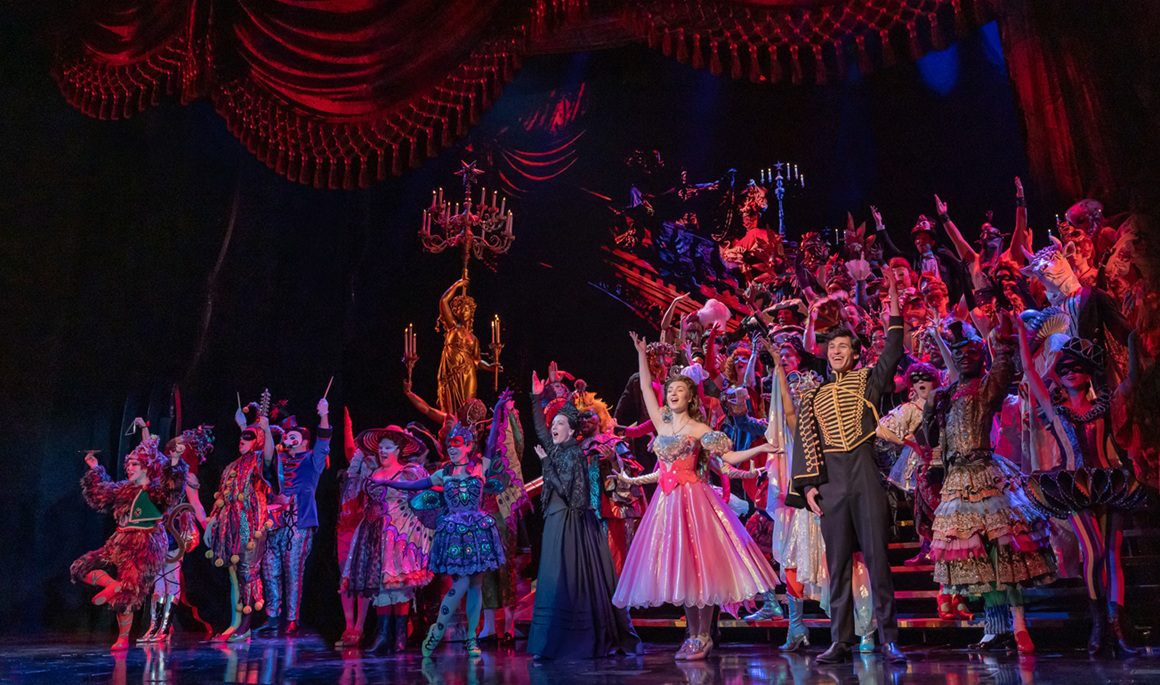
There was a lot of buzz about Maria Björnson’s brilliant scenic design for this show and it did not disappoint as the landscape was a fantastic blend of old and new, elegant and simple. Some settings were as clean as a lavish drapery and a desk which perfectly set the stage for the notes. Others, such as the grand staircase for “Masquerade” were extravagant and highly detailed. There was a brief hiccup after the show’s prologue auction as the set is impressively restored from dilapidated to renewed where a technical element delayed the start of the Hannibal rehearsal, but it was quickly remedied and the audience both humorously appreciated the snafu, and roared with appreciative cheers as the show quickly resumed.
Over and over, the staging was stunning. The ramps descending into the depths of the Opéra Populaire were fantastic as the depths of the phantom’s lair itself with raised candles, an organ and the boat which converts to a divan when turned. I was thrilled by the dynamic practical set on the roof of the opera house during “All I Ask of You” but no moment was more well designed than the cemetery for Gustave Daaé. And, yes, the Chandelier was fantastic.
Bravos are in order for excellent lighting design from Andrew Bridge as the lights so often were dramatic, even startling, with fantastic focus, purpose and coloring throughout. I loved seeing the top of Act 2 as the masque ball begins and the wash of red on Msr. Andre’s costume made him appear for a moment to be the Phantom. Likewise the costuming, sound, and other technical elements were pristine. I loved that during the masquerade, Madame Giry remained unchanged in her ballet blacks.
Performances
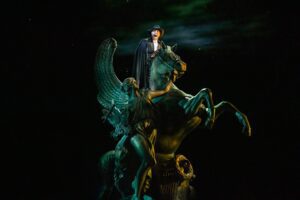
Isaiah Bailey was an incredible casting choice as the title role. Having seen other high caliber tours and productions of Phantom, I’ve seen a range of choices from the aggressive to the pitiable. Bailey was incredible in his gentility with the character. At the end of the song “The Phantom of The Opera”, as Christine (Jordan Lee Gilbert) begins her soprano cadenza, Bailey is enamored as much or more with the music than the person. His acting in this and leading into “Music of the Night” centered so much of his thought process not on possession of Christine, but on his primary desire to see how she brings life to his music. It’s nuanced, but not subtle as a choice to make the Phantom understandable and human. Bailey’s rich talent was on full display with exceptional vocal clarity and control and expected delivery of key moments. Most of all, Bailey is an elite actor who brought exceptional emotional and character dynamic to a role done many times and which has not aged kindly to some.
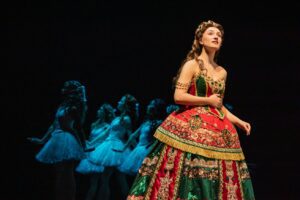
Gilbert’s performance as Christine was similarly dynamic. So much of what works for all of this performance is the non verbal storytelling. Gilbert excelled in finding interesting moments to look, express, or respond to the world around her. Brilliant writers have pointed to Christine’s loneliness in a world of people who resent her success or ignore her real problems compared to their own. Gilbert found profound ways to be the hero of her own story, make strong choices, and add her exceptional vocal skills to a storied role. I appreciated seeing this in the clear realization from Gilbert that the Phantom has invaded the stage for Don Juan. Rapidly you see her go through the four F’s of a trauma response as she freezes, thinks to flee, and then opts to fawn until it is safe before finally fighting as she reveals him on stage. The blocking gives her the power to push away concerned others and stand her ground in a powerful way.
The other leads were exceptional without fail. Daniel Lopez as Raoul brought an arrogant and assertive counterbalance to Bailey’s Phantom. Lopez moved with the self assurance of a viscount, and I appreciated seeing Lopez find ways to take a more assertive role throughout the production. It’s easy to see Raoul as the default option, but he demonstrates his merits as a concerned, if brash, protector.
Midori Marsh and Christopher Bozeka played the opera power duo of Carlotta and Ubaldo Piangi respectively and they found excellent moments to shine. Marsh’s Carlotta has a great moment when the trap is being set during “Twisted Every Way” and Carlotta gives a non-verbal nod of support to Christine acknowledging that she’s bearing the brunt of this conflict. Bozeka’s Piangi played an excellent second to Carlotta and together they brought key humor. So ,too, for William Thomas Evans (Monsieur Firmin) and Carrington Vilmont (Monsieur Andre). All throughout the show, these actors were easy to understand and emotionally connected as strong supports to the main conflict.
The cast found the right amount of humor, humanity, and subtext to tell a great story. The stage was never bare of people making choices that grabbed and held attention as the show moved forward. I was impressed by motivated ensemble stage business and togetherness from the beginning, and despite the reprimands of the severe Lisa Vroman as Madame Giry, the dancing was not dreadful. In fact in many moments is was one of the most spectacular elements. In particular, Masquerade was a number that was a visual feast in all ways and I wish it had been done again as an encore.
Recommendation
I feel privileged to spill more ink on a show that probably has had many creatives think “far too many notes for my taste!” This production was spectacular and was done in a way that responds to the social commentary of forty years of fan service and commentary. The phantom’s flaws remain, and so do those of each of these dynamic characters. But if you get the chance, I urge you to see it whether for the first time or for life long fans, once more.