

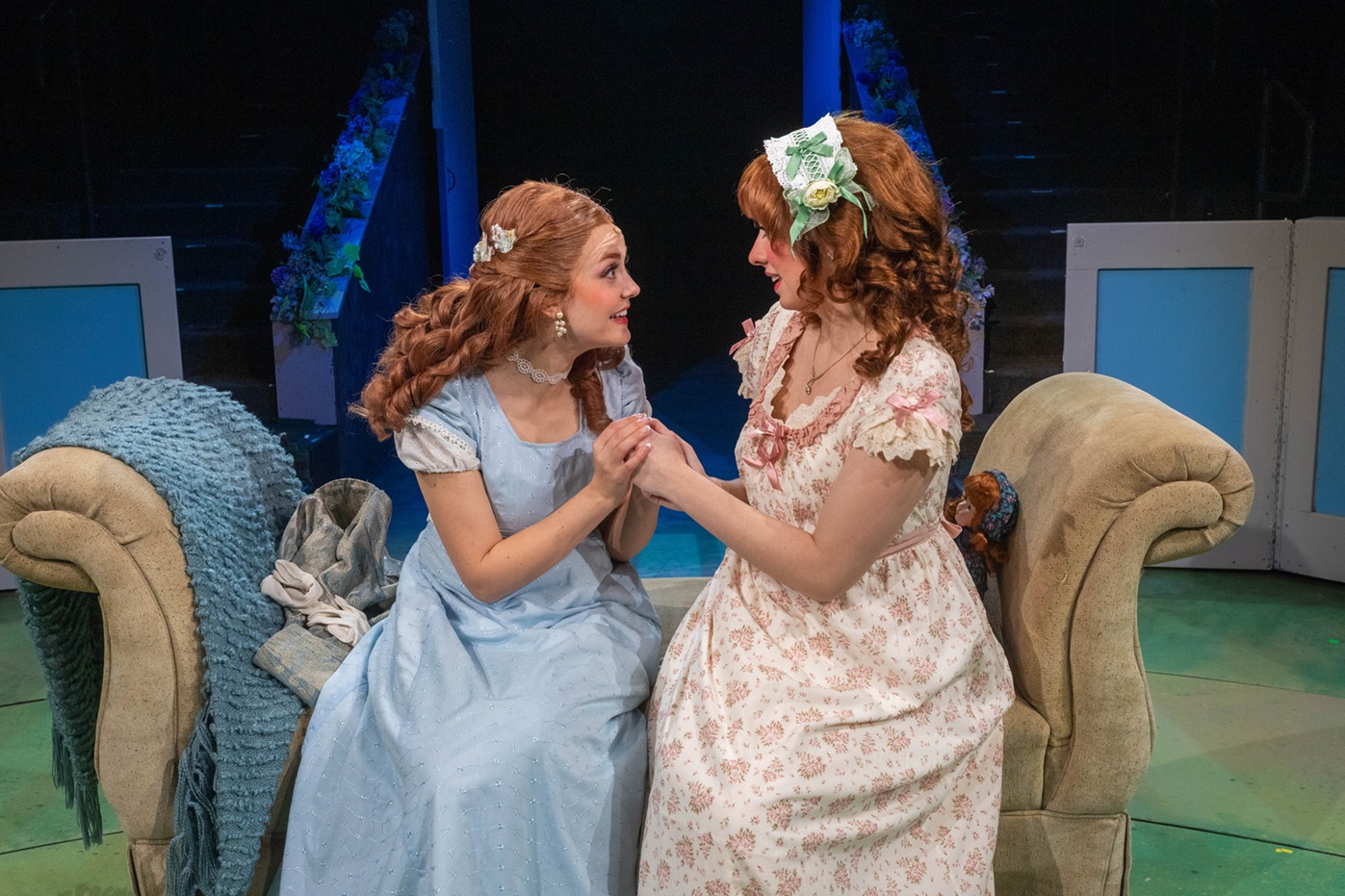
WEST VALLEY CITY — Walking into the West Valley Performing Arts Center for Kate Hamill’s Emma, I wasn’t entirely sure what I was going to get. I’m an avid reader with a broad love of genre, but Jane Austen typically sits near the bottom of my personal list. I’ve often found her work dry and tedious. Because of that, I was genuinely surprised to find myself laughing out loud, caring about the characters, and enraptured by this production. Under the confident direction of Kristi Curtis, Emma becomes lively, witty, and deeply engaging. The show certainly honors Austen, but the direction, cast, and design all give the story a modern pulse.
The West Valley Performing Arts Center is well-suited for this play. Its in-the-round configuration places the audience intimately close to the actors, which is ideal for a domestic dramedy. You don’t just observe Emma Woodhouse meddling in the lives of others, you’re pulled into her confidence through numerous breaks in the fourth wall, so it feels like Emma is spilling the tea just for you.
Morgan Golightly’s scenic design complements this intimacy beautifully as the set uses movable panels that quickly establish different locations as wagon pieces of furniture roll in and out smoothly, never slowing the action or cluttering the space. I especially loved that the vomitoriums were closed with doors painted to resemble English homes that were stylized just enough to feel like dollhouses. Curtis’ direction has Emma playing with a doll at the top of the show and explains in her Director’s Note that “Emma Woodhouse approaches life in Highbury as though it were her personal dollhouse.” This clever visual metaphor clearly shows the audience how Emma “plays” with the people in her life, arranging and rearranging them as if they were toys rather than fully autonomous individuals.
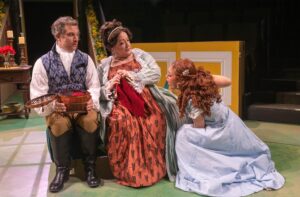
That idea reinforces one of the production’s strongest themes: Emma’s constrained potential. Though she is a sharp, extremely educated woman of about twenty, society infantilizes her, offering no meaningful outlet for her talents beyond managing social relationships. Morgan Fenner plays Emma, the delightfully flawed heroine of the show, as a confident, fiery, ginger-snap with boundless energy and, though meddlesome, is ultimately very lovable. Emma frequently breaks the fourth wall, pulling the audience into her inner monologue. These moments feel natural and reinforce Emma’s belief that she knows best about everything.
Opposite her, Clayton Barney’s Mr. Knightley is a compelling counterbalance. The chemistry between Fenner and Barney crackles, particularly when they bicker like children splashing tea at one another. Yet their relationship also carries real romantic tension. One standout moment has Knightley leaning into Emma’s space, briefly pinning her against the refreshment table before casually grabbing a drink and leaving her to dance with another woman. It’s playful, frustrating, and electric all at once.
Emma’s new friend, the sweet and simple Harriet Smith, is played by Sofia Paredes-Kenrick and is charming. Portrayed as dim but deeply earnest, Harriet’s fear that she has reached the “ancient” age of nineteen without securing a husband is played for big laughs. Her morbid visions of dying alone, an old maid, shriveling up, and being eaten by rats are delivered in such a way that Utah audience members will connect with and love, as this can still resonate in our own local culture. Harriet’s dire need of marriage thus established, she becomes the perfect object of Emma’s matchmaking schemes.
The supporting cast is uniformly strong. April Fossen’s Mrs. Weston brings warmth and grounding, with real emotional depth when she dresses down Mr. Knightley and gives modern connection and stakes to the show. Emily Henwood’s Jane Fairfax radiates quiet competence as well as beauty, which makes her a believable source of Emma’s insecurity. Garret Rushforth’s Mr. Elton is hilariously self-important and over the top in his attempts at courtship, so his surprise bride Mrs. Elton (Bryn Campbell) has to be even more over-the-top in being gloriously insufferable to match his energy. Seth Johnson’s Frank Churchill is charming and mischievous. Brooklynn Pulver Kohler’s Miss Bates is a standout performance. Kohler leans fully into the character’s absurdity. Savanna Finley’s wig design plays a huge role here with an exaggerated style that perfectly enhances Miss Bates’ ridiculous nature.
Costume design by Alicia Kondrick and Kelsey Nichols effectively places everyone in Regency-era fashion without overwhelming the eye. A particularly smart choice was keeping Emma in the same gown throughout, while changing her look with jackets, aprons, and overgowns to signal shifts in location or activity. It reinforces Emma’s centrality while allowing visual variety. Finley’s wigs across the cast are beautifully styled and period-appropriate.
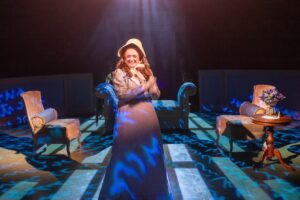
Savannah Garlick’s lighting design adds strong storytelling moments, especially when characters literally fight to be in the spotlight. Another memorable effect occurs whenever Emma mentions Jane Fairfax, flashes of red spot light signal Emma’s jealousy and irritation with theatrical clarity.
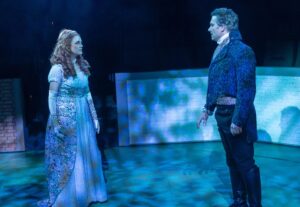
Rachel Mardis’ sound design may have been my favorite element of the whole production. Using orchestral covers from the Bridgerton soundtrack is inspired. These contemporary songs, reimagined in a classical style, infuse the show with immediacy and relatability while still feeling appropriate to the period. Among many other songs, the ones that stood out to me were when a scene change was set to “Uptown Funk,” it cleverly underscores the class dynamics while allowing for movement and fun. “Material Girl” plays as Emma dresses Harriet like a doll. The ballroom dancing was similarly classical with extremely modern twist for the audience to relate to, like when “What About Us” played during the height of tension between Emma and Knightley, and “Kiss Me” overlays their romantic resolution. The sound design transformed the scenes to convey emotions in a way not conventionally tapped into outside of musical theatre and I loved it.
Kristi Curtis’ direction keeps the pacing brisk and the tone balanced. The show never drags, and every design element works in harmony to support the story. The result is a production that feels fresh, funny, and surprisingly resonant.
I don’t think that traditional Austen productions will ever make the top of my list, but this staging of Emma felt fresh and relevant, while still holding true to the clean, proper romance that Jane Austen would approve of and it kept me captivated the whole time. Younger children may struggle with the nuance, but I believe that teens and adults will find plenty to connect with and enjoy and I wholeheartedly recommend it.

MORE INFO: Emma plays on Fridays and Saturdays through February 28th at the West Valley Performing Arts Center (3333 Decker Lake Drive, West Valley City). Tickets are $23-$35. For more information, visit https://wvcarts.org