

SALT LAKE CITY—Theatre companies regularly produce the same safe and often tired crowd pleasing musicals, it is a testament to the bravery of Pioneer Theatre Company to produce the world premiere of a new musical. Ten Brave Seconds is an original musical with music and lyrics by Will Van Dyke, book and lyrics by Jeff Talbott, and directed by the talented Ellie Heyman. The show takes place on a single day in history, and is the coming out story of a teenage boy; but it is so much more than the story of one gay kid. It’s the story of being brave in the face of hard things and finding power in a moment. This production is worth every second and more.
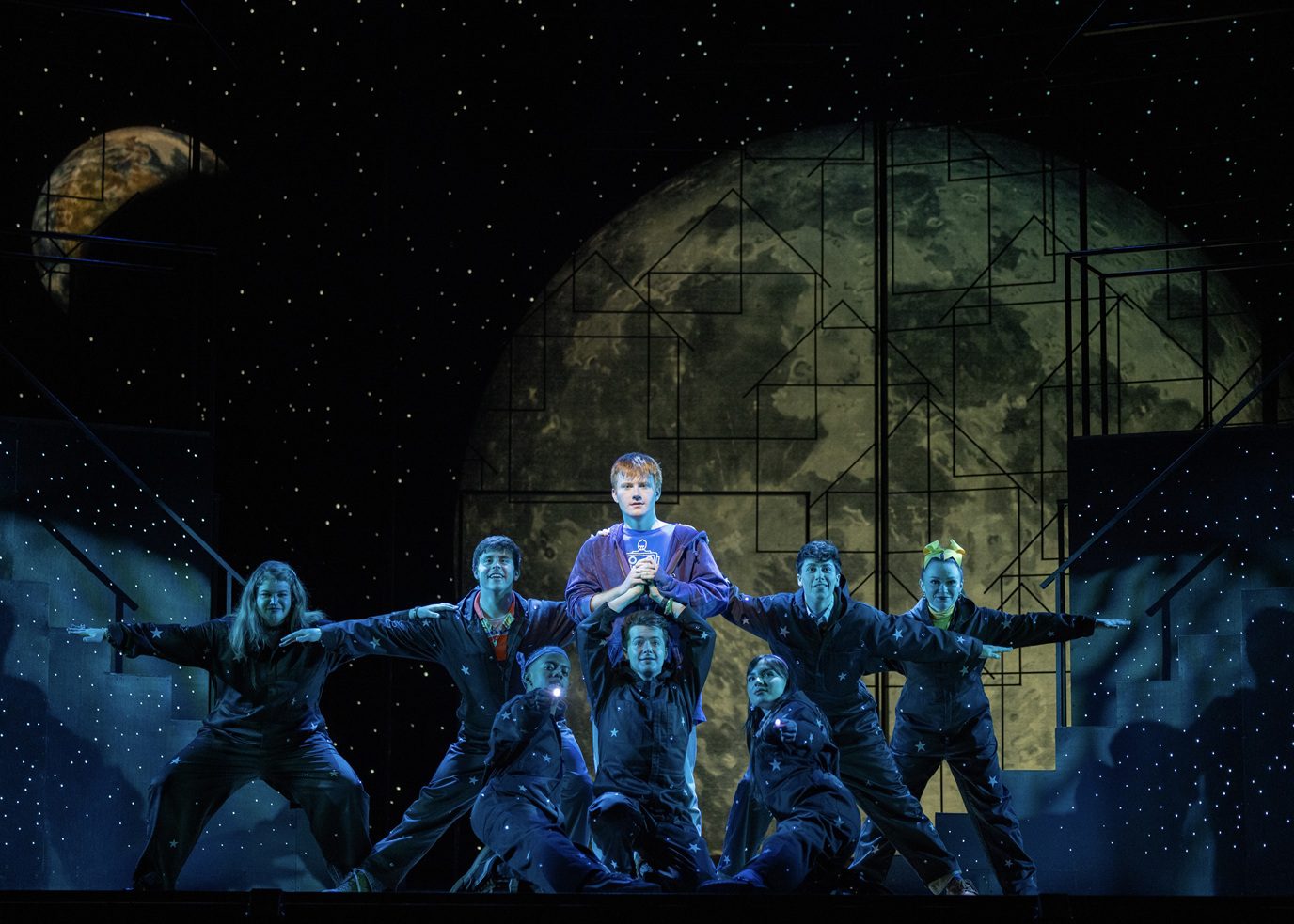
The set design on stage in the Roy W. and Elizabeth E. Simmons Pioneer Memorial Theatre by James Noone, is refreshingly simple. With house shaped metal scaffolding framing the sides and back of the stage, and a star-filled galaxy projected onto a large drop at center, while low, other-worldly rumblings by Sound Designer Aaron Hubbard hover in the air. The set is well-designed for function as much as form, with the metal framed houses transforming into banks of lockers in a high school hallway, a classroom, a lunchroom, a bathroom, and more.
The show opens with Mike, played by Carson Stewart, appearing from underneath the galaxy drop, reaching out to the audience, pulling us into his world, as his bedroom seems to orbit and coalesce from space into physical reality around him. Actors dressed in black coveralls strewn with stars, move set pieces in a well-timed dance, becoming part of the constellation around Mike in the opening number, Day One. From this very first moment, Heyman’s direction and Reed Luplau’s choreography are tight, creating seamless and fluid scene transitions. Luplau’s choreography throughout is not delicate, neither is it heavy-handed. There are no large Broadway style tap numbers. But the modern mix of hip-hop and jazz choreography that flows in and out of the story, is just the right balance of strength, grit, and physical storytelling. There is a magical moment in Astronaut 63 where the start-bedecked ensemble becomes a spaceship that Mike is navigating, then just as quickly dissolves back into the atmosphere. These skillfully choreographed transitions become part of the throughline where doorframes enter and envelop the actors, who don’t move from one scene into the next so much as allow the scene to move into them.
Talbott’s expert dialogue under Heyman’s skilled direction is tight and overlapping, creating natural conversational patterns that instantly define the complicated family dynamics from the first moments. Mike and his dad Carl, played by Will Blum talk circles around each other without really listening to anything the other is saying. Mike’s little sister Becky, played endearingly by local talent Heidi Farber, seems to be the only person in the family really paying attention. Becky leads the number, A Moment of Silence, by stopping time around her—a magical, but simple stage convention that pauses the action briefly to allow the audience to really see the current state of the family.
The music is generally upbeat, with a couple of notable exceptions. These intentionally slow the pacing down to highlight a moment and accentuate the drama with a talented live band in the pit. While excellently performed and danced, the musical numbers do occasionally get in their own way. This is especially so in the middle of the first half where many scenes in the halls of the high school have musical numbers begin to blur. The script then rewinds in Pop Quiz and re-summarizes the last four songs. This number, and perhaps parts of those leading up to it, seem unnecessary and don’t to drive the plot forward.
Costumes by Brenda Van Der Wiel successfully create a traditional array of teenage personalities, with Mike’s oversized purple sweatshirt practically becoming its own character. Mike disappears into the hoodie when reality becomes overwhelming and later attempts to shed the garment as he discovers his courage, eventually succeeding in the end, setting the hoodie aside to embrace his family.
The production is very well cast—from the leads to the teen ensemble, the group dynamic is cohesive and appears effortless both physically and vocally, from start to finish. Luke Mannikus as Tim shines vocally in Ride to the River, and Jessica Money as Gabby builds a captivating and complex character arc. Stewart’s Mike is an awkward and hard to love teenager, so well done that it takes a bit for the character to become likable. Later in the production Gabby and Tim accurately capture this in an interchange that goes something like “He’s a mess isn’t he?” to which Gabby responds “yeah, but he’s worth it.” And he is—Stewart creates a character worth waiting for.
Blum’s Carl is so painfully familiar, capturing those moments of awkwardly trying to be a good parent, while saying and doing all the wrong things. The humor during a scene between Mike and Carl, where both are on the phone in separate bathrooms, balances the emotional honesty that comes out in that interchange and in Carl’s song Sally at the Water Park. The stage convention that transitions a phone conversation into face to face, deeply vulnerable encounter, then back again, works beautifully. The scene is raw and real. There is intentionally no choreography here—the stillness of the scene a contrast to all those that proceed it.
John Cariani as Mr. G is extraordinary. As a counterbalance to Carl’s parental mis-firings and the frenetic energy of the angst filled high school, Cariani’s empathetic history teacher is grounded and endearing. Mr. G serves as a soothsayer and a conveyor of wisdom and experience in his interaction with Mike, and within the production as a whole. This scene, including Mr. G’s song Beautiful Boys of Boystown is the pivotal moment in the production where Mike’s frantic trajectory changes for better. It’s as if Mike, the astronaut has been careening out of control in space, and Mr. G is able to stabilize and re-tether him so that Mike can begin the difficult task of pulling himself back to safety. Cariani handles this moment with frankness as well as exquisite grace and tenderness.
The themes of grief, loss, fear, and heartbreak are potent. But they are also so human, universal, and handled with enough intermingled joy, that the show isn’t bogged down by its own weight. Ten Brave Seconds is about community and the hard, awkward, painful and joyful parts of those relationships. It is the story of all of us—of our best and worst moments, our big and little daily struggles and triumphs, and the power of choosing to be brave.

MORE INFO: Ten Brave Seconds plays January 30 through February 14 with an ASL interpreted performance on February 9 in the Simmons Pioneer Memorial Theatre (300 S 1400 E, Salt Lake City). Tickets are $57-83. Students K – 12 or ages 5-18 are half-price Monday – Thursday. For more information, visit pioneertheatre.org