

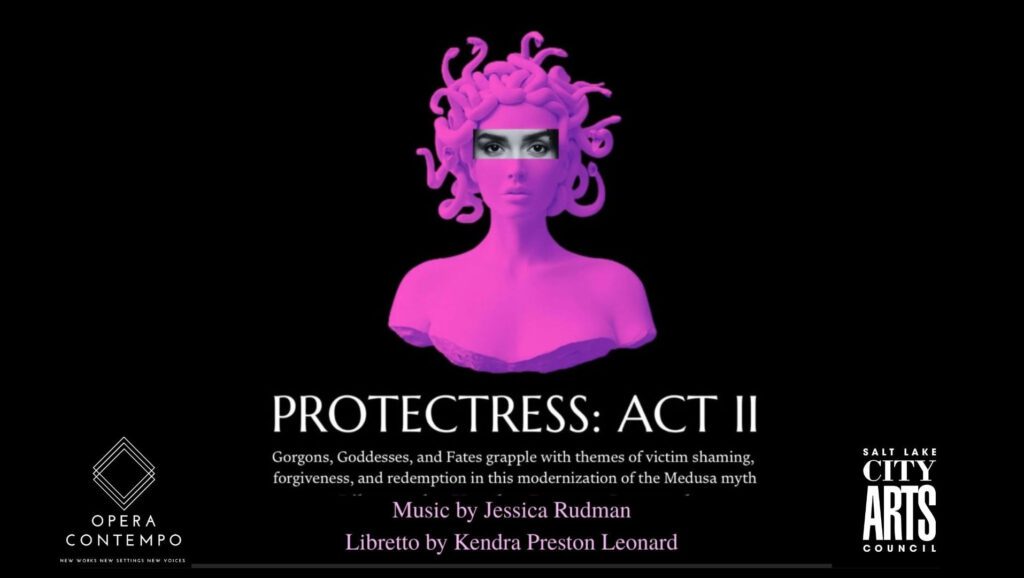
Opera Contempo’s latest project is a semi-staged, score-in-hand, reading of Act 2 of a new opera, Protectress, by local composer Jessica Rudman and librettist Kendra Preston Leonard. The final dress rehearsal took place Thursday, November 20, 2025, in the University of Utah’s Voice Box; two public performances will be presented on Saturday. This is a rare opportunity to see a work in process: to hear new creative voices expressing a story that is important to them through drama and music. Go hear all the voices, and experience this re-visioning of the Medusa myth. See what you think of something new and untested!
Director Anthony T. Buck’s selection of steamer trunks and ornamental trees, as well as a screen upstage that serves as a backdrop for scenery and supertitles, provided visual interest and places for groupings of characters onstage. Costumes were minimal, except for Athena’s, and may have been offered by the singers themselves, as personal additions to the read. Stage movement had to be kept to a minimum, since the singers were also referring to music in hand. I look forward to seeing a full production of Protectress someday, when the director can plan more action for them.
Since this is Act 2 of the story, Opera Contempo Artistic Director Mandi Barrus gave a recap of Act 1 at the top of the performance. Opera Contempo’s staged reading of Act 1 took place 2 years ago, back in November 2023, so the recap was crucial.
The story of Act 2 centers around a conflict imagined between Medusa, who is being tortured with nightmares by Athena, Goddess of War and Wisdom. The other gorgons and goddesses (9 of them) support Medusa, whom they fondly address as “Duse.” All of them agree that Athena must be challenged for her stubborn, irrational blaming of Medusa for breaking an oath of chastity by getting raped. That’s right: Athena blames Medusa rather than the rapist. The circle of enlightened female immortals summon and then confront Athena, insisting that Athena stop torturing Medusa, and also in general extend her wisdom and support to women, beyond just her warriors. Scene 1 ends with a surprising event, which I will forego revealing here.
Scene 2 began after a brief pause. The plot was easy to follow, especially with supertitle assistance, as well as a change in the backdrop projection and a few prop and set pieces. The Epilogue after Scene 2, however, was confusing: after a haunting yet comforting piano interlude (delivered beautifully by Emily Williams), it’s gradually evident that years have passed. The program lists an event at a university campus bedroom, and I couldn’t grasp why it existed – nothing was sung to explain. The Halloween scene that follows was compelling, and the wordless chorus of the gorgons and goddesses surrounding the stage at the end was gorgeous, full of love and harmony. Medusa is the character identified as the titular Protectress, but it’s clear at the end of the opera that all of the female immortals are protectors, paying attention and harmonizing together.
The production features superb local opera performers, including U of U voice faculty and graduates of the U’s voice program. The singers’ diction was excellent across the board, though supertitles were still useful. Rudman makes use of their full operatic ranges, often sending them high, so if you love the resonance of beautiful human voices filling a fairly small space (and soaring to vocal heights), you will be well-rewarded for attending.
Aubrey Adams-McMillan’s Medusa projected wisdom through experience at every moment. Her rich mezzo-soprano voice expressed deep empathy, though she didn’t have as much to sing in this act as she did in Act 1, which Opera Contempo presented in 2023. Kahli Dalbow shone in her short solo as the young Athena. Especially impressive was Nicole Heinen as Athena, as she took on all the other immortal women and insisted on relying on the way things have always been done. Her focused and consistent soprano was thrilling to hear, especially in the relatively small space of the Voice Box. She projected power in every way.
Contrasting with the solo singing was the trio music of the 3 Fates, Hilary Koolhoven, Kahli Dalbow, and Natalie Easter. Their role as Fates, as conceived by Leonard and Rudman, is not to determine a character’s fate, but to track it, adjusting their predictions when life situations alter. They also have power to alter the threads they read: they can pare away anger and provide strength through their weaving. They are a captivating part of the thematic implications of Protectress, as we see immortal females live beyond trauma and support each other in re-inventing life.
Musically, the opera is also a fascinating journey. Conductor Christopher Ramos’ ability to guide the singers through their score was impressive, because Rudman’s music evades the sense of downbeats and eschews typical musical structures (there are solos but no real arias, or anything you might call a song). She calls for fully sung conversation, and the musical lines she creates focus on expressing the drama of each moment. The music doesn’t settle: it flows and flows.
The only time I found the music mystifying was during a huge ensemble in Act 2 when the gorgons and goddesses are casting a mutual blessing for Athena. For a lengthy period everyone sings their own text and melody at the same time, and it felt chaotic rather than harmonious. It seemed to be a moment in the story when they were all working together, so the effect was confusing.
Rudman’s orchestration (for piano only at this point) sometimes is light, with gentle chords behind the vocals, and other times busy with musical figures communicating anger or rising tension or light-heartedness. From time to time the vocalists are assigned spoken lines, a few of them funny; these moments always drew attention because the musical river suddenly took a pause. I got caught up in the musical style and went for the ride. I hope you can too.
[box]Opera Contempo’s Protectress Act II is at the University of Utah’s Voice Box, on the corner of 100 South and University Avenue. Performances are Saturday, November 22, 2025 at 4pm and 7:30pm. Run time is approximately 1 hour. The opera is sung in English, with piano accompaniment and projected supertitles. Because of mentions of rape and suicide, Opera Contempo recommends this production for ages 14 and up. The performances are FREE; pre-registration is recommended at operacontempo.com.[/box]