

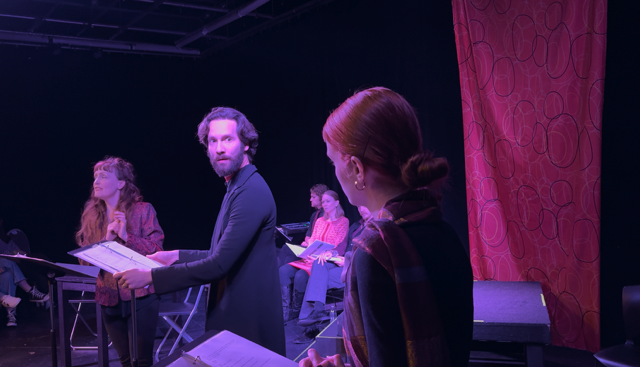
SALT LAKE CITY — One of the rare joys as a theatre critic in Utah is to see a work in progress. This weekend at Scaffold Theatre playwright Bradley Moss presented his first staged reading of a new play, Heretics, directed by Jennifer Kunz, and I was delighted to be in the audience. A historical piece that follows the events that lead up to the conviction and execution of Jacques De Maloy, played by Tatiana Christensen, the final grand master of the Knights Templar, and the muddy history that contributed to that part of European history.
Produced in a small black box theatre in the industrial west side of Salt Lake, a directed script reading is light on technical elements but this does not mean that it is light on entertainment value. Director Kunz has paid attention to many little details that made this evening more than a simple table read. Stage manager Garan Maughan was also quite the MVP, with the added task of reading the stage directions (something usually reserved for the rehearsal space) Maughan became a part of the performance as well as part of the production team. Maughan did not just read the directions, but let them be an integral part of the story, making up for the lack of set design, ability to enter and exit the stage, and gave needed context for much of the production that would have been filled in with a fully realized show.
Those unfamiliar with the process of playwriting might wonder the point of a staged reading rather than a fully devised play. On the night of the performance, there was also a talkback with the cast, director, and playwright, in which a key topic explained well the point of staged readings. After hearing the actors speak the words with movements, precision, actions and emotions, and seeing the audience respond, Moss expressed that he would be taking what he has learned and the feedback given to dig into another rewrite, and then hopefully move on to a fully staged version. It is so exciting that companies such as Scaffold take the opportunity to do staged readings, and those in the audience can then come back to shows like Heretics and see the progress from rough draft to finished product.
Another note gained from the topic was on the fantastic casting choices. Kunz discussed that Moss had stated in the script that while all the characters in the show are male, the parts could be played by anyone who fit. The cast was completely gender blind, and each choice was impeccable. Julie-Anne Liechty as King Philip IV of France has the strength and power to command a room with force, and paired often with Christensen’s more quiet yet stalwart conviction as De Maloy, they both were a master class in acting. There are several scenes where the two sit at a table, playing a game that is perhaps like chess or checkers, one cannot know without a set, but the level at which the two played their parts with such conviction, it was easy for me to forget they were reading scripts or playing without a set at all.
Winona Kasey played the interesting character of Guillaume de Nogaret, a figure I knew nothing about before coming into the evening, and her solid yet menacing persona had me so intrigued that I spent most of the intermission googling the historic figure trying to find the accuracy of the person, only to discover what was later confirmed in the talk back, which is that experts cannot agree on any of these men and their stories. Moss has done a great job of pulling together what might have happened, but as with any history, that is all we can do, speculate.
Morgan Gunter as Pope Clement V shows a very vulnerable yet fierce character in his portrayal of the spiritual man caught up in the challenges of the trials of the Knights Templar. In the scene of his promises to King Philip you see his battle with his desires to do the will of God and his desires for power. I was impressed yet again with the level of acting that was able to be done while holding scripts and without the aid of props, costumes, and all the other things we use to make a story flow. Rounding out the cast was Anton Moss as Hugues de Peraud, who also showed a great deal of fortitude in his ability to increase the emotional stakes with such limits. The cast rehearsed only three times before performing. Yet the story was deliciously dark, poignant, and thought-provoking.
Of course there is a lot to work on. With the first act already seeming a bit long, the fear of adding elements like set and transitions would only make it longer. At the same time, the choice of where the act ended, story-wise, seemed apropo, so playing with timing and flow seems in order. There is a question of if more cast might be appropriate, yet I truly did love the intimacy of the play. I think that even in a fully staged production, I would love to see a minimalist design, because the words and the deeds are what take center stage.
As someone who really loves history, I was surprised how much I did not know. I would assume this would be the case for most of the audience. It might be prudent to have a bit of explanation in the program for a fully staged production of the Knights Templar and King Philip and a bit of the history there. These are very small suggestions because of the nature of the evening. Overall, it was a highly delightful experience, and I hope to be in attendance when a fully staged version happens in Utah.
[box]Heretics played at Scaffold Theatre November 21 & 22nd, it has now closed. For more information, visit https://www.scaffoldtheatre.org/ .[/box]