


GSL FRINGE 2025 REVIEWS (Updated August 8, 11:05 pm — 13 total reviews)
SALT LAKE CITY — Each summer, the Great Salt Lake Fringe Festival transforms downtown Salt Lake City into a whirlwind of bold creativity, experimental storytelling, and theatrical risk-taking. Celebrating original works from local and visiting artists alike, GSL Fringe is a haven for boundary-pushing performances that thrive outside the mainstream. Whether it’s raw solo work, laugh-out-loud comedy, genre-bending musicals, or avant-garde movement pieces, the festival offers something unexpected and electric in every venue. This year’s lineup bursts with inventive spirit, and we’ve compiled reviews of each show to capture the pulse of this vibrant celebration of live performance.
To make it easy to follow the action, all of our Great Salt Lake Fringe reviews will be collected right here in one place. As the festival unfolds, we’ll be updating this post regularly with new reviews—so be sure to check back often! The newest reviews will appear at the top, giving you a fresh take every time you visit. Whether you’re planning your next show or just want to keep up with the buzz, this is your one-stop hub for everything Fringe.
[box] GREAT SALT LAKE FRINGE FESTIVAL Takes place at various venues in Salt Lake City on weekends from July 24-August 3, 2025. Single Show tickets are $15, a pack of 3 is $35 and a 10-pack of Fringe shows is $85. More information can be found online at https://www.greatsaltlakefringe.org/ or on Instagram @GreatSaleLakeFringe. [/box]
= 
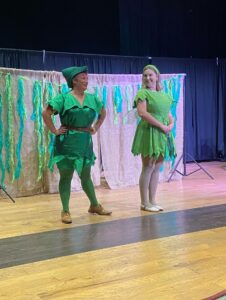
Hearts are Hooked by A BATTLE FOR NEVERLAND
Hook vs. Pan: A Battle for Neverland — Salt Lake Children’s Theatre
Hook vs Pan: a Battle For Neverland is a charming TYA play (Theatre for Young Audiences) that was performed by Salt Lake Children’s Theatre at Fringe Fest. It won the festival award for Best Family production, and for good reason. It is a show that is fun for all ages, but is especially magical for young children.
The forty-five minute long play, written and directed by Mindy Curtis, is a sequel to the beloved story Peter Pan and explores what Peter, Tink, Hook, and Smee are up to after the Darling children leave Neverland. After being banished to their ship, the pirates are trying to steal Pan’s treehouse, and Peter and Tink play lots of tricks on the sneaky pirates. It is a fun and upbeat story that is full of the familiar characters we all know and love, but is full of new adventures and pop-culture references. For example, there are pirate versions of “Hot To Go” and “Shake It Off”, and the pirates pretend to be everything from girl scouts to solar panel salesmen. This show will have children and parents alike laughing and involved.
A unique feature of this production was the large amount of audience participation, the children got the chance to be a big part of the story. Before the show even began, actors were walking around the audience giving people flags, a green flag for team Pan, and a pirate flag for team Hook, it was up to you to decide which team you wanted to join! Actors were constantly going in the audience to ask questions and ask for help. Children were invited up on stage to wave ribbons or play an instrument to help the characters fly, or invited up to help in a pirate scheme.
The small group of actors was perfectly suited for telling this story in this high energy and interactive way. Syd Peronnet had a chaotic and childlike energy in their portrayal of Peter Pan, and was paired perfectly with the sassy and fun Emily Tatum as Tinkerbell. On the pirate team, Zac Curtis was a flawless Captain Hook that was full of charisma, charm, and just the right amount of villainy. Paired with Hook, Jake Andersen’s Mr. Smee had impeccable comedic timing and brought a fantastic humor to the show.
This show is a perfect way to introduce young children to the idea of a play, and watching a story unfold live right in front of their eyes. As a service to the community, this is a free children’s show that will be touring to libraries, festivals, and other community events. If you have young children, or if you’re a child at heart, you will love this charming show.
— HANNA SCHNECK
Hook v. Pan Touring Production Dates/Locations after Fringe.
Sat. August 9, 11 AM – Anderson-Foothill Branch, Salt Lake City Library
Fri. August 15, 5:45 PM – Midvalley Performing Arts Center, (West Side Arts Fest)
Sat. September 27, 2 PM – West Jordan Branch, Salt Lake City Library
Wed. October 22, 6 PM – Herriman Branch, Salt Lake City Library
GONZO RISING is A Call Back to Classic Vaudeville with a New Age Twist
Gonzo Rising Fringe — Scixxy’s Greater Shows
Produced by Scixxy’s Greater Shows, Gonzo Rising is billed as a series of variety shows that are celebrating the strange and weird acts of Utah, and giving people stage time that might not have that time elsewhere. While I was able to get to a website and FB page of the company, I did not have a credited program to call out the players by name. I can say that these acts were strange and yet highly entertaining. The rating for this fringe show was the triple FFF, so it is for a more mature audience. Some of the highlights included the MC, a comedian named Andrea that kept the audience entertained in between acts and had a nice level of innocence about them, joking and laughing with the small mishaps throughout the night. One of my personal favorites was watching a makeup artist work in a small area of the stage, transforming another player into a horror figure before our eyes. Thie is an interesting display of talent, and not one that we get to see all the time. The intricate way that makeup can be made to change a whole persona, and being able to see the whole thing happen while watching a production was fascinating. I also really loved who they billed as their “resident songbird.” She sang two songs from Sweeney Todd, traditionally male, and she was able to really knock them out of the park. I was wishing I could see her play the full role. Another singer played guitar and sang a song that was an original, full of emotion and power. The night ended with a big of interesting comedy and sex education that was rather funny but did actually make me blush, which is not something that often happens.
The evening was an interesting way to look at how the vaudeville oddity show is done, and how it would have evolved if it were still the main source of entertainment today. I found it a perfect blend of interesting talent that fits the definition of fringe, while honoring the style of vaudeville. It incorporated the interests and styles of today, and made it a fun and fresh evening.
— MAREN SCRIVEN SWENSEN, PhD
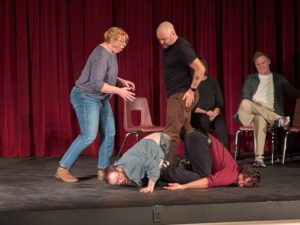
Improv Salt Lake Delivers Laughs to Last the Night
Improv Salt Lake Presents — Improv Salt Lake
Improv groups are a great deal of fun, and we would be remiss to ignore the city’s own Improv Salt Lake. So when I saw that they had a show at the Fringe, I was happy to let that be the final part of my Fringe experience this year. For those who have not had much experience with Improv groups, there are many different games that Improv troupes learn, so that they can practice and rehearse to get better at their comedy. However, when you see them in performance, they will not have rehearsed the exact things that you are seeing, hence the term Improv, or improvisation. The game the team did on the night I was in attendance was where the members would tell a story, and the other members could ask questions about the story, to get more from them about the story. Then the audience would vote to see if this story was truth or a lie. Afterward, the actors will work together to try and act out bits of the story.
What ensues is great comedy. The 6 members of Salt Lake Improv, who are not credited in the Fringe program, have truly built up the ability to share their comedy together. From reacting to the stories when they are being told, to the quick witted ways in which they are able to then find ways to share their stories through improv, and then how they add on to the humor together is absolutely wild and humorous. At one point several players were pretending to be Navy seals lifting a car out of a ditch, and at another point they were trying to be the worst person at a support group. And then there was a running joke about Panera Bread. In a world where often there really is not often enough to laugh about, this was really a great way to end the night, with a lot of laughter.
— MAREN SCRIVEN SWENSEN, PhD
Catch MY BROTHER WAS A VAMPIRE Before it Flies Away
[box] Editor’s note: Another UTBA writer also reviewed this production outside of fringe. See the review here. [/box]
My Brother Was a Vampire — Immigrant’s Daughter Theatre / Lil Poppet Productions
Immigrant’s Daughter Theatre, together with Lil’ Poppet Productions, gifted us the horror comedy we didn’t know we needed in My Brother Was a Vampire. This spooky and thought-provoking script by Morag Shepherd will be moving on to the Edinburgh Fringe Festival after completing its run in Salt Lake, so don’t miss your chance to see it!
With excellent relationship-focused direction by Stephanie Stroud, Vampire uses the mythological monster as a metaphor for everything we find wrong with ourselves, for everything we hate and love about ourselves and our closest family members.
Siblings Callum (Tyler Fox) and Skye (Ariana Farber) have a complicated relationship, to say the least–they bicker, they control each other, they judge each other, they sing together, they fly together, they support each other, they can’t stay together too long or something bad will happen–and it’s made all the more mysterious by Shepherd telling their story in reverse chronological order. Both actors give intensely layered performances as people in mid-life, then mid-twenties, and finally as children growing up in a household where violence and abuse happen.
Skye and Callum both speak of having bite marks on their necks, of surviving a monster, but there is always the mystery of how much of Skye’s powers are real, and whether Callum truly WAS a vampire. But the themes of addiction, abuse, survival, manipulation, love, of wounds that don’t heal but get worse over time, are all clear.
This production, meant for touring, is intimately simple with only two stools and two props. The sound design by Griffin Irish adds deliciously to the horror aspect, while the dance-like transitions and flying scenes choreographed by Meghan Durham-Wall bring whimsy to the otherwise dark scenes.
Those who enjoy well-crafted dialogue and expertly delivered lines should not miss My Brother Was a Vampire–its depiction of sibling rivalry and survivorhood will leave you thinking long after the last light has gone out.
— MANDI BARRUS

5² is Perfectly Irreverent Parody and Farce
5²: Twenty Five Plays in Fifty Minutes — Running With Scissors
The Running with Scissors Theatre Company has delivered a delightful and inventive experience at the Great Salt Lake Fringe Festival. The premise is simple yet engaging: five players—True Leavitt, Emily Tatum, Jordan Palmer, Katie Lobrot, and Akina Yamazaki—work from a list of 25 skits handed out to the audience. After each skit, the actors shout “next,” and the audience calls out which skit they want to see. A clothesline numbered 1–25 tracks progress, with the goal of performing as many skits as possible within 50 minutes. At the performance I attended, they completed an impressive 23.
Production-wise, there was much to praise. The sound design stood out, especially for a Fringe production where sound and lighting are often overlooked. Many skits relied on parodying popular shows, horror flicks, dating games, and more, making the sound and lighting integral to the humor and storytelling. Though no credits were given for these elements in the program, their impact was clear and effective.
The humor across the skits was consistently spot on. The Fringe rating system—from one F (family-friendly) to three Fs (Full-Fledged Fringe, roughly equivalent to an R rating)—was worth noting, as some skits leaned heavily into irreverent and edgy comedy. For example, the parody of Little Shop of Horrors was both hilarious and blush-inducing. Despite the edgy humor, the chemistry among the five actors created a warm and relaxed atmosphere. The show balanced prepared material with improvisation and audience participation beautifully.
I especially appreciated the clever titles like “Queer Eye for the Dead Guy,” which infused the show with just the right amount of dark humor. It provided a welcome relief from the stresses of daily life while delivering sharp, entertaining performances.
— MAREN SCRIVEN SWENSEN, PhD
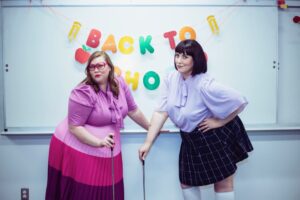
FAT is the Right F-Word in WELCOME TO FAT SCHOOL
Welcome to Fat School — Fat & More Than OK
Run (or walk, roll, or crawl—whatever feels best in your body) to Welcome to Fat School at the Great Salt Lake Fringe Festival.
Written and performed by Olivia Custodio and Kelsie Jepsen, this production is part TED Talk, part comedy sketch show, and all perfectly paced edutainment. The smart, snappy writing—paired with direction by Ali Lente—keeps the show moving with energy and impact.
Custodio and Jepsen (or Miss Olivia and Miss Kelsie, as they’re known in Fat School) are, by turns, bubbly, biting, and brilliantly authentic. They keep the audience laughing—and occasionally crying—as they myth-bust fatphobic beliefs, lead the class in a new mantra (“fat is not a bad word”), and guide their audience-students in reclaiming the word “fat” as a neutral, descriptive term.
Breaking the fourth wall, Custodio and Jepsen use thoughtful slideshows to explain the history and science behind fatphobia and body shaming in the U.S. Interspersed throughout are comedic sketches that illustrate the everyday discrimination fat people face—from biased medical treatment to public harassment and moral judgments based solely on body size.
Some of the most affecting moments occur when Miss Kelsie and Miss Olivia share personal stories of living in fat bodies. Their accounts of medical malpractice, assault, abuse, and their ongoing journeys toward self-love and body acceptance are deeply moving and powerful to witness.
But don’t think this is all “numbers numbers, boring boring” or a heavy-handed downer. Welcome to Fat School is hilarious. The quick pacing, clever audience interaction, and genuinely fascinating facts make this one of the most entertaining and thought-provoking shows at the 2025 Great Salt Lake Fringe Festival. A particular highlight was the list of ten action items Miss Olivia and Miss Kelsie offer to help their students continue resisting and navigating fatphobic systems.
If you are a person, living in a body, you’ll want to get to Fat School before the bell rings. Miss Kelsie and Miss Olivia will be waiting—pointers in hand—to welcome you.
— MANDI BARRUS
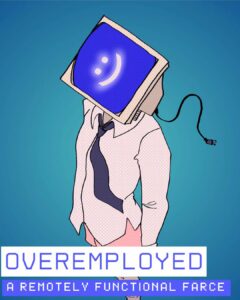
OVEREMPLOYED Gives Energetic Overwhelm
OVEREMPLOYED: A Remotely Functional Farce — Rambelotle
How do modern workers get by in today’s world? That’s the meaty question behind writer/director Rambelotle’s new play Overemployed. The story centers on Whit (played by Jovi Attridge), who begins another chaotic day juggling two full-time remote jobs—while also trying to ace an interview for a third. Fueled by energy drinks and desperation, Whit’s day quickly spirals out of control.
Whit’s best friend, Manny (Bryson Dumas), a warehouse worker, arrives with good news: his facility is on strike, and he has the day off. But rather than reconnecting with his friend, Manny becomes the audience’s voice, witnessing Whit’s increasingly wild scheming. Juggling alerts, devices, and ever-watchful corporate overlords powered by AI, Whit barrels forward, ignoring all sense and reason in his pursuit of financial security and workplace efficiency. Rambelotle’s bold writing debut explores pressing issues facing the modern workforce, including class solidarity, housing affordability, and corporate surveillance.
The five-person cast works hard to match the script’s frantic, farcical energy—necessary to highlight the absurdity of modern corporate life. Adding to that absurdity, the characters are named for their professional roles in a clever nod to medieval morality plays. Whit’s boss, Brand, tasks him with firing Margin, a fellow employee discovered to be secretly working a second job. The assignment forces Whit to confront his own hypocrisy and fear of exposure.
The set, designed by Mike Evans, cleverly depicts Whit’s tiny studio apartment, which doubles as a virtual workspace filled with remote meeting screens. The use of cardboard props for laptops and phones is a humorous and effective design choice. However, as the chaos escalates, the show begins to falter in clarity. In an effort to convey Whit’s mounting anxiety, Attridge rushes through otherwise well-crafted lines, often with a frozen, panicked expression that limits emotional variation.
As the play reaches its climax, the actors’ voices and sound effects rise into a cacophony of acronyms, pings, and buzzes—eerily familiar to anyone who has ever worked from home. Like a day full of Zoom meetings, the experience is by turns frustrating, humorous, and overwhelming.
Workers deserve more art that meaningfully engages with the absurdities of late-stage capitalism and the pressure it places on our everyday lives. Overemployed shows promise, and I hope Rambelotle continues to refine and develop this script for future productions.
— MIRANDA GILES
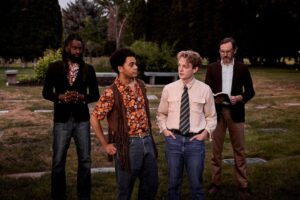
THE PRIESTHOOD takes Fringe attendees on a Beautiful Journey
The Priesthood — Mad King Productions
In collaboration with MadKing Productions, Carlton Bluford’s The Priesthood benefits from strong, smooth writing and clear direction by Bluford, assisted by Nicole Finney. The show’s refined writing and strong character development are likely the result of the workshops and readings it has received from Plan-B Theatre Company. The phenomenal acting is enhanced by the creative use of MadKing’s unconventional stage and the sound and costume designs.
The Priesthood follows two sets of fathers and sons in the 1970s. On stage left are Theo Lincoln (Jarvis Cullimore), the preacher at First Cavalry Baptist, and his son Adam Lincoln (Kaplan Keener), a pot-smoking young adult who visits his mother’s grave while considering his identity and values. On stage right are George Hansen (Tyson Baker), an LDS bishop, and Everett Hansen (Jordan Briggs), a young man recently returned early from an LDS mission who struggles with his father’s condemnation of Everett’s sexual identity. Adam and Everett meet at the graveyard, where each was seeking solitude and a place to consider their doubts, maturing identities, and values.
Over the course of months, the two young men learn more about each other and become friends. As Adam’s interest in the LDS faith grows, so does Everett’s disillusionment with the homophobia taught by his father and the Church. A sticking point arises when Adam’s father Theo tells him that Mormons are racist, and that Adam should ask Everett about “the curse.” When Adam confronts him, Everett explains that “the curse of Cain” prevents anyone with African blood from holding the priesthood in The Church of Jesus Christ of Latter-day Saints. Adam clarifies that if he joined the Church, he wouldn’t be able to receive the full blessings because of his lineage, and Everett confirms and agrees that it’s wrong. They continue to work through this conflict throughout the play.
The set at MadKing Fellowship Theater included two levels used by Bluford and Finney to reinforce the theme of symmetry and two forces learning to accept each other (family to family, father to son, religion to religion, racism to equal rights, homophobia to inclusion). The downstage level was the graveyard where Adam and Everett meet and begin to bond over their search for identity. It doubled as the homes of each family (the Lincolns on stage left and the Hansens on stage right). The upper level became, at different times, an LDS sacrament meeting, an LDS bishop’s office, a Baptist preacher’s office, an LDS baptismal font, and a gay bar. Although no costume designer or sound designer was credited, their touches were genius in communicating time and location (sound), and the subtle character changes as the two young men worked through their doubts (costumes).
The acting quality in The Priesthood is extraordinarily high. Baker, as the father George Hansen, brought weight and history to his relationship with Everett Hansen (played by Briggs in an immediately likable portrayal of a gay kid trying to follow every LDS rule). The two brought dimensionality to both sides of the charged issue of being gay in the LDS Church. Keener, as Adam Lincoln, was one of my favorite characters onstage. They brought a genuine openness to this jaded character and made me root for Adam to find peace within the LDS Church (even though that is a difficult sell for this reviewer).
Although slightly under the high quality of the rest of the cast, Cullimore as Theo Lincoln was nonetheless a commanding presence onstage, even though the first scene between Cullimore and Keener read more like a friendship than a strict preacher with his rebellious son. Cullimore’s energy seemed misplaced and lenient, mismatched to the text of that scene. However, he seemed to grow into the dominance of the character as the play progressed.
This play is a beautiful journey of people on opposite sides learning to hold space and respect for each other’s experience. As Bluford mentions in his director’s notes, it does indeed show us “many different points of view about life and religion and what it is to be human.” Audiences who value excellent acting, refined scriptwriting, and clear direction will enjoy this production, as will those who are interested in LDS history, social justice themes, and storytelling that leaves you with hope for the future.
— MANDI BARRUS

A HAIRCUT IN SLC is a Cut Above
A Haircut in Salt Lake City— Ricks/Bay Productions
A Haircut in Salt Lake City is a new work that had its world premier this weekend at the Great Salt Lake Fringe Festival. Written by local playwright, Max Ricks, it explores his personal experiences growing up gay in Utah’s church saturated culture. This heavy hitting subject matter was framed by a circumstance that will be familiar to many people: a conversation during a haircut. A young man named Bruce (played by playwright Max Ricks) nervously comes into a barbershop for a new haircut and discovers that he and his barber, Stevie (played by Autumn Bay), have more in common than they might have expected. Through a series of stories and questions, the two explore their personal queerness, complicated family relationships, and their upbringing in the Mormon church — all while Bay worked on Ricks’ hair.
This play was beautifully simple in how it told its story. Thirty minutes long. A chair and a block. Two actors. The play didn’t use any sound design, and only very minimal (but effective) lighting. More than anything, this play felt real. No spectacle or crazy drama, just two very real and complicated people having a conversation about their very real and complicated lives. The simplicity in the staging created the perfect avenue for a remarkably grounded and vulnerable experience. I frequently forgot that this was acting, because it felt more like a private peek into someone’s everyday life, this realism is a credit to both the actors as well as the writing. It felt very personal for this local audience, every mention of a local place, event, or common experience was met with laughter or nods of recognition.
This show is rated FF – Fairly Fringe-y (PG-13), due to its use of strong language and heavy themes. For local members of the LGBTQ+ community, and for those who want a better insight into the experiences of this community, this is a beautiful and impactful play that reminds the audience of the importance of sharing stories. “Even when things didn’t go well, we survived. We’re still here to tell our story. That’s enough, isn’t it?”
— HANNA SCHNECK
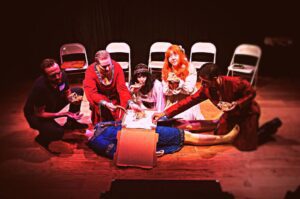
[box] Editor’s Note: By a happy accident, we had two reviewers cover The Rest is Silence. Both reviews are posted below. [/box]
Chaos Abounds in THE REST IS SILENCE
The Rest is Silence: A Support Group for the Dramatically Damaged — New World Shakespeare Company
New World Shakespeare Company’s production of Élise C. Hansen’s The Rest is Silence: A Support Group for the Dramatically Damaged suffers from disorganized writing but manages moments of brilliance.
Donuts. Coffee. Folding chairs. And a beheaded body dressed in Elizabethan garb—it’s another meeting of “The Support Group for the Dramatically Damaged.”
Audiences are met with confusion (perhaps intentional) at the onset of The Rest is Silence, and the characters onstage seem just as confused as the audience. Although they wear name tags, it’s difficult to read the characters’ handwritten identities. Even once we hear their names, it remains challenging to determine from which of Shakespeare’s plays they’ve sprung, as their costumes appear modern-day. “Why are we here?” they ask—seemingly a pretext for Hansen to quote Shakespeare’s best lines on existentialism and to veer into Waiting for Godot-style ennui.
Although the plot is muddled and unclear in the first act, there are beautifully written and acted moments. One standout was Perdita’s (Cami Rozanas) monologue about her violent upbringing. “I felt like no more than a concept,” she tells the audience, breaking the fourth wall. “I was just a prop in someone else’s happy ending.” These moments of specificity allow the audience to connect with a character written over 400 years ago, aligning with New World Shakespeare Company’s mission to make classical characters resonate with modern audiences.
The second act is far easier to follow, thanks to costumes (by Mandi Titcomb) that define the characters clearly and more recognizable characters stepping onstage. For example: Romeo appears in his doublet, Cleopatra in a black wig and gold sandals, Lady Macbeth in tartan with blood-stained hands, and Ophelia in a white gown, submerged in a kiddie pool. This act especially shines during scenes featuring Horatio/Hamlet (Zachari Reynolds), where all five characters serve as metaphors for forgotten and unseen survivors of violence.
Each actor played two roles, and their physicality helped define and distinguish their characters. Bianca’s (Mandi Titcomb) cocked hip, Perdita’s (Rozanas) skirt-swirling, and Edgar’s (Jaxton Romeo Brenner) inability to sit in a chair like a normal person were especially effective. Credit goes to director Blayne Wiley for encouraging such clear, differentiated performances in an otherwise chaotic narrative.
Are you a fan of support groups? You might miss the structured rhythm of an AA-style meeting, but you may enjoy this more chaotic and theatrical take. Are you a Shakespeare fan? You’ll appreciate the in-jokes, quotes, and relationship dynamics among some of the Bard’s lesser-known characters. Give The Rest is Silence a whirl—but don’t be surprised if you find yourself needing to exit, pursued by a bear.
— MANDI BARRUS
The Rest is Silence: A Support Group for the Dramatically Damaged-Theatrical Therapy
A theatre critic therapist naturally had to go to a fringe production of group therapy for characters from Shakespearean Plays. Produced by the New World Shakespeare Company, written by Elise C. Hanson and directed by Blayne Wiley, this show follows a fascinating look into the psyche and trauma of those who grace the stages of the stories we know so well.
Hanson’s story is fascinating in many ways. The first act consists of some of the secondary characters of Shakespeare. Horatio, played by Zachari Renolds, serves as a mediator for the others. Jaxton Romeo Brenner plays Edgar from King Lear, Hanson as Queen Elizabeth I (Bess) from Richard III, Mandy Titcomb as Bianca from Othello, and Cami Rozanas as Perdita from Winter’s Tale. The second act has the same players step into larger characters, Hamlet, Romeo, Ophelia, Lady MacBeth, and Cleopatra. The amazing way that both the writing and the players dig into the nuance of mental health and trauma was intriguing. For instance, Hanson as Bess was regale and elegant yet with an air of aloof feelings repressed, while Hanson as Ophelia was childlike and wistful, as if the world was stolen away. To see such a change of character happen in mere moments was a beautiful display of acting prowess. Brenner as Edgar appears lost and confused, while his Romeo appears arrogant and unfulfilled. Titcomb’s Macbeth shows supreme understanding of trauma with her portrayal of Lady MacBeth.
One of the best lines of the show was “What is disorder but an evolutionary mismatch to society.” When watching mismatches of these characters and their stories, yet their need to discuss their traumas and experiences remains the same.
It is not uncommon to look at the characters of Shakespeare and give them new life in another realm. Rosencrantz and Guildenstern gained a famous story of their own at the Edinburgh Fringe many years ago. I appreciated the program provided many links to mental health resources that may be needed. I love the idea of providing stories and life to characters that were sidelined. I also love looking into the traumas and healing of everyone, including Shakespearean characters.
— MAREN SCRIVEN SWENSEN, PhD
RESURECTION MEN Raises Important Questions
The Resurrection Men — Gray Matter Theatre
The sound of digging in a graveyard in the middle of the night is not likely to put anyone at ease, but it’s a solid opening moment for Nicholas Dunn’s new macabre comedy about grave robbing. Like the gravediggers in Hamlet, Dunn and his foil, Matt Whitaker, make a compelling comic duo as two down-on-their-luck Dickensian schemers hoping to make quick cash in the “resurrection” business. With new scientific discoveries fueling a black-market trade in fresh bodies, Hatt—a cynical veteran of Waterloo—and Fitz—a softhearted, desperate father—see an opportunity. The law only permits the use of executed criminals for dissection, but with “convictions in short supply,” resurrection men are called in to meet the demand.
Dunn’s clever dialogue and tight pacing keep the humor and pathos moving at an excellent clip. Audiences may find themselves rooting for these two ne’er-do-wells to succeed in their unsavory venture, even as deeper themes of spirituality, survival, and class emerge. Dunn’s writing is at its best when a third character, played superbly by Sara Ragey, enters the scene and complicates the relationship between the grave robbers.
The production’s strength lies in its simplicity. A few well-chosen props and clear costuming choices support the actors in telling the story. The minimal set—a simple open grave—could easily be adapted for a trap door stage. The use of darkness as a force within the world of the play is highly effective in setting the tone and building tension.
As the conflict between characters becomes increasingly fraught, the audience is left to wrestle with difficult moral questions. As the saying goes, “There is no honor among thieves,” but more pointedly: if a thief could afford honor, would he still steal? What laws—of God or man—would you break to feed your hungry child? How do we weigh the grief of one family’s loss against the potential to save many more lives? As one character states, “Laws and morality aren’t always aligned.”
This production is a fantastic treat for anyone interested in the power of intimate theatre, the talents of a local creative team, and an hour of darkly comic twists and moral turns that will leave you wanting more.
— MIRANDA GILES
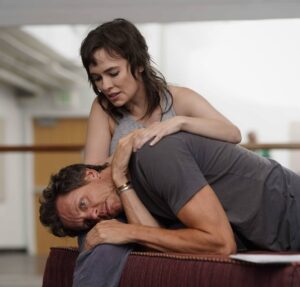
THE WORDS AT THE DOOR Reveals the Writing on the Wall
The Words at the Door— Sackerson
Sackerson’s The Words at the Door packs an emotional punch. Written by Jesse Nepivoda, the production follows the relationship of two lovers from beginning to end through a series of flashbacks.
The movement work in the production—directed by Matthew Ivan Bennett—is a mix of realism and stylized dance. The realistic moments effectively communicate the characters’ emotional journeys, while the stylized sequences, though visually striking, sometimes muddle the clarity of the storyline.
The play begins with a simple premise: in the first flashback, Girl (Kristina Shearer) meets Guy (Jason Hackney); they share an intimate first date, smoke a joint, and begin a relationship.
But the relationship is foreshadowed to end in tragedy. Ominous bass vibrations in the sound design and eerie red lighting set the tone. The Girl tells the audience she is reaching for memories “like stars from the sky,” but admits that some are better left forgotten. Over the course of the piece, we learn that the Girl is a driven ad executive, and the Guy is an artist who lives off his wealthy brother’s generosity.
Upon entering the performance space, the audience must walk around an actor lying halfway in a bathtub—a striking image that becomes symbolic throughout the production. The tub represents both safety and escape for the Guy. In one key flashback, the Girl comes home from work to find the Guy sitting fully clothed and dry in her tub after a difficult day. She invites him to move in, and he tentatively agrees. She joins him in the tub, and he warns her that he has something to share—something that might make her reconsider. The secret he reveals becomes the catalyst for the unraveling of their relationship and ultimately leads to his death. These are “the words at the door”—what the Guy calls “the writing on the wall that everyone knows is there, but no one wants to read.”
This production contains themes that may be triggering for some viewers, particularly those who have experienced loss due to mental health crises or who are navigating their own mental health journeys. However, many may also find it cathartic. The Words at the Door is worth seeing for its emotional intensity and the closure it offers through the honest, painful story of two people learning to confront what was always waiting to be read.
— MANDI BARRUS
The following shows did not receive a UTBA review:
PARK BENCH ROYALTY — Salt Monster Theatre Co.
Ants Go Marching — Pendulous Productions **This show drew reviewer interest but due to an unexpected conflict, it was not reviewed**
Second Grade Problems — Cache Dexter
Juan Jose and the Deathly Vatos — Plan‑B Theatre Company
To Be Frank… — Salt Lake Community College
Book of Ego: A Sacred Parody — Irene Loy
Still Life… (by Beth Anne and Tami) — company: Beth Anne and Tami
Puppet Up! Puppet Karaoke — Puppets in the City
As reviewers are able, other shows will be added to our pool of reviews.