

LOGAN — When Paige Monson walks into a theater — or any public space, for that matter — she isn’t simply taking in the ambiance. She is running a quiet checklist: Where is the signage? Where are the wheelchair ramps? If I need to leave how do we get out? It is a habit she developed not in a classroom, but at home, starting around age eleven, when she began helping care for her father, a disabled veteran who uses a wheelchair and lives with a traumatic brain injury.
“I’m just used to walking into a space and seeing how it doesn’t work for people,” says Monson, a Caine Scholar for Excellence at Utah State University who is days away from completing her undergraduate degree in interior design. “Ability is such a temporary thing anyway. Everybody is going to experience disability in some form in their life. So I don’t understand why we don’t just design spaces with that in mind.”
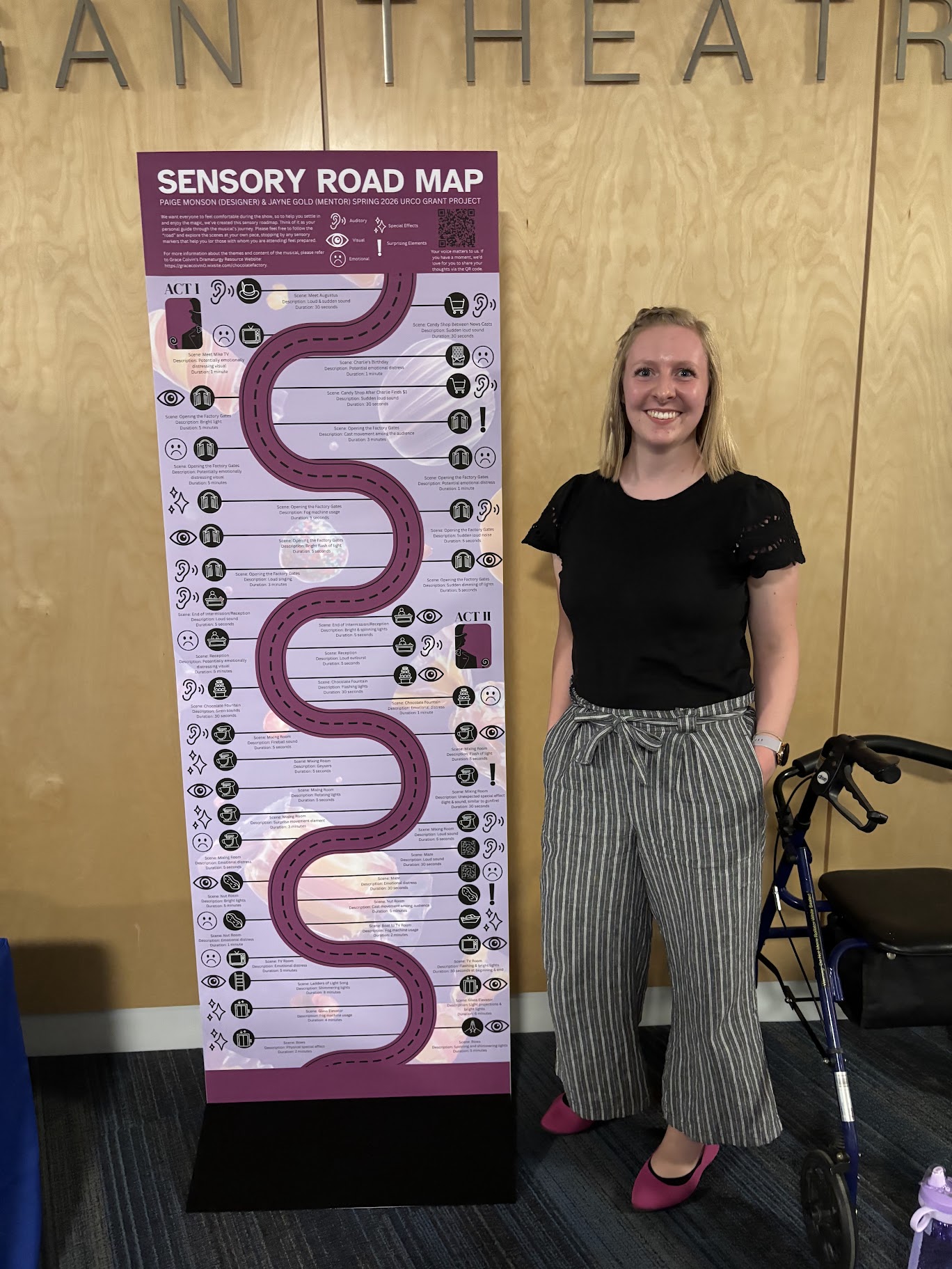
That philosophy has driven Monson to do something that, remarkably, few in Utah’s performing arts community do. She created a practical, repeatable tool that gives audiences detailed sensory information about a live production before they walk through the door.
A Road Map for the Senses
The project, developed through an Undergraduate Research and Creative Opportunities (URCO) Grant from USU under the mentorship of Dr. Jayne Gold, resulted in what Monson calls a Sensory Road Map — a visually clear, easy-to-read guide that tells prospective audience members what sensory elements they can expect during a specific production. Think of it as a parent’s guide for live performance: strobe lights in Act Two, fog machines during the opening number, a sudden loud sound effect in scene four.
“With movies, you can look up reviews, you can see a parent’s guide, you can watch trailers,” Monson explains. “With live performances, that usually doesn’t happen. The sensory road map tries to fill that gap — providing information about unexpected elements without giving away the plot.”
The tool was built with a wide range of people in mind. Audience members with epilepsy, sensory processing differences, autism, anxiety, chemical sensitivities, or chronic migraines all stand to benefit — as do caregivers who need to make quick decisions about whether a show is right for the person they support. Monson, who also experiences migraines herself, designed the map to be scannable at a glance. “If I’m pushing someone in a wheelchair into a space, I already feel rushed. I already feel like I’m in everybody’s way. I wanted the road map to be really quick and easy — just get it.”
Starting with Empathy, Not a Sledgehammer
One of the most striking things about Monson’s work is its practical appraoch. She isn’t asking theater companies to gut their historic buildings or rip out decades-old seating. She’s asking them to provide information.
“Once the space is built and you can’t change it, there have got to be different ways to make it accessible without changing physical elements,” she says. Her research focused specifically on existing venues — spaces where a full renovation is impossible — asking the central question: how do we incorporate inclusivity into already-built spaces through information and wayfinding?
To build the map, Monson drew on research about sensory design, studied existing sense maps developed for hospital environments, and — critically — went directly to the communities she hoped to serve. She conducted surveys and interviews across a variety of populations to make sure she wasn’t projecting assumptions onto people’s lived experiences. “My lived experience is as a caretaker, and that’s going to be different from someone who is living with those different needs,” she says. “I wanted to make sure I wasn’t making any assumptions.”
The actual process of creating a road map for a production is far simpler than it sounds. Monson attended the final dress rehearsal for a USU Theater production of Charlie and the Chocolate Factory and catalogued every sensory element — unusual sounds, lighting effects, fog, anything out of the ordinary — noting what it was, when it happened, and how long it lasted. “It sounds a lot more challenging than it is,” she says. “You’re watching the play all the time when you’re rehearsing and when you’re directing it anyway. It’s really simple to just make a few notes.”
A Template Built to Last
Monson is candid about one of the biggest barriers to inclusive practice in performing arts: it feels new, and anything new feels hard. To address that, she created a fully editable template that USU’s theater department can use for every future production — no design degree required. “I’ve created a process to remove that barrier for them,” she says.
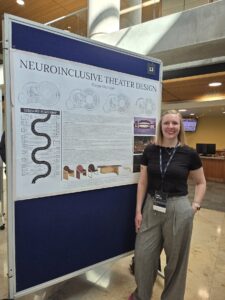
She presented her research — including the Sensory Road Map template — at USU’s Undergraduate Spring Research Symposium on Neuroinclusive Theater Design. The research is forthcoming in the Curiosity Journal, a publicly available publication. Monson is also working with the university to explore publishing the template on a dedicated website, making it available to theater makers beyond USU.
Her message for theater makers who feel overwhelmed by where to start? Begin with a single walk-through. “With anything with inclusive design, you have to start with empathy,” she says. “Walk through the production or the theater space during rehearsal and think: how might this be for somebody else? That automatically will show you a lot of ways you can help make it more accessible.”
What Comes Next
In just a few days, Monson will graduate and move into the next chapter: seeking a position at a commercial interior architecture and design firm in Utah, and beginning a graduate architecture program this fall. She hopes to carry her inclusive design lens into every project — spaces that work better for people who navigate the world differently, and by extension, for everyone.
“If we change the policies and design of spaces to work for people who are disabled, then it works better for able-bodied people as well,” she says. “There’s no reason to keep marginalizing people.”
For theater companies interested in implementing a Sensory Road Map, or for anyone who wants to learn more about Monson’s research and resources, she welcomes outreach.
Contact Paige Monson: paigemonsondesign@gmail.com · LinkedIn: paige-monson-7b39152a5