

MAPLETON — One of my favorite things about the story of Cinderella is how it consistently has a new start – and it’s never on the same foot. At first, things couldn’t be more idyllic for her with a wonderful home life and loving parents. As things change, they would struggle to be much further apart due to neglect and mistreatment, but her perseverance keeps hope alive until she’s able to find her happily ever after.
Mapleton Community Theatre’s first production, Rodgers & Hammerstein’s Cinderella: Enchanted Edition, got the company off on the right foot to begin with. Director Kristina Holley’s note discusses the magic of a community that rallies around a great idea, and watches beautiful things happen, and the show as all the trimmings and trappings of a lovely show.
Immediately, the cast visually felt like the kind of community that carries such magic. In the opening number after the introduction, Simple flats, rolling carts, and a myriad of engaged actors of all ages filled the stage as Ashlee Riggs, playing the step mother, leads her own charismatically aloof daughters Grace (played by Alyssa Stansel) and Joy (Emma Ashby) through town seeking to dwindle the fortune they have already squandered so much of.
From both an ensemble acting and design perspective, the show was on point. Actors had crisp assignments and clear goals, muted conversations felt engaging and fun rather than over the top and caricatured. Overall, the cast excelled in doing what Holley’s note intended, “keeping the focus where it belongs—on Cinderella’s journey.” The ensemble did a lovely job of creating a world that was alive but not distracting from the journey of the central protagonist.
Paige Nelson played Cinderella, and had a clear, bright sound to her singing voice that matched the optimism of Cinderella well. That gentleness carried through to the acting and brought out a good-natured and kindly Cinderella that made her easy to root for. A few moments, Nelson found another element to Cinderella, such as when singing “A Lovely Night” with Joy and Grace. There was a more excited energy of a girl who had things to say and a mind full of wonder that was a lovely change of pace later in the show.
I’d have loved to see a little more dynamic interaction from those that played directly across from Nelson in a couple of instances. Samantha Parks played the Fairy Godmother, and while she had a lovely dynamic range, and received raucous applause throughout the show, it felt like Nelson and Parks didn’t have on-stage chemistry. When Godmother tells Cinderella her dreams are nonsense, there’s a level of interplay and subtext that needs to draw the conversation into a more complex area. It didn’t always do that, and it instead felt as thought the Godmother simply changed her mind about withholding magic instead of teaching a deeper principle. Independently, Parks was a strong performer and narrator, but the interplay wasn’t there. Similarly for Joshua Craft as Prince Christopher. Craft had a strong vocal range and was a solid dancer. However, he tended to be overpowered by stronger personalities on stage rather than finding what drove him to seek for love in his own way. When interacting with Cinderella, their mutual sweetness and compatibility was nice, but there wasn’t an urgency in the characters at times.
By contrast, the step sisters were more concrete in their relationships to Cinderella and one another. In particular, Ashby’s highly expressive face as Joy was a delight throughout the show. The reactions she gave were consistently nuanced and fun to watch, and her envy of Cinderella was incredibly clear without being poisonous. She simply read as unhappy and not as conniving. Stansel’s grace was a little more subdued until she took off her wig after the ball. This small change seemed to liberate her and bring some greater energy to the performance that crescendo for the three sisters as they reminisced about the evening’s events.
The ensemble characters were clearly identifiable through strong traits that they portrayed in complimentary ways. Riggs’ portrayal of the stepmother was defined by a playful edginess that had notes of Bernadette Peters in it without copying that performance. Lionel, played by Michael Pulsipher, was a delightful busybody. Pulsipher found moments to show both the character’s irritation and at times his more thoughtful and caring side. Daniel Reese’s King Maximillian was a dry wit with his almost blasé disinterest in the battle between his wife and child. However, the ensemble role that stood out the most clearly was Queen Constantina, played by Maggie Gillespie. In the role, Gillespie found nuance and thoughtfulness to the relationship with her son. Instead of a slapstick browbeating, Gillespie found ways to make her barbs land and her reactions sincere in a refreshing performance all around.
Emily Goates’ choreography served the cast well. Community theatre productions bring out a wide range of dancing abilities, and Goates planned and helped the cast execute dances that were simple enough to be performed well and complex enough to add interesting visual layers throughout.
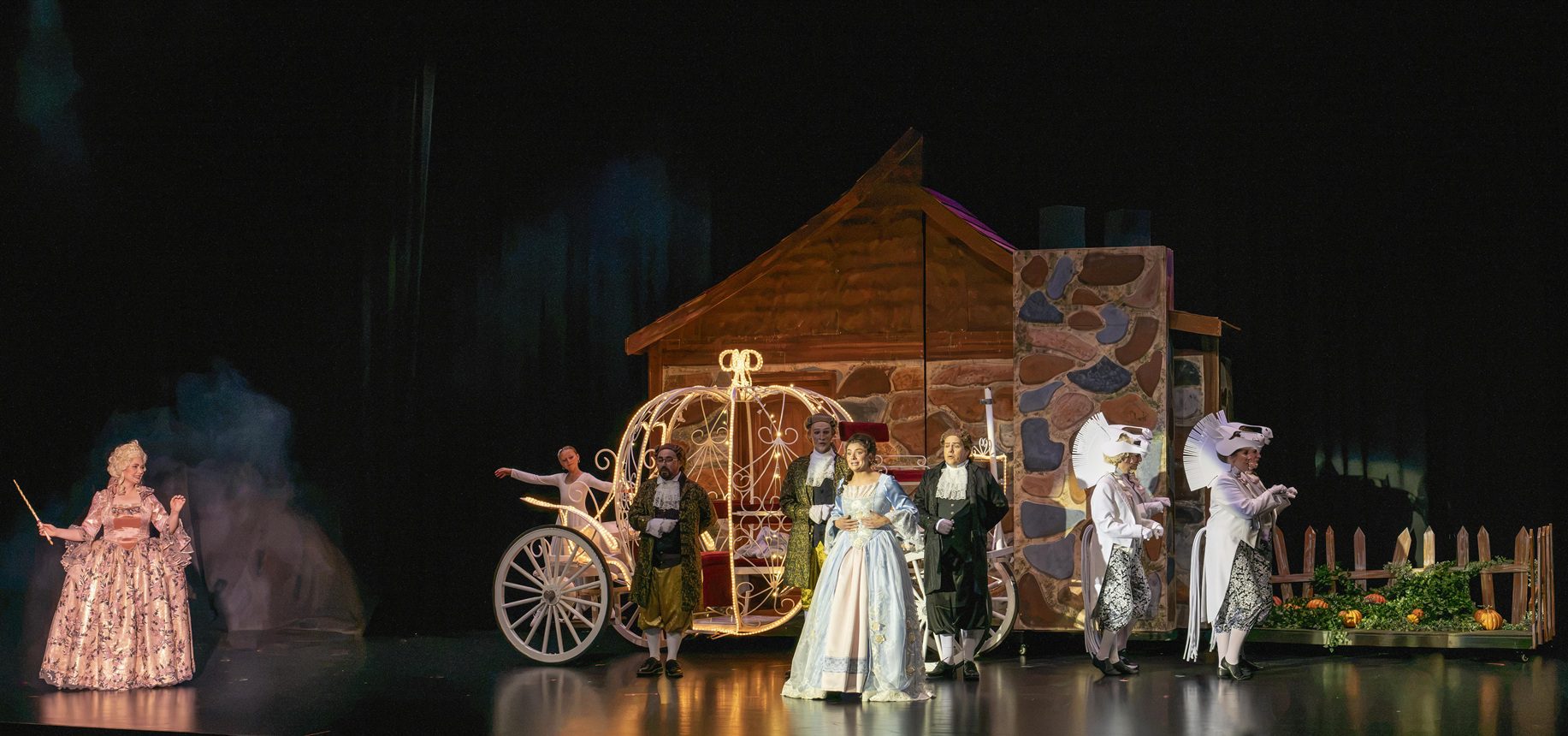
Costumes from costume manager Rochelle Zibetti were exceptionally good. For the volume of costumes, and changes, that needed to happen, the show’s visual palette was immaculate, and the costume work helped transport the audience between locations all the time. Adorable child ensembles playing farm animals, elegant ball gowns, and a visually striking transformation for Cinderella from pink to blue all accentuated a wonderful design that elevated the production well. Strong work from the lighting, props and set teams created a lovely world for this production of Cinderella. Perhaps at no moment was this more true than with the stunningly beautiful carriage transformation for Cinderella including some very clever white horses transformed from white mice.
There was only one technical element that seemed discordant at times was the sound design. The actual effects and music, as well as balancing were overall excellent work from designer Colton Purcell. However, there seemed to be areas of vamping where either tracks were running long or actors were missing cues. For the penultimate performance of a community theatre production’s inaugural show, this didn’t create huge misses and it’s a nit to pick at what was overall, a nice show. These were also largely ironed out in the second act where pacing and energy were at a high level. However, in act one, there seemed to be uncertainty between the two elements that led to slow paces and dampened energy.
This production has already turned back into a pumpkin, so Mapleton adjacent audiences who missed this first show are going to be left cursing with their Folderol and fiddle-dee-dee until the next production comes along. MCT certainly got off on the right foot, and I look forward to more lovely nights from Utah’s newest community theatre.
MORE INFO: Rodgers & Hammerstein’s Cinderella: Enchanted Edition plays June 18–22 and June 25–27, 2026, as the inaugural production of Mapleton Community Theatre, a program of Mapleton Parks and Recreation. Performances were held at Maple Mountain High School Auditorium (51 N. Spanish Fork Parkway, Spanish Fork), with 7:00 PM performances on June 18–20, 22, 25, and 26, and a 2:00 PM matinee on June 27. For more information, visit Mapleton City’s Community Theatre page or the Stride Events listing, or follow @mapletoncommunitytheatre on Instagram.