

I made up a saying decades ago: B.C.M.I.B. “Beethoven Can Make It Better!” And indeed he can.
Utah Opera’s current offering is Beethoven’s only opera: Fidelio, first produced in 1805. Beethoven’s life, and music, may sometimes be called “tortured.” Marked by profound struggles, his most devastating challenge was progressive hearing loss beginning in his late twenties, eventually leading to near-total deafness. For a composer and pianist, this was catastrophic. The Heiligenstadt Testament, a letter Beethoven wrote in October 1802 addressed to his two brothers, Carl and Johann, which he never sent, reveals his despair and suicidal thoughts during this period, though he ultimately chose to live for his art. And thank heaven he did!
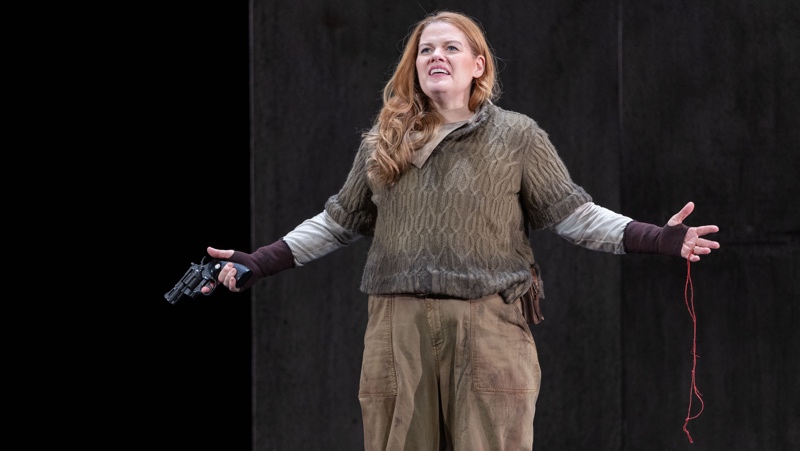
Fidelio tells the story of Leonore, who disguises herself as a young man named Fidelio to work at a prison where her husband Florestan is secretly imprisoned by the tyrannical governor Pizarro. Florestan, a political prisoner, is left to die in a dungeon. As Pizarro plans to murder him before a minister’s inspection, Leonore intervenes at the crucial moment, revealing her identity and protecting her husband at gunpoint. The minister arrives, exposes Pizarro’s crimes, and frees the prisoners. The opera celebrates marital devotion, freedom, and justice triumphing over oppression and tyranny…but most of all it celebrates LOVE!
Dressing up a woman to pose as a boy, or better known in opera as the “pants part” or “trouser role,” has been a tried and true theatrical device in opera and theatre for centuries. Shakespeare used it, French farce used it, Mozart used it. And in more contemporary stories, the movie YENTL used it. It’s always fun, effective, and, at times, a bit heart-wrenching, as there is always a young woman who falls for the “male” version of the “pantsed up” heroine. And indeed, that happens in FIDELIO, as the young Marzeline, falls head over heels in love with Leonore’s male persona, Fidelio.
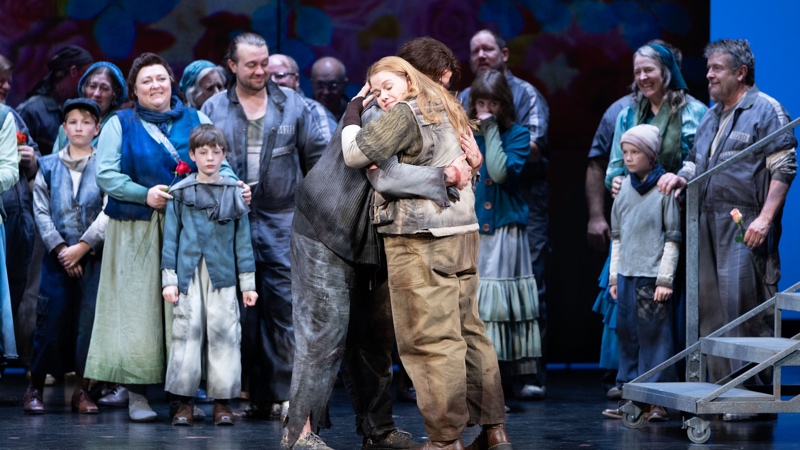
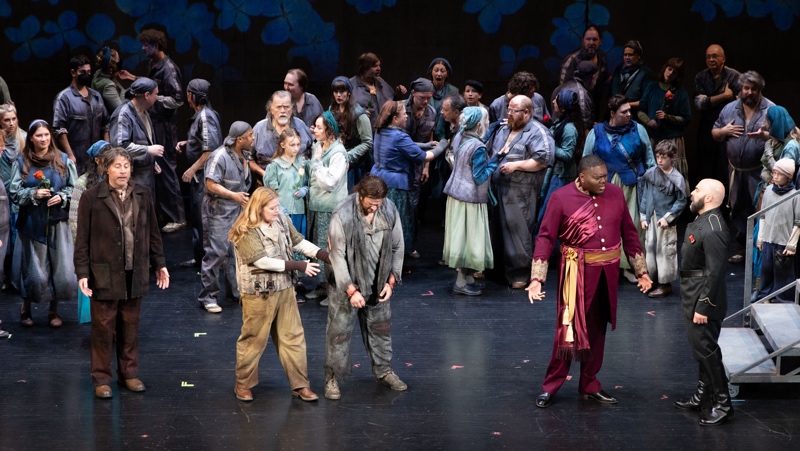
Utah Opera’s new production of FIDELIO is superb, from its brutalist sets echoing the worst gulags, to its proletariat costumes that seem right out of Joseph Stalin’s closet—masterfully and finely constructed by costume designer Fan Zhang—to the lush voices that turn the brutalism into sheer joy. The structure of the opera itself is surprising. In 1805 the music world was just coming out of the classical era into the romantic, and the opera reflects that transition. Set in an oppressive prison with a tyrant as it’s commandant, act I, scene 1, is light and almost comedic, reminiscent of Mozart or Rossini. Then, act I, scene 2, introduces us to the inmates of the prison, unjustly and cruelly treated. The tone changes and becomes darker. We see in the prisoners’—who have been allowed outside for just a moment to see the sun and breathe the fresh air—misery and pain as they long for freedom. Then in act II, scene 1, we dive into the bowels of the prison, the deepest, darkest region, where Leonore’s husband, Floristan, has been banished and forgotten. All lightness and hope are gone. We are like Orpheus descending into hell. In act II, scene 2 we emerge back into the light, and love has triumphed.
The direction and opera concept were perfectly executed by director Tara Faircloth. She was able to balance the harshness of the plot with the love and hope felt by Leonore skillfully so that the production never became oppressive to watch. She also expertly balanced her concept so that it didn’t overpower the humanity of the characters or themes of the show. It didn’t become a show about the concept, which is boring at best. It remained a show about the characters, which is moving.
One artistic choice that Ms. Faircloth made in the production is the insertion of a woman in white she named, “The Oracle,” played regally by Sharlene Wells. Throughout the production The Oracle “oversees” and weaves in and out of the action, commenting on it through exquisite poetry and prose by Edna St. Vincent Millay, Nelson Mandela, Viktor Frankl, and others. At first I was irked and wondered why they would interrupt the flow of this well-crafted opera for a “concept” of commentary. Then, amidst the stark differences between the drab and dirty prison/prisoners and the woman in white, the reason became clear: a timely observation of freedom, tyranny, justice, and love. It was quite brilliant.
Credit must also be given to the rest of the creatives: lighting by Eric Watkins, who threw shadows onto the concrete walls to make them appear like communist posters; projection designer, Sarah Tundermann, who kept a beautiful, subtle movement going throughout the production; and wig and makeup designer Kate Casalino.
Central to any opera—and frankly, the reason to go—are its singers, and the collection in Fidelio are breathtaking. From the first note to the last, they hook your heart and never let go. Marzelline, played by Stephanie Chee, and Jaquino, played by Aaron McKone (who unfortunately was sick and walked his part while another singer sang, very well, for him stage right) did a great job as the mismatched young people: Marzelline in love with Fidelio and Jaquino in love with Marzelline. Raymond Aceto, as Rocco, Marzelline’s hapless father, who does the evil Pizarro’s dirty work, was excellent, with a rich voice. He walked the tightrope between the needed comic relief and enabler of a tyrant. Rodney Sharp II, as Don Fernando, the minister of state and the prisoners’ rescuer, has a clear tenor voice. Then there’s Zachary Nelson, who played Don Pizarro so well you wanted to “boo” him off the stage. Sublimely nasty, with a full-bodied, thundering bass voice, he was the perfect “bad guy.”
But the enthusiastic kudos must go to Thomas Kinch as Florestan and Wendy Bryn Harmer as Leonore (Fidelio). These singers are the driving forces of the production. And what forces they are.
Mr. Kinch is one of the best tenors I’ve heard on the Utah Opera stage. The clarity and power of his voice is astonishing. He opens Act II—a solitary figure in a massive and stark dungeon—and sings, “Gott! Welch Dunkel hier!” (God! What darkness here!) with such power and pathos that the audience can’t help but pity and root for him.
However, the star of the production is Ms. Harmer, as the title character. She has a resonant and soaring mezzo-soprano voice that shakes the chandeliers! Rich and emotive, and able to pierce through and rise over orchestra and chorus. Her performance is truly stunning and worth the price of admission.
But what is most important are the last words of the opera: “Love has saved us!” So true. And it’s the only thing that can. Go and see it!
[box]Utah Opera’s production of Fidelio, plays at the Capitol Theatre, 50 W 200 S, Salt Lake City, Utah, January 17 & 23 at 7:30 PM, January 19 & 21 at 7:00 PM, and a matinee January 25 at 2:00 PM. Ticket prices are $23.50 to $112.00. For additional information, visit utahopera.org.[/box]