

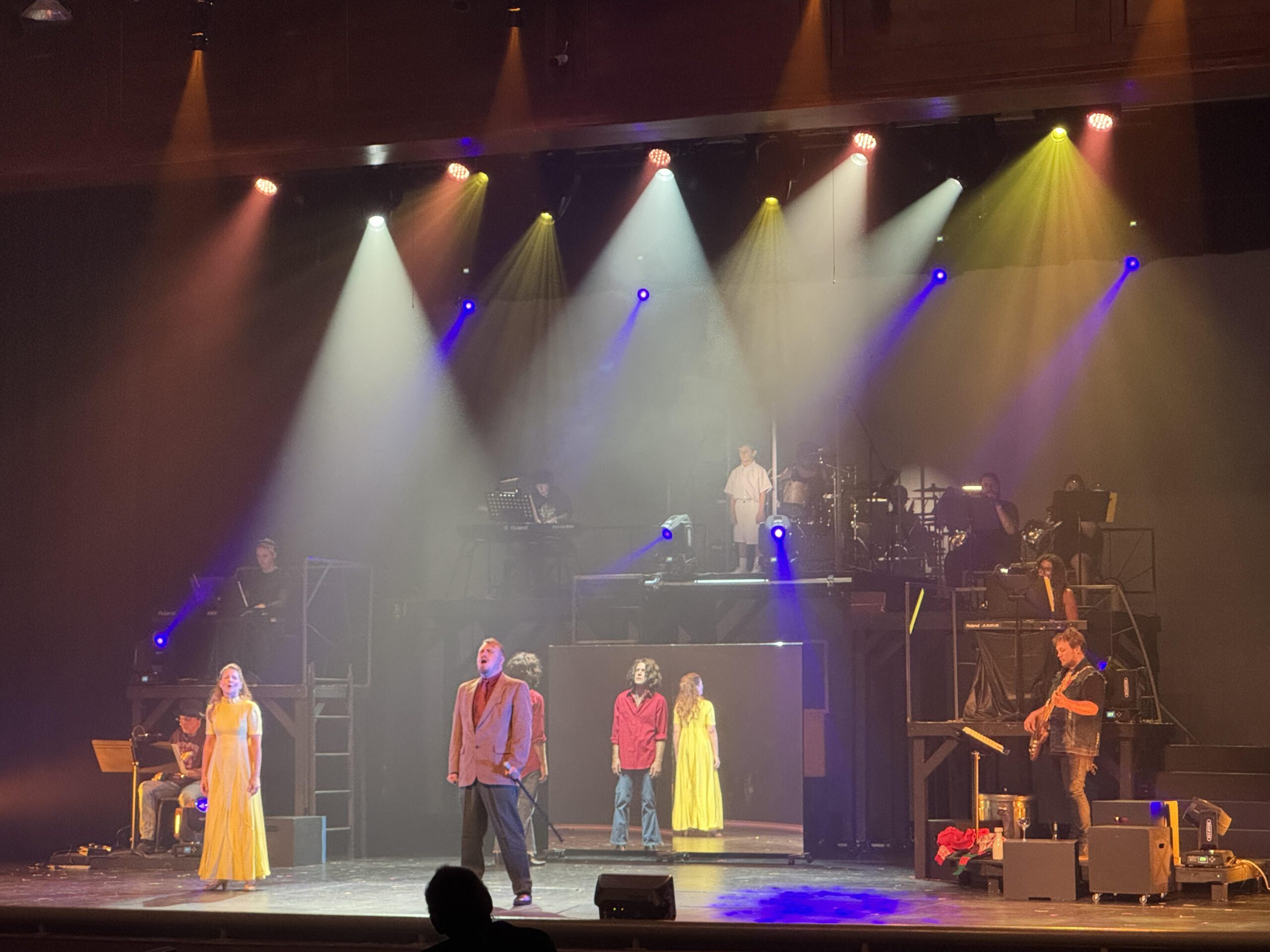
CEDAR CITY — Jukebox musicals are easy to conceptualize, harder to create, and exceptionally difficult to do well. The concept is easy. Take songs that were created independently and structure them so as to tell a story. This has been done for centuries with songs of the age woven into productions. Making it still requires a creative team to develop a cohesive plot, characters worth thinking about, and connected tissue of design to make it all work together. Pete Townshend of British rock band The Who originally devised the concept album in the late 1960’s. Which was adapted into a movie in the 1980’s and a stage musical in 1992. As an appreciator of the form, I was thrilled with the chance to see it come to Utah in Cedar City’s hidden gem, American Crossroads Theatre (AXR), formerly known as Simonfest. The rechristening of the theatre is new this year, and I love the Americana feel of the season, even if two are heavily British productions (Chitty Chitty Bang Bang and Tommy).
The set is centered on large mobile mirrors that allow the audience to see themselves in Tommy which is a crucial part of the storytelling. These are surrounded by a multi-tiered orchestra set up that gives space for 2 guitarists (Stan Szczesny lead, John Blasko 2nd), a bass player , 3 electric pianists (Sally Hunter Jensen, Kipper Roach, and Tamara Reber), a french horn *Camille Overson) and a drummer (Dan Fowlkes). This live band was exceptional all around as many sang through the show, and all brought the house down with rock..
Tommy’s concept album and musical are both centered on the idea of a young Tommy Walker who becomes a “deaf, dumb and blind kid” after witnessing a traumatic event. In the stage version, this is all done through visual storytelling set to music of the “Overture”. Here’s everything you see in that sequence.
In England, 1940, Tommy’s father, Captain Walker (Taylor Wilkes) is a soldier being shipped out shortly after learning his wife is pregnant. He flies to war (in a fantastically choreographed sequence), is injured and taken away. Mrs. Walker (Krstina Harding) receives news of his death, gives birth and sees her son grow, falls in love again. Captain Walker returns and sees Mrs. Walker flirting with another man. He grabs her away, and they embrace as they reunite. The other man and Captain walker get into a fist fight which leads to Captain walker shooting the other man in front of Tommy. The parents beg Tommy to say nothing, and after a trial, Captain Walker is acquitted.
That’s just the first few minutes with virtually no sung lyrics or spoken dialogue. The incredible thing is I didn’t need to ask any questions about it. The staging was that clear. Director Rebekah Bugg holds an MFA (highest professional arts degree) in stage management from Iowa and it was on full display in this production. To tell all of that with staging, was incredible, but so many other impressive things happened in that sequence. Both shooting instances took place supported only by acting, lighting and in the case of Captain Walker being shot in battle, live drumming. The aforementioned airplane sequence was fascinating to watch as the cast became a whole airplane including tilting wings.
The amount of work that must have gone into creating that sequence alone was evident in its smooth transitions and dynamic staging. A huge credit to a director, Bugg, who gets what a daunting task orienting so many moving pieces in real time requires, and an ensemble, technical team and live orchestra who made it look and sound incredible. Like last year’s Steel Magnolias on this same stage, this was an exceptional production from such an underappreciated venue (as evidenced by the small audience).
However, it’s what happens after this that was the most stunning part of the performance. Tommy becomes shell shocked after the shooting. Young Tommy (Ryder Reber) spends the rest of the first act standing like a glass eyed statue. He’s manipulated by others in the cast, but he stands completely unresponsive as people sing, dance, and act both near him and directly to him. It was uncanny. I was incredibly grateful when Ryder is swung by a couple of older actress and he cracked the slightest smile and then snapped back to his completely shell shocked form. It was a reminder that he was ok. I don’t know how many adults could have been that still for that long as so much was going on, and Ryder hardly ever flinched or blinked out of character. Well done Ryder. Also, maybe go get some sunshine.
The rest of Tommy’s story is similarly vacant. Every avenue is taken to wake him from his trance including a host of doctors, a mystic invocation, religious services, and more can’t seem to wake him from this spell. He’s left with an uncle who abuses him, cousins who harass him, and he clearly suffers as he stares into glass mirrors that open to reveal his inner self (Tyson Chanticleer) who sings “see me, feel me, touch me, heal me” as he desperately tries to engage with the greater world in dreadful, silent stillness. It was a haunting opening act.
The entire first act felt more like a rock ballet supported by some lyrics than a musical in the traditional sense, but it was highly effective. Tommy isn’t a musical you’ll walk away singing much of, but it captures the essential nature of theatre that requires the performance to be live and visceral.
The second act explores how the adult Tommy comes out of his trance, becomes a spiritual leader, and then a rejected messiah as he expresses the beauty of simply being alive – that he has no new truth to give, but is grateful simply to be among people who experience day in and day out with the chance to react and respond. The ending doesn’t resolve totally neatly and requires the audience to look over some of the grittier aspects of the show, but AXR’s creative team handles adult content issues of the piece tastefully and delicately.
The production team was outstanding. Szczesny’s musical direction rocked, and his pre-show comments about Tommy being one of the only shows that could bring him to theatre were telling. Juliet Elise’s choreography felt like both music video and ballet. Her scenic design was also essential and highly effective. Dylan Frank’s lighting, sound, and projections created a true concert experience. While lyrics were occasionally hard to make out, the story remained clear, and the visual storytelling carried the load.
The cast was strong throughout. Chanticleer played both the tormented inner child and the grown “messiah” with power and charisma. Wilkes and Harding brought strong chemistry, vocals and physical presence as Tommy’s parents. Supporting roles were equally well executed. Kamron Tackett impressed in his stage debut, and Tamara Reber delivered a standout performance as the Acid Queen—striking a balance between seductive mysticism and PG-rated restraint, which is extra notable considering she’s Ryder’s real-life mom.
Tommy is unconventional, and perhaps not for everyone. But AXR’s production was gripping, artistically stunning, and deeply moving. As far as we can tell, it’s only been previously staged twice in Utah — in 1996 at Kingsbury Hall as part of Theatre League of Utah’s season and in 2018 at Ziegfeld and The Egyptian. For lovers of theatrical risk-taking, rock music, and bold staging, this is a rare treat not to be missed.
[box] The Who’s Tommy plays at 7:00 PM on July 5 (preview, half price), 10, 18, 23, 26, 29, and August 1. Matinees are at 2:00 PM on July 12, 17, 25, and 31. All performances take place at American Crossroads Theatre (105 North 100 East, Cedar City). Tickets are $34 for adults, $27 for veterans and students with ID, and $20 for children (ages 5–17). For more information, visit americancrossroadstheatre.org. [box]