

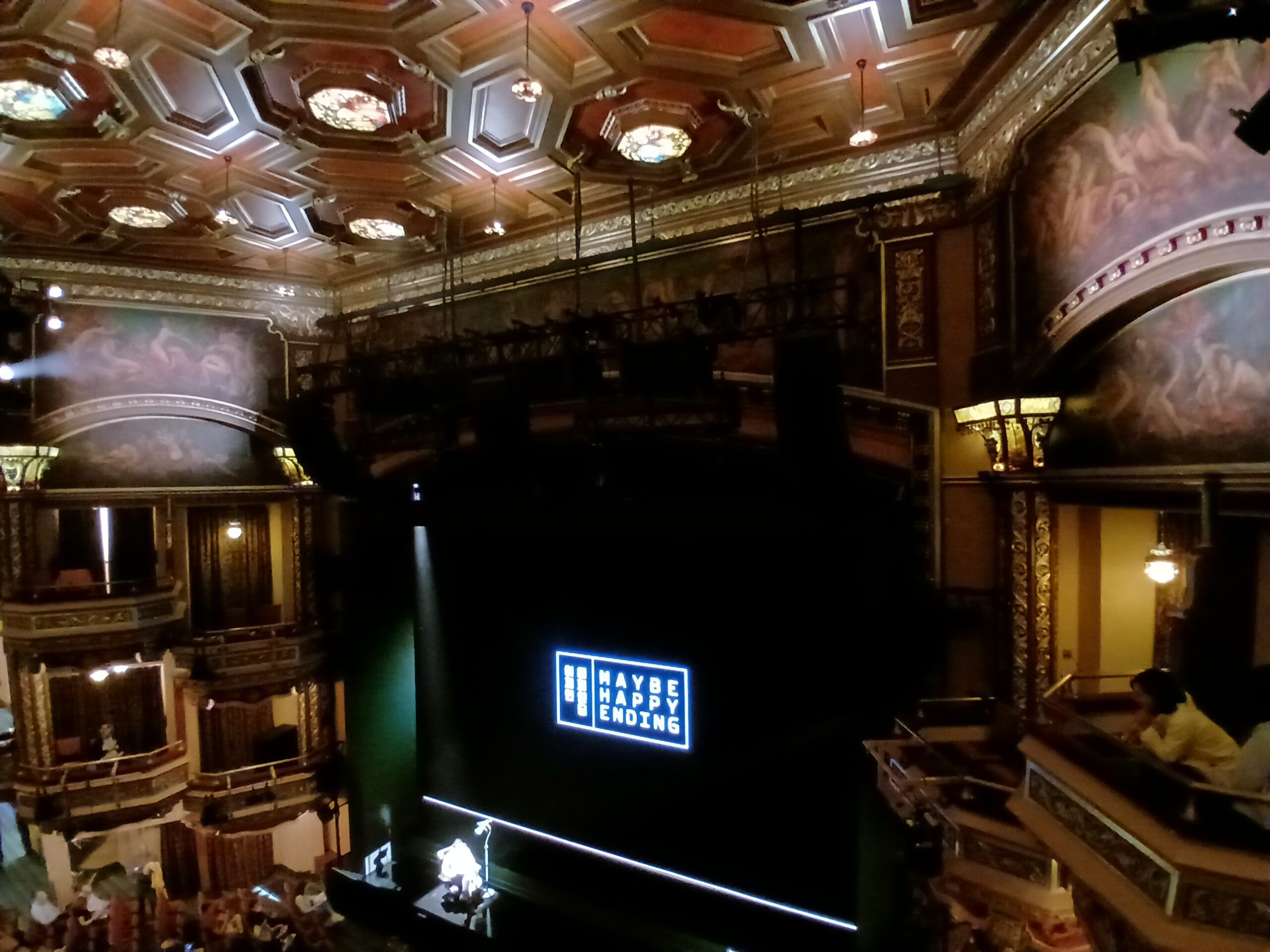
It has been an exciting year in the world of theatre in New York. At one point, all 41 theatres that qualify to be called Broadway houses were had running productions, and it made for an exceptionally competitive 2025 Tony Award season. After racking up 10 total nominations and six Tony wins – including Best Musical – Maybe Happy Ending is on a meteoric rise. The musical has a strange premise. It’s a show that originated in Korea about two robots that learn how to develop connection and love. However, what will be most interesting to Utah readers is the general manager of the show, Andrew Joy, grew up in Clinton, Utah, got his love for the theatre world right here in Utah, and made his way to a career on Broadway and beyond. He recently agreed to sit down with me and talk about his experiences, answer the questions that I and all of the writers here at UTBA had about his journey, what his job is like, Maybe Happy Ending, and more.
Tell us a little about yourself and what sparked your interest in theatre.
As a young child, I loved the theatre and started doing shows in school. I acted in productions throughout junior high and high school. My high school teacher at Clearfield High, Alyn Bone, was the most influential teacher and friend I had—and she remains a close friend to this day. I appreciated how she taught us to be fully involved in the process, from acting on stage to painting sets. She inspired me to study theatre, which I did for a year at Weber State before continuing in the BFA program at BYU. While at BYU, I began to realize that although I enjoyed performing, I had an even stronger passion for the management side of theatre. That passion really crystallized when I advocated for a production of Merrily We Roll Along at BYU. I had performed in the show in high school, and since it’s so rarely produced, it meant a lot to me. As far as I know, Clearfield High and BYU are the only places that have staged it in Utah—and I was part of both. Championing that production at BYU helped me see how much I loved that side of the theatre world, and that’s when a career path truly began to take shape.

What does a general manager do? What does a producer do? Are they the same or different? What training do you need? Why do they deserve a Tony?
As a general manager, I wear many hats for the production. Anything that needs to happen usually crosses my desk. I also serve as the liaison between the creative team, the producers, and the director, choreographer, and others. Essentially, I make sure the whole production is running smoothly. This role is very different from that of a producer. A producer’s main responsibility is securing funding, but they may also work alongside the general manager to hire the team, oversee marketing, and ensure the show stays financially viable. It was actually the Tony Awards rules committee that decided executive producers are the ones who receive the statue when a show like Maybe Happy Ending wins a Tony. Because a Broadway production is such a team effort, that’s why you see such a large group of people on stage when a show wins Best Musical.
Training can vary. For me, after finishing my undergraduate work at BYU, I went on to graduate school at Columbia University, where I earned an MFA in Theatre Management and Producing. That program gave me both the training and the professional connections I needed to build a career on Broadway.
How do you decide on a project?
A lot of decisions in this industry are made based on connections. I work for Foresight Theatrical, which manages several shows on Broadway. Because of the relationships I’ve built over the years, new projects often come my way through people I’ve worked with in the past. For example, I currently manage all the professional Kinky Boots productions worldwide. I’ve helped launch a few productions in Asia, which has expanded my professional network even further. I’ve also served as the general manager for The Great Gatsby on Broadway. The track record of success that Foresight has built gives people confidence that their projects are in good hands, so they often reach out to us directly. In this business, who you know really does matter—and reputation plays a huge role in landing new projects.
Maybe Happy Ending-How has it changed from the beginning until now?
Maybe Happy Ending, as a transfer from Korea, hasn’t gone through many changes. The team who brought it over—Hue Park and Will Aronson—are the same people who created the original version, and they’ve worked hard to keep it true to the original piece. A few songs were added, and one new character was introduced, but overall, it’s very faithful. I’d say the biggest differences are some of the technical elements we’ve added, which are unique to the Broadway production.
There’s much concern that costs to see Broadway shows, like many other things, are inflated prices. What do you think?
While I agree that the cost of many Broadway tickets is rising, I think a lot of that perception is subjective. Yes, there are high-priced tickets—like $800 seats for star-driven shows—that make headlines. But there are also plenty of productions, including Maybe Happy Ending, that offer affordable ticket programs. For example, we have a daily rush ticket program where seats are just $49, and balcony seats are available for $89. A big part of the pricing challenge comes from the high cost of running a show. But it’s a misconception that all seats are in the hundreds of dollars range.
I also think it’s important for audiences to look beyond just Broadway or the most talked-about shows. Sometimes, lesser-known productions or Off-Broadway performances can offer incredible value and artistry. As for shows closing early—Broadway is a business. If funding is tight or ticket sales drop, a show may not survive, even if it’s artistically strong. That’s why it’s important to think outside the box when it comes to supporting theatre. Supporting the arts—wherever you are and however you can—is vital. There’s a lot of money in the world; we just need to find more effective ways to direct it toward supporting great theatre.
What advice do you have for those with big theatre dreams in Utah?
Just do it! Be involved in every part of the process. Ever since I was in high school, I’ve worked both on stage and behind the scenes. You never know where a career in theatre might take you. People often say you need a backup plan, but that mindset ignores the fact that there are real, viable careers in this industry.
One of the most important things I’ve learned is to be a kind, respectful person. Your reputation follows you everywhere. I’ve had the chance to recommend people I’ve worked with in school or on projects to directors or managers—and some of them have landed jobs because of that. I’ve also seen the opposite: people who land a big role in one production but struggle afterward because of how they treated others. Who you are and how you treat people truly matters in this business.