

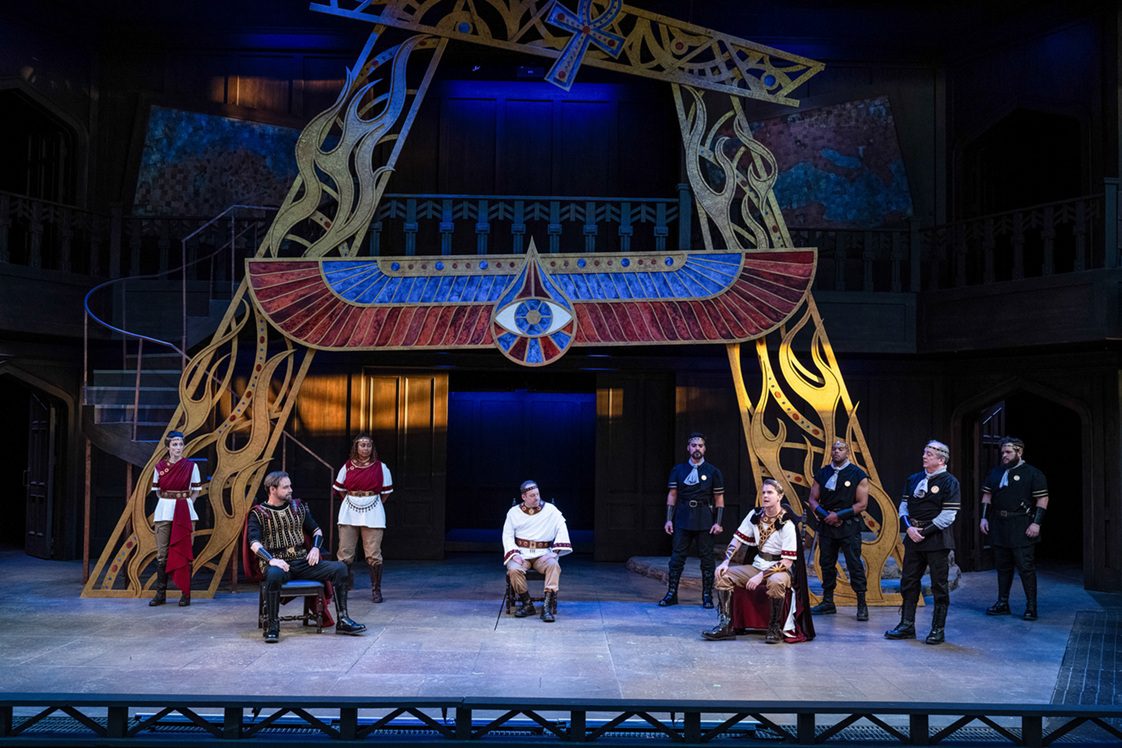
CEDAR CITY — William Shakespeare’s Antony and Cleopatra is not often produced. This fact alone should entice Shakespeare lovers and novice’s alike to flock to Cedar City to see Utah Shakespeare Festival’s production. Directed by Carolyn Howarth, with stunning costumes by Raven Ong, the show is lovely in so many ways. The Englestad is a beautiful re-imagining of Shakespeare’s original Globe Theatre. Open to the stars and true to the interior shape and feel of the old Globe, the modern exterior of the space is sleek, with clear elements of Tudor styling. The set, designed by Apollo Mark Weaver, features a large golden Egyptian arch with flames licking up each side, adorned with Egyptian symbols with red and blue accents, representing fire and water.
The remarkable set matches the drama of this Shakespeare show. Mark Antony, one of three rulers of Rome, is in love with Cleopatra, Queen of Egypt. Antony is summoned back to Rome, where he clashes with another ruler Octavius before returning to Cleopatra in Egypt. Now in battle with Octavius, Antony and Cleopatra suffer losses and miscommunication, leading to deadly consequences.
It’s no surprise that Antony is entranced by Cleopatra, especially this one. Kathryn Tkel as Cleopatra is strong and regal – in many ways larger than her petite physique would suggest. Tkel also plays the Egyptian queen as somewhat unhinged, given to fits of rage and passion. Geoffrey Kent’s Antony on the other hand, is played somewhat less regal and loose, making him seem smaller in some ways than Cleopatra, despite his relative size. As Antony is contemplating his summons back to Rome, he appears in an oversized dressing gown that makes him appear small within it. This and other costume pieces by Ong create a sense of false largeness in the character. This fake bravado in Antony echoes throughout the production. At times, Antony’s lines are humorous, almost clownish and seem unbefitting of such a powerful figure. Where one might have expected a grander, larger than life character of mythic proportions, Kent’s Antony is almost disappointingly human. But I think that is actually the point made by this production. When Cleopatra eulogizes her lover with language such as “His legs bestrid the ocean” and “his reared arm Crested the world”, her hyperbole seems to highlight what Kent’s Antony lacks.
Other standouts among the cast are Graham Ward as Lepidus as the peacemaker of the Roman triumvirate. Ward’s comic timing is impeccable, particularly in the drunken ship party scene, and later when Ward reappears as the countryman who brings Cleopatra a basket of figs and snakes. Blake Henri is very strong as Eros, who connects all of his messenger scenes well. Chauncy Thomas as Pompey is fantastic. His character has the presence I initially missed in Mark Antony and actually made me want to root for the rebels.
Director Howarth’s vision is complemented by Sacha Comrie’s choreography. The shipboard dance and song sequence fills the space with energy, leading to a physical encounter between Antony and Octavius Caesar, played by Gabriel W. Elmore. In the midst of this raucous party, Howarth suddenly freezes the action for an interchange between Pompey and Menas, played by Elijah Hernandez. This exchange, written as an aside during the scene, instead takes place in the midst of the frozen party, to great visual effect. The shipboard scene is easily the highlight of the production for its choreography, musicality, and tight direction. Fight direction by Geoffrey Kent works best in scenes like the shipboard rumble, and again when Cleopatra assaults a messenger, but is less gritty and more performative in the large battle scenes.
Howarth’s direction is very tight, simple and balanced. The text jumps from Egypt to Rome and back again without any real grasp of time, space, or geography. Howarth accomplishes these transitions seamlessly, overlapping and interweaving scenes, driving the pace and connecting the plot in a way that is clear and engaging. Shakespeare has a tendency to write action off-stage, and have a character appear and tell the audience what they missed. Howarth instead sometimes shows the audience this off-stage action while it is being described – a convention that really helps the audience understand more clearly.
One missed opportunity is the sea battle staging. Howarth uses flags to create a visual for the off-stage action, which works reasonably well, but Cleopatra’s retreat is so quick it becomes confusing. Slowing it down or overlapping it with the following description, as done elsewhere, could have clarified the moment.
The second half of the production, particularly after Antony’s death, does drag a bit, in large part due to the density of the script between the deaths of the two titular characters. The benefit of this however, is the time the script spends with Cleopatra, allowing us to see into her character more fully, and appreciate the many dimensions and layers that both Shakespeare and Tkel infuse into her.
The best part of the production are the costumes by Raven Ong. While the mix of modern and classical can be jarring at first, the costume pieces are each so beautifully designed it quickly becomes easy to accept the blended convention. Cargo pants distinguish the Roman factions by color. Caesar’s faction with tan pants, white tunics and vibrant red drapes align with Caesar’s gorgeous blood red velvet cape. Pompey’s crew contrast the Romans with mismatched blues and grays, creating a gritty, layered look that befits the rebels. Cleopatra’s gowns stun as teals, purples, whites and golds shimmer down her like water, enveloping her small frame. Also delightfully designed is the costume of the Soothsayer, who was played by Olivia D. Dawson. Its layers of textured fringe are accompanied by creepy finger extensions, making it a sight worth seeing.
Overall, this production uniquely utilizes the themes of power and legacy to craft a dynamic show. From the casting to the costumes, this production emphasizes that neither Kent as Antony in all his humanity, nor Tkel as Cleopatra in her mania could possibly live up to their mythological personas. Dramaturg Isabel Smith-Bernstein described in the play seminar how Howarth views these two as “rock-stars” of their era, so hyped and mythological that their humanity could never match the legend. I recommend attending the play seminars USF offers the morning following each production, where Smith-Bernstein gives some context of both the script and the production and answers questions.
Antony and Cleopatra is a beast of an undertaking, both for the audience and certainly for the company. However, Utah Shakespeare Festival definitely rises up to the challenge with their current production. Be sure to check it out this summer!
[box] Antony and Cleopatra plays Monday through Saturday at 8:00 PM, through September 5, in the Engelstad Shakespeare Theatre at the Utah Shakespeare Festival (195 W Center Street, Cedar City). Tickets are $25-$85. For more information, visit Bard.org. [/box]