
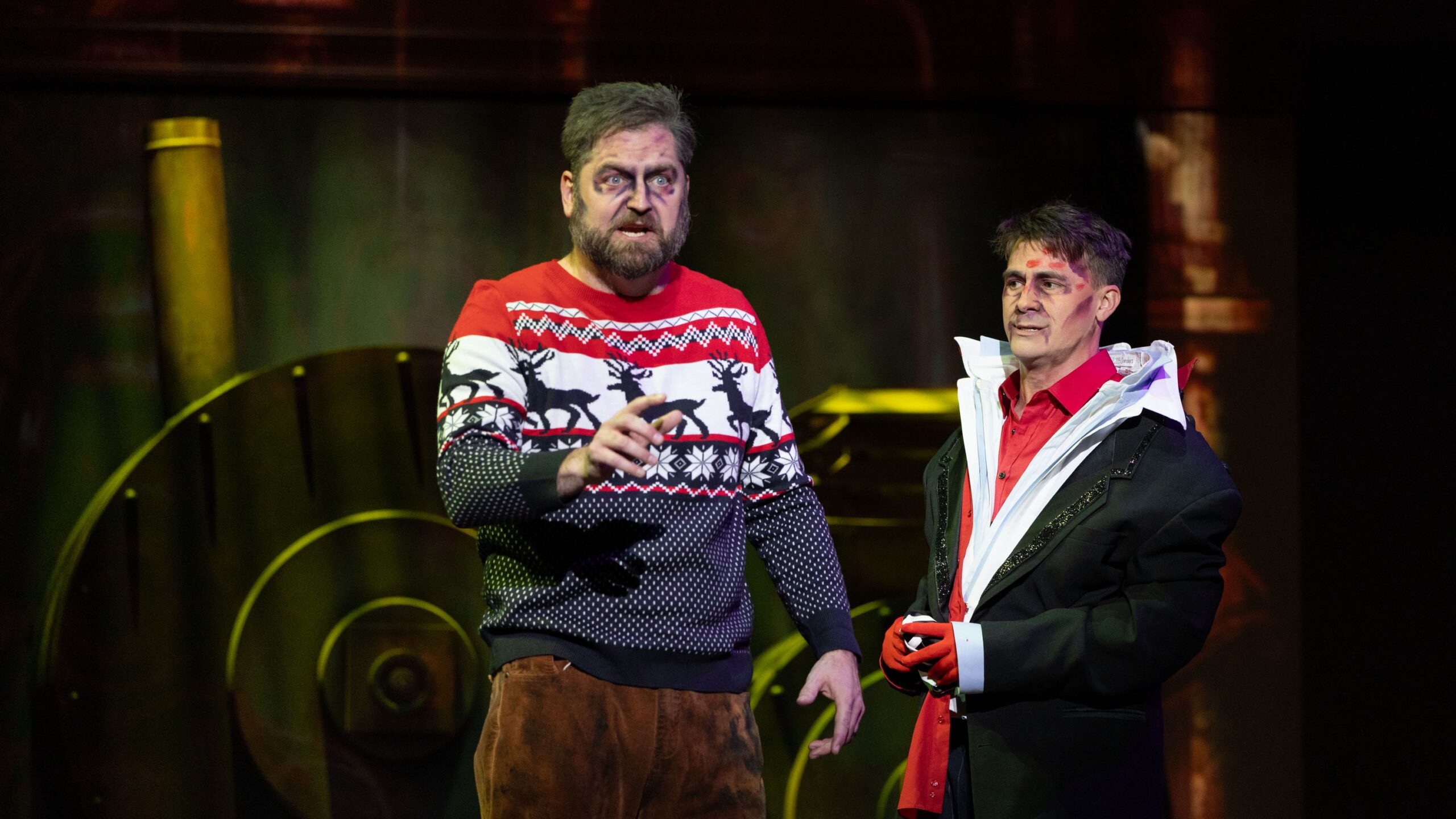
SALT LAKE CITY — The Shining, the first offering of Utah Opera’s 2025-2026 season is a psychological thriller (or some call it “horror”) that hopes to take its audience along with the main character as he descends into madness. The problem is: the main character’s descent is too sudden, contrived, and rather unbelievable, which makes this production of The Shining…dull.
Adapting Stephen King’s third published novel that firmly established King as a preeminent author in the horror genre, was a bold and daring move by composer Paul Moravec and librettist, Mark Campbell. Both seasoned and experienced contemporary operatic creators, each has an impressive resume and multiple awards to their credits. But why The Shining? According to composer, Paul Moravec, “Stephen King’s novel, The Shining is naturally operatic: it sings.” And, indeed, it has all the required aspects of opera…or epic theatre, for that matter: love, death and power. I would also add, that its story revolves and evolves around the most dramatic of all backdrops: the family.
The Shining also has all the dramatic aspects of a perfect horror story: Jack Torrance and his family are hired as winter caretakers for the isolated Overlook Hotel, an infamous location where murder, suicide, and unspeakable evil happened. As a snowstorm traps them, Jack Torrance descends into madness, driven by the hotel’s malevolent forces and his own inner demons, while his young son Danny uses his psychic “shining” ability to try and protect his family.

The opera should explore gripping family themes of isolation, alcoholism, and domestic violence, but it gives each of those compelling issues mere cursory glances, choosing instead to focus on superficial operatic bravado that seems to be bellowed at the audience with constant force. Madness, true madness, creeps up on you here a little and there a little. It’s not loud and verbose, it’s quiet, and constant, and menacing, playing at your weaknesses and fragilities. And that’s what makes it horrifying to an audience: the fact that, under the right circumstances, it could happen to any of us. We should see ourselves in the main character of Jack Torrance, whose last chance of saving his family AND himself lies within these hotel walls. Then little by little, as the solitude hems him in and the chaos of his former life—each weakness and addiction he brought with him—start to take over, should be terrifying to experience.
But in this production, Jack’s madness happens almost magically, without believable events with his wife or with the hotel. Just because he comes across a scrapbook with clippings about the grisly murders and suicides doesn’t automatically push someone over the edge.
Act I ends with a cacophony of the hotel “ghosts” who come to haunt Jack in a supernatural New Year’s Eve party scene. It’s almost like the creators felt like there needed to be a big number to end Act I, but whereas these ghosts, who have committed murder, suicide, and filicide should be seen and represented as the haunting and gruesome beings that they are, it’s more like a ride through the Haunted Mansion, with each dressed in stylized costumes and inflated mannerisms. The result is more cartoon than terror.
The music by composer Paul Moravec is lush and evocative, but still never quite finds the passion and intensity needed for the complexity of the story. The music longs for a “theme” that the audience can grab onto and become acquainted with. Otherwise an audience leaves the theatre “humming the sets.”
The libretto by Mark Campbell is more often than not stilted, with clunky exposition coming at us full-force at the very beginning, not trusting the audience with understanding that Jack is an imperfect and nearly broken man, trying to reassemble his life. Exposition, like madness, should come a little here and a little there, and only be given in order to avoid audience confusion. Moravec and Campbell are two impressive talents, who have written and created extraordinary works, but this one just misses the mark.
Stage Director and concept designer, Geoffrey McDonald does a sufficient job in staging, but falls short of creating the terror that The Shining has come to represent. (And why don’t we ever find out what “REDRUM” meant? Son, Danny, says it once and then we never hear about it again. It’s MURDER spelled backwards. Why don’t we find that out?)
As disappointing as this production is, it’s even more heart wrenching because there is such and abundance of talent on the stage. Craig Irvin, whose clear, reverberating baritone echoes through the Capitol Theatre, does an amazing job with what is given to him. As does the truly extraordinary Kearstin Piper Brown, who performs the “Lullaby” with poignancy and clarity. It was again unfortunate that the music didn’t quite evoke the emotion of the character, not soaring into the hope that Wendy Torrance has for the healing of her family.
Patrick Blackwell’s incredible bass voice is perfect for the “all knowing” Dick Hallorann, who’s “sixth sense” is able to divine young Danny Torrance’s gift of “the shining.” Bella Grace Smith and Emmy Ward (I don’t know which young actress I saw) work well as Danny Torrance, the child with the extraordinary psychic gift of “the shining.” The rest of the supporting cast does well: Christian Sanders is great as Delbert Grady, the killer who murdered his family in the hotel and who, like a devil on Jack’s shoulder, keeps pushing Jack to “correct” his family; Christopher Clayton is first-rate as Mark Torrance, Jack’s abusive father; Aaron McKone is skillful as both Bill Watson and Lloyd.
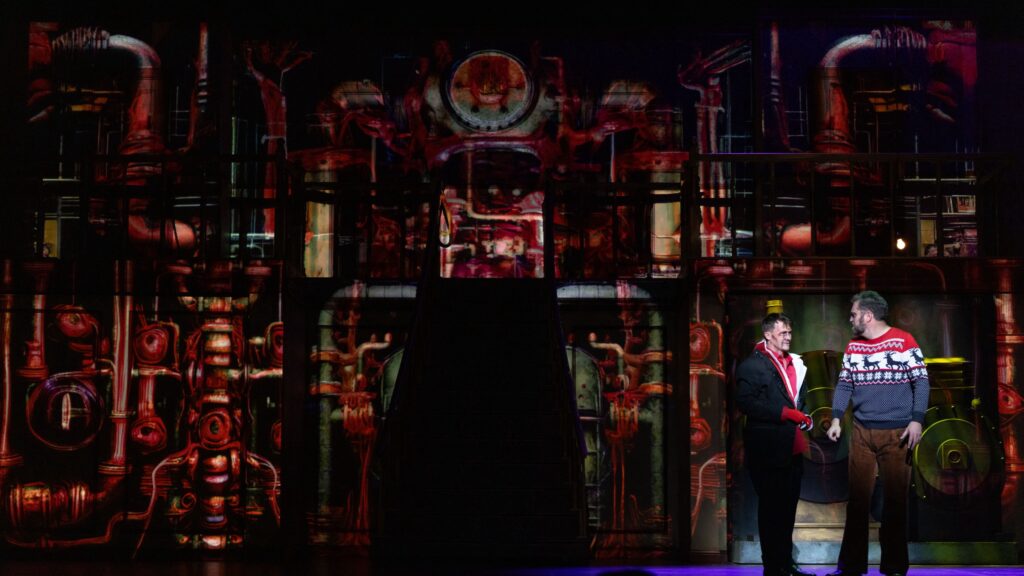
The sets by Jacquelyn Scott were masterfully designed, being both welcoming and creepy at the same time, and the costumes by Alina Bokovikova took me back smack-dab into the 1970s. But what really stood out were the projections by David Murakami. They moved us through a mountain forest and right into the hotel, then they showed the murderous escapades that took place in the historic hotel, and finally, they made the hotel breathe. They were impressive, even if the overall production wasn’t.
[box]Utah Opera’s production of The Shining, plays at the Capitol Theatre, 50 W 200 S, Salt Lake City,Utah, October 11 & 17 at 7:30 PM, October 13 & 15 at 7:00 PM, and matinee October 19 at 2:00 PM. Ticket prices are $19.00 to $117.00. For additional information, visit Utah opera.org.[/box]