

CEDAR CITY — One of the least known but most excellent theatre events in Utah happens each August as the Shakespeare Festival‘s summer season winds down. From hundreds of submissions, two new plays are selected for a week of workshopping and professionally staged readings in the Anes Studio theater. A few hundred of the Festival’s most devoted patrons are able to attend the workshop. Like me, they are thrilled to hear a new play be read aloud at 9:30am. As Festival Artistic Director John DiAntonio reminded the audience on August 22nd, “even Shakespeare’s plays started with words on a page. In that tradition, the Festival’s commitment to shining a light on scripts journeying toward becoming classics is to be lauded.
This year’s offerings were two tightly constructed two-person scripts, both less than 90 minutes, that explored the ever-evolving relationships of powerful men and the women who work behind the scenes to raise them beyond all expectations. Questions of love, passion, loyalty, respect, and power – all the same themes that drive the greatest works of the Bard – were on full display in these short offerings.
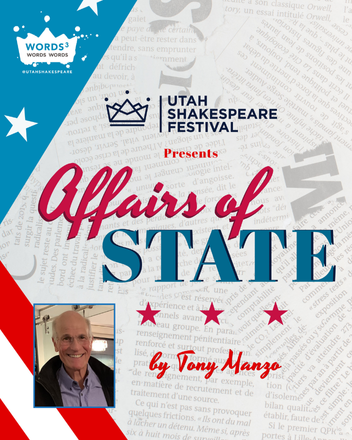
Affairs of State by Tony Manzo is a Sorkin-esque one-room political drama. Walter Kmiec, featured as Macbeth this season, reads the role of a beleaguered progressive democratic congressman. Jack is on edge as his reelection prospects are slipping away after the latest poll. He is facing being replaced by a handsome idiot backed by endless corporate funding. Into his hotel room walks an ambitious and beautiful reporter, Jenn, read by the captivating Kathryn Tkel, also playing Cleopatra this summer. It is quickly revealed that Jenn and Jack had a passionate affair five years earlier during Jack’s early rise from city council to Capitol Hill. As the scene progresses in real time, Jenn reveals that Jack’s life and reelection are about to be fully derailed by an accusation of sexual assault. As the two drink, banter, poke at, and flirt with one another, their past love and current motives are laid bare. Jenn not only wants to advance her career with this important interview, but she also wants Jack to back a progressive bill that lacks support to get to the House floor. Questions of journalistic impartiality are explored as Jenn tries to convince Jack to reignite his early-career zeal. Despite his less than stellar extramarital romance record, Jack firmly denies the assault allegations and frets about the impact of a scandal on his family and future. The two characters clearly still have great affection and admiration for one another, and their chemistry was well articulated with direction by Lisa Quoresimo.
The two actors are expert in their execution of Manzo’s script. The piece is well structured with interesting backstory and robust relationship details revealed as the scenes progress, however the dialogue has a tendency toward a sort of outdated flashiness. The surfeit of snappy one-liners and sharp three line exchanges give the characters a sort of Hepburn-Tracy air that clashes with modern sensibilities and the issues at hand. This is particularly evident in Jack’s use of phrases like “She’s a nut,” and “Pal, am I getting through to you?” These, along with the unironic hotel minibar day-drinking might as well place this pair in the Watergate scandal. Prescription drugs or a vape seem more likely relaxants for two children of the 1980s than a stiff whisky in the afternoon. Indeed, for a play centered on two present day, forty-something New Yorkers who have climbed out of the circumstances of their working class roots, it is fair to expect familiarity with and debate around current leftist thinking on wealth taxes, universal basic income, or healthcare reform, but the script seems intentionally vague around their discussion of the specific policies that Jenn wants Jack to fight for. The argument between them would be more powerful if specific issues are examined more closely. Jack is painted as both jaded by his time in congress and also so innocent that he would rather take a personal loan than money from willing corporate interests. The driving force behind that purity and exhaustion are both left in question. It would be interesting to hear more about the roadblocks he faced during his time in congress, and what he still wants to accomplish if he wins. Jenn refers to him as “lost,” and she must support him now that he is on the brink of humiliation. Her motives are both personal and political, but her backstory could also use some additional filling in. The final minutes of the play offer a tidy conclusion by resolving a major plot point. This creates a nice button, but also feels a bit convenient for everyone involved.
Overall, like a first-time candidate practicing her stump speech, this script still requires some fine tuning and some fleshing out before it’s ready for a larger audience.
Muse of Fire is a script in development by nationally celebrated playwright Lauren Gunderson, author of Book of Will and Silent Sky, which have both been given full productions at the Utah Shakespeare Festival in recent years. Long-time Festival favorites Melinda Parrett and Geoffrey Kent are unquestionably outstanding in their readings of Anne and William Shakespeare. This staging is as close to a fully developed production as any I have seen in my years attending the new play series. Director Evren Odcikin made excellent use of the abundant acting talent at his disposal. While aided by the simplicity of the stage directions, these masters of their craft had sections of the dialogue already memorized and their fervor for Gunderson’s script was apparent.
We are introduced to Mr. and Mrs. Shakespeare at their home in Stratford in 1611. Will has arrived unexpectedly on Christmas day, much to Anne’s dismay. Immediately the tone of their decades long marriage, with all its love and frustration is crystal clear. The famous couple’s lines mingle as they speak over one another in entirely contemporary language, replete with “okays” and modern profanities. Any Shakespeare lover can tell you there are few things worse than listening to anyone’s attempt to match Shakespeare’s own skill with poetic dialogue, and thankfully Gunderson steers well clear of this folly. Still, the playwright’s deep affection for Shakespeare’s brilliance is fully on display as the two discuss Will’s scripts and poetry in detail as the story progresses. The couple has reached a crisis moment familiar enough in modern marriages: imminent professional retirement. While he struggles to finish the ending of The Tempest, he surprises Anne with his decision to return to his country home and leave London permanently. Before she can welcome him back into her life, Anne has questions about her husband’s time in London, and she demands answers.
As the story proceeds it is clear Gunderson is delighted by her experience of imagining Shakespeare in the flesh. In his own home she can banter, argue, question, and flirt with her Muse while he does the same with his wife. In the first week that the reading was staged, Gunderson herself performed the role of Anne. I wish I could have seen it! (As a life-long Shakespeare lover myself, the chance to write myself going toe-to-toe with the Bard is electrifying.) Tender answers are revealed as Anne and Will rehash their scandalous romance, their children, their resentments, and their separations – physical and emotional – that have kept them from knowing each other fully in the years they have lived apart.
In Anne’s efforts to reconcile the public and private versions of her husband, she probes deeply into his texts, looking for evidence that her life and their love mattered to him. Will is grappling with his own legacy as a successful artist and a bad father. He is looking for redemption and he is smart enough to know that is not easily given or accepted. In this vein, my only suggestion for the text would be a deeper exploration of why Will forbade Anne from traveling to London to see his plays performed. When Anne questions Will, he explains that he didn’t want to bring her into his very busy work life in a filthy and dangerous city, which was surely true. However, as Gunderson has imposed this mandate on the characters, (there is not a historical record that demands Anne’s never seeing a performance, as far as I know), there is also an opportunity for Will to express a deeper vulnerability. Most creative souls I know would far prefer to perform for and be critiqued by a hundred strangers rather than their own nearest and dearest. Gunderson makes it clear that Will deeply craves Anne’s praise, so it is therefore understandable that he would dread her rejection or apathy to the work so beloved by thousands. The moments where Anne and Will bond over his art are delightful to anyone who has ever ventured to give a gift of their own creation to the one they love.
I applaud Ms. Gunderson’s efforts to explore Anne and Will’s ‘course of true love that never did run smooth.’ This script is a gift to all of us who have been swept off our feet by our love for Shakespeare’s words and the mysteries of his life. I hope to see this script fully produced in due time at The Utah Shakespeare Festival where it is sure to find a very welcome reception.

The Words Cubed New Play Series has ended for another year, but I look forward to two more new scripts next August. Meanwhile, indoor Festival productions will continue to run until October 4. These include excellent productions previously reviewed by the UTBA team: Ken Ludwig’s Dear Jack, Dear Louise, The Importance of Being Earnest, A Gentleman’s Guide to Love and Murder, and Steel Magnolias. Don’t miss your chance to enjoy some of the best theatre in the world at the Utah Shakespeare Festival.
[box] For information about productions at the Utah Shakespeare Festival, visit bard.org. [/box]