

SOUTH SALT LAKE — In his bestselling business book Good to Great, Jim Collins discusses the Hedgehog Concept: a principle suggesting that an organization can only become great by understanding and embracing its core identity. Parker Theatre, in many ways, embodies that concept. Their performances are limited to weekends. The company is family-run. Though they rebranded from “Utah Children’s Theatre,” they’ve retained a strong connection to family-friendly productions while also branching out artistically.
One mainstay of their season is a Shakespeare production. And each year, Parker plays fast and loose with the Bard’s language—and sometimes, even the plot. The intent is to make the plays more accessible for modern audiences. While Shakespeare certainly allows for broad interpretation, some of Parker’s departures from the text yield mixed results: some delightful, others disorienting. It’s unclear who holds authorship for the adaptation, as the program credits “Shakespeare’s Macbeth,” but the production includes major deviations, additions, and revisions.
This year’s Shakespeare pick is the dark and often “cursed” tragedy Macbeth, which centers on a Scottish nobleman who learns from three witches that he is destined to become king. Parker’s production adds a modern staging concept by introducing a silent prologue in which Macbeth and Lady Macbeth mourn the death of their infant. The image of both characters dropping handfuls of dirt over their child’s grave before Macbeth is called to war adds emotional weight and supports Lady Macbeth’s later line, “I have given suck, and know how tender ’tis to love the babe that milks me.”
However, the production then takes a stranger turn. The witches rob the infant’s grave—a choice made to support an altered version of Lady Macbeth’s final scene. Shakespeare originally wrote her descent into madness as a sleepwalking confession, observed by a doctor and gentlewoman. In Parker’s adaptation, Lady Macbeth is alone until the witches return with a young girl—presumably her daughter, though this is never clarified. Whether metaphor, nightmare, or resurrection, the change felt more confusing than compelling.
Lucas Charon played Macbeth, and I’ve previously written positively about his leading roles in Of Mice and Men and The Woman in Black. In Macbeth, Charon delivers moments of brilliance: a fierce warrior, occasionally an unhinged tyrant. But overall, his performance doesn’t fully land. Like many in the cast, Charon’s accent was inconsistent, surfacing best during key speeches. Early in the play, Macbeth’s motivations lacked urgency, and Charon never quite commanded the stage as king. In the Banquo ghost scene, the nobles seemed more uneasy than terrified. Even when Macbeth lashed out violently at Lady Macbeth, the tension was undercut by Mentieth (Zac Ballard) stepping in to stop him. While I appreciated director Brinton Wilkins’s decision to confront domestic violence directly, the result made Macbeth appear weak—more pitiable than dangerous. If a lesser would risk attacking him and intervene in that moment, Macbeth wouldn’t truly strike fear in any heart. His downfall felt inevitable rather than tragic.
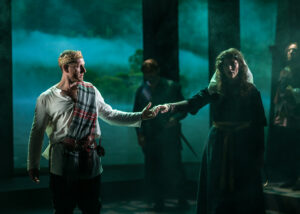
As Lady Macbeth, McKenna Walwyn began with unconvincing sobs in the prologue, but she grew stronger throughout the production. She brought tenderness and concern to the role, though that softness clashed with the fierceness required in moments like “unsex me here” and the murder plotting. The chemistry between Walwyn and Charon never fully ignited, making it hard to believe their passion could lead to regicide.
Technically, the production had much to commend. Spencer Hohl’s fight choreography was intense but precise. The battle sequences were brutal yet controlled—a highlight of the evening. James B. Parker’s scenic and lighting design was excellent, using pillars and platforms to create a space that felt both cavernous and intimate. The lighting consistently elevated the storytelling.
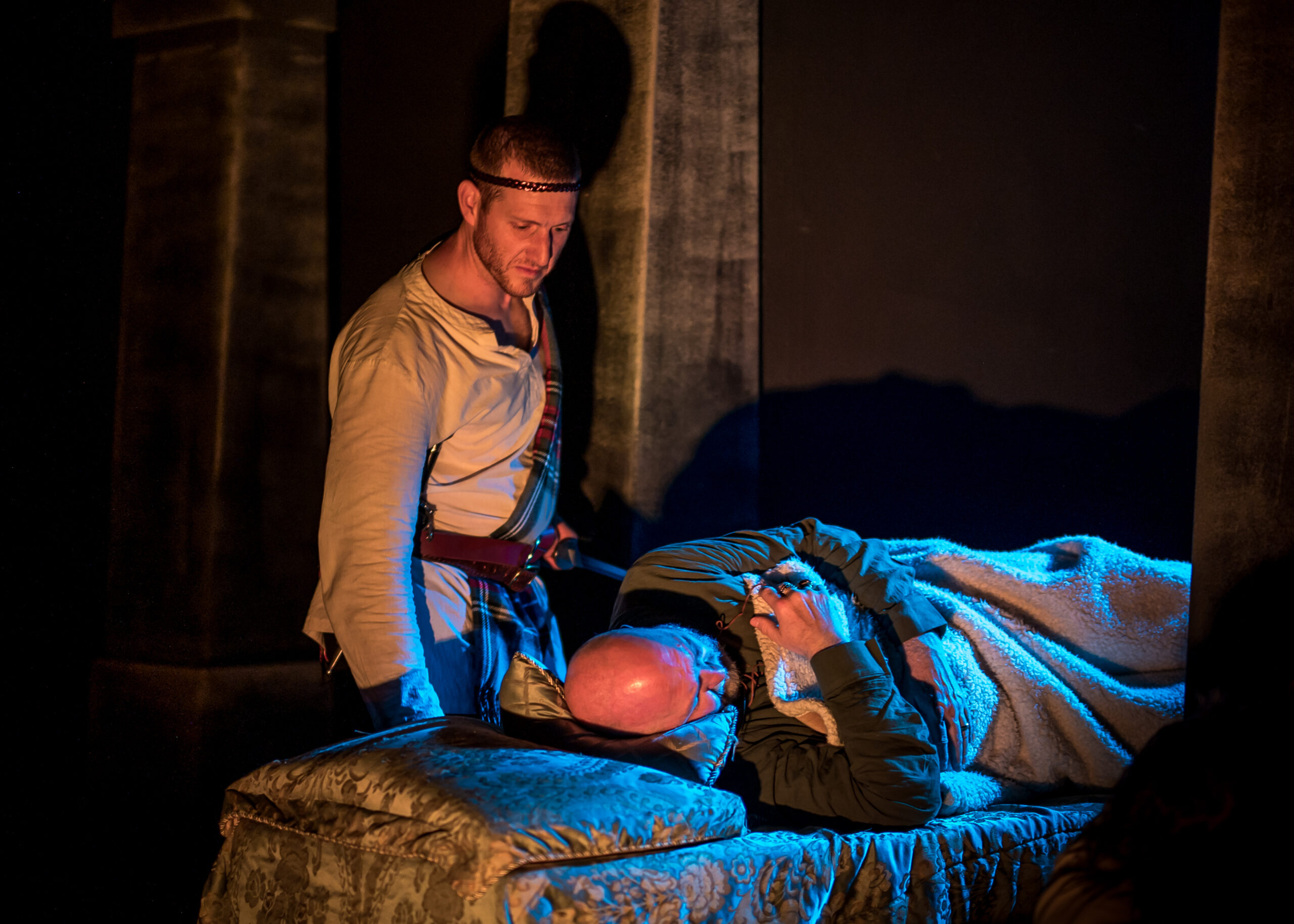
Wilkins’s direction embraced “show, don’t tell,” and some of the play’s strongest moments came through wordless storytelling. For instance, Macbeth taking the crown was executed beautifully through action alone. Conversely, showing Duncan’s murder on stage (rather than offstage, as in Shakespeare’s script) undercut the horror of the act by making it too literal.
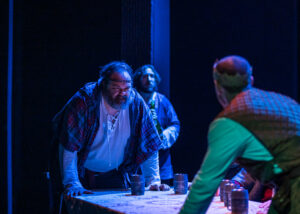
The ensemble performances were generally strong. David Hanson’s Banquo was especially memorable—a lovable, Hagrid-like presence whose death was deeply affecting. His return as Banquo’s ghost was chilling, especially when he grinned to torment Macbeth. Hohl was also excellent as Malcolm, projecting strength and poise through the battles, and sorrow as he rejected his father’s crown in the final moments. Among the witches, Kathryn Atwood and Isabelle Purdie gave dynamic, eerie performances using low crouches and strong physicality. The third witch, though still mysterious, lacked the clear vocal or physical definition of the other two.
I’ve been attending shows at Parker Theatre for several years, and one of the company’s most admirable qualities is the way the space visibly improves each season. Parker is a bootstrapped, family-run company, and that’s worth celebrating. Still, this Macbeth sometimes felt uncertain of its identity. It lacked the comedic irreverence of Parker’s Hamlet and Romeo and Juliet, but also failed to offer a consistently serious or cohesive reinterpretation. It was, in many ways, a solid performance—especially for audiences unsure of Shakespeare. But just as Macbeth’s unchecked ambition leads to a questionable execution of his goal, so too does Parker’s Macbeth.
[box] MACBETH plays Fridays and Saturdays at 7:30 PM through August 30, 2025, at Parker Theatre (3605 South State Street, South Salt Lake). Tickets are $31 for adults and $22 for children (17 and under). Recommended for ages 8 and up. For more information, visit parkertheatre.org. [/box]