


CEDAR CITY — Shakespeare’s Troilus and Cressida is a play that has been put in a number of categories in its history. Some consider it a Tragedy, others a History, and some put it in the unique category of “Problem Play.” Regardless of its categorization, Troilus and Cressida is a thrilling and rarely-performed story that combines epic tales of Ancient Greece with romantic additions from the Medieval Ages. The Utah Shakespeare Festival is making its own addition to the story by setting it in a time inspired by the 1940s and the heat of World War II.
During the chaos of the legendary Trojan War, the Greeks and the Trojans are in their eighth year of the conflict sparked by the abduction of the beautiful Helen. Troilus, the youngest of the Trojan princes, falls deeply in love with the charming Cressida. Their passionate romance is torn apart when Cressida is traded to the Greek camp and forced into a relationship with another man. Meanwhile, the Greeks try to spur the moody Achilles to action against the Trojan leader Hector so the war can finally end. The consequences of pride and passion come to light as the war rages on.
Apollo Mark Weaver’s scenic design is stunning and evocative, made up of ruined architecture, newspaper clippings, and graffiti. A broken statue of an angel of war takes a central position, and in a clever nod to the infamous Trojan Horse, a wire horse head sits among the rubble. Additional nods to the Trojan War are seen in newspaper clippings that state “Cassandra Foretells Doom” and “Achilles Stands Down.” Another excellent design choice that highlights the play’s tone was the sound design and original music by Lindsay Jones. Hearing upbeat jazz music juxtaposed with planes, bombs, and brutal violence was fascinating.
Even though the play is named Troilus and Cressida, these two characters aren’t necessarily the play’s main focus. More than anything, it is an ensemble show. The play is about the larger conflict of the war and the way it has an impact on each individual. The play’s design highlights its ensemble nature and emphasis on the impact of war.
A brilliant choice by director Carolyn Howarth was turning the character Thersites into a jaded war correspondent by giving him the prologue, an epilogue, and even presenting the play almost from his point of view. In the “Dramatis Personae” of the original script, he is listed as “a deformed and scurrilous Greek,” he has many moments of comedic criticism, but he doesn’t really do much. In USF’s production, Blake Henri crafted a Thersites who is cynical and mocking and tired. Henri presented the character’s scathing commentary in a way that felt justified and interesting. His tired cynicism was also balanced by moments of brilliant comedy, such as when Thersites mocked the warrior Ajax. Another interesting use of Thersites as a war correspondent was done by lighting designer Michael Gilliam when key moments of fights were highlighted by a light effect representing Thersites’ camera flash.
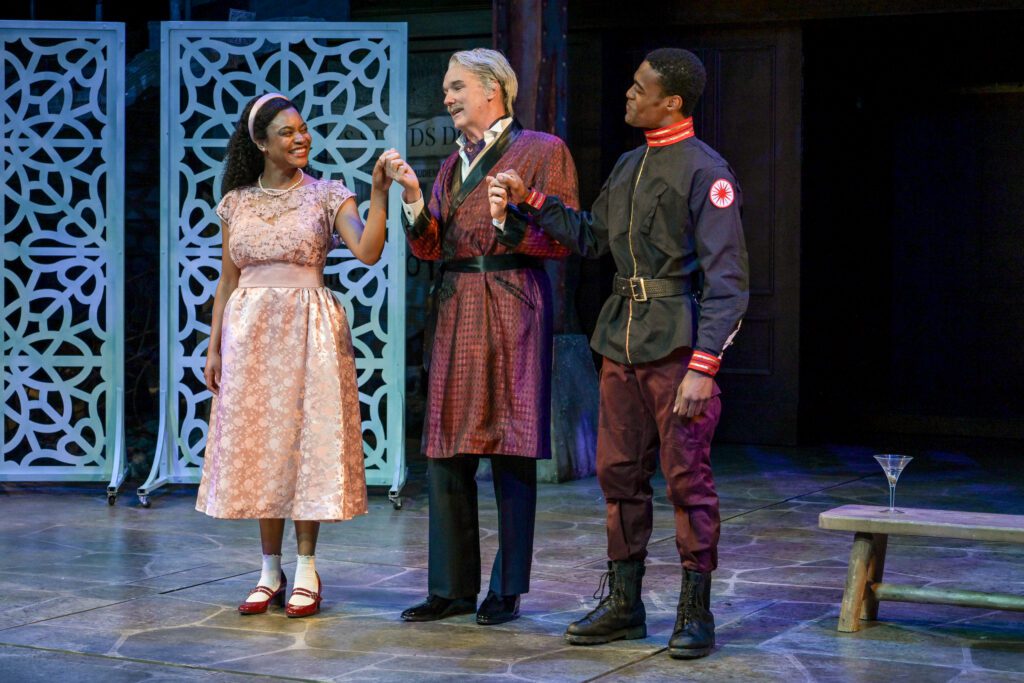
Avery Michael Johnson and Brianna Miller were lovely and tragic as Troilus and Cressida respectively. Johnson created a Troilus reminiscent of Romeo, ceaselessly romantic and almost blinded by love and passion. Alternatively, Miller crafted a bold and assertive Cressida, who seemed almost embarrassed for falling in love, which was relatable and charming. At first, their romance was very sweet as they danced around their affection for each other. Then. it was very satisfying to see them finally give in to their love.
John Harrell as Cressida’s Uncle Pandarus was a fantastic wingman, it was a ton of fun watching him scheme and take joy in helping these two young people he cares about admit their love for each other. Johnson and Miller created this romance convincingly and quickly, because they don’t get much time together before they are separated. However, their excellent build up makes their eventual separation all the more tragic.
An interesting difference in this production versus the original script was the omission of Cressida’s father, Calchus. In the original script, Calchus is a Trojan priest who defects to the Greeks, so it makes sense for Cressida to be traded to the Greeks because it means returning to her father. With the omission of Calchus in this production, that trade makes a lot less sense. In this production, it feels like the Trojans essentially sell her to the Greeks. Though this production choice leads to a bit of confusion, it does allow for a more sympathetic arc for Cressida. Now her betrayal of Troilus feels like more of necessity for her safety in an enemy camp. Miller played Cressida’s terror and heartache beautifully, so instead of a betrayal it feels like watching a young girl make an impossible choice. However, this alteration does make Troilus’ rage at Cressida’s betrayal less sympathetic. While the anger was performed heartbreakingly by Johnson, it didn’t quite make sense as it does in the original text.
Troilus and Cressida are directly juxtaposed by the relationship between Paris and Helen. Emily Hawkins presents a beautiful Helen who loves Mat Hostetler’s Paris madly and seems to revel in being a prize and the source of the conflict. Hawkins’ creation of a Helen who delights in being a prize adds more depth to Miller’s Cressida for whom that is her tragedy. Helen doesn’t say much, but Hawkins doesn’t let that stop her as she struts, poses, and primps to create the character. Helen’s role as a “prize” is made most clear in an added scene at the top of the second half during which the entire cast comes together to perform a “Fight for Helen” Propaganda Musical Number, during which Hawkins shows off incredible vocals. This theme is amplified by the costumes designed by Jen Gillette that dress Helen in golds and jewels. One of the most dazzling costumes in the show is a sheer bedazzled bodysuit that Helen wears in the bathtub.
Other standout performances include Mare Trevathan as Ulysses, Lavour Addison as Ajax, and Walter Kmiec as Achilles. Trevathan’s Ulysses was clever, manipulative, and brutal, she bent every situation to serve her ends and was the mastermind behind many of the key events in the play. Casting a woman in this role was a fascinating twist that I thoroughly enjoyed, especially given the role of the other women characters in the play. One of the most interesting uses of the character is not something found in the original script: after Achilles’ companion Patroclus, played by Calvin Adams, is wounded by John Keabler’s Hector, Ulysses is the one to brutally and secretly finish Patroclus off, though she blames Hector. Ulysses brutal action spurs Achilles to action, which was the goal of the Greeks for the entire show. Trevathan’s calculating portrayal of the character made this a justified and fascinating moment.
Lavour Addison’s Ajax was a wonderfully comedic addition to balance the darkness of the rest of the play. Addison utilized physical comedy brilliantly, showing off somersaults, incredible muscles, and a well timed hug to great comedic effect.
Kmiec as Achilles showed wonderful range as he went from aggressively chill in bunny slippers and a silky robe to aggressively enraged when he finally commits to killing Hector. The convincing chemistry Kmiec and Adams shared as Achilles and Patroclus respectively helped to aid that change, because once Patroclus was killed, Kmiec’s Achilles became absolutely chilling.
The themes of war and the impact that it can have on individuals and groups was palpable, and the incredible fight choreography by Geoffrey Kent was impactful. From a boxing match that was undoubtedly the best hand to hand combat I have seen on stage, to the thrillingly choreographed battle sequences at the end of the play, the fighting did some excellent storytelling.
Though they do their best to present the world and the characters, in order to fully appreciate the production it would be helpful knowing basics about the Trojan War’s events and key players. This production made consistently strong editing, design, and performance choices. Not all of them worked perfectly, but they did all contribute to the larger goal of having a strong perspective on this story. Utah Shakespeare Festival’s poignant and thought provoking production of Troilus and Cressida is sure to leave audiences breathless.
MORE INFO: Troilus and Cressida is currently playing at the Utah Shakespeare Festival (195 W Center St, Cedar City, UT 84720) in the Engelstad Shakespeare Theatre as part of the Festival’s 2026 Season. Performances are held at 8:00 PM on select Monday and Thursday evenings from June 18 through September 3, 2026. Tickets for Troilus and Cressida typically range from $35 to $85, depending on seating location and performance date. For the most up-to-date schedule, performance details, and official ticketing, visit the Utah Shakespeare Festival website: www.bard.org
FOLLOW US ON FACEBOOK and INSTAGRAM!
If you’re a director, producer or marketing contact who would like to have us review your show, please fill out this form.
If you have comments about this article, please fill out this form.