

Online — A new work was recently produced at Spotlight Performing Arts. The Keeping Place by Colton Kraus is takes as it’s premise that theater can be a repository of memory and emotion. The small cast of 6 actors portray numerous characters and relate many stories of youth and growing up grouped into seasons (spring, summer, fall, and winter). These various stories are taken from interviews with young people and from the lived experiences of the playwright himself.
The play opens on a space filled with boxes and pictures, items that are being kept and stored away. It has the appearance of an attic or storage room. The actors enter the space and proceed to select various items that then relate to a particular story or memory that they then relate to the audience and each other. There are chairs placed throughout the space and each actor takes center stage to relate their memory, with the other actors often taken roles of individuals in the story or portraying objects or scenery as needed. The stories are taken from young children to early adulthood, and they are told with humor and heartfelt emotion.
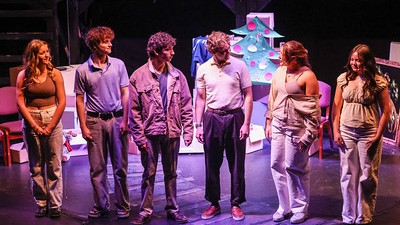
As director, Colton Kraus, keeps the action moving and makes the interactions between the actors feel genuine and natural. The emotions conveyed are realistic and seem to be deeply felt. The transition between seasons is handled by use of overlapping recorded dialogue as the actors select different objects from the boxes around the stage. The stories emerge from the objects with a sense that they evoke the given memory or related tale.
Several of the stories told are humorous in nature and are delivered in a lighthearted fashion. But many are quite serious and heavy in tone. It was evident from the recording that many in the audience were moved to tears as some of these were conveyed.
Unfortunately, I did not have access to a program to know who the actors are or what who had designed the set, lighting or sound, the overall effect was very cohesive. I would have liked to have seen more done with lighting to emphasize the different sections and the individual memories, the overall flow of the production was well planned. Each story flowed from the previous one and created a universal theme in each season.
AS I say, I was not able to know the actor’s names, they all did well in their respective parts. Occasionally, their natural delivery gave way to a more theatrical style and this brought me out of the performance a bit, but these instances were few and far between. The actors seemed to have been well rehearsed and had a natural rapport that carried a lot of the spirit of the production forward.
I understand that this is part of the author’s capstone project for their degree at Weber State University. The work is well organized and extremely well written. At just over one hour in length, it does cover a wide array or emotions and memories. I like the idea that objects convey not only the story, but the emotion and importance of our shared histories, and that theatre can become a repository for these lived experiences. I hope that this production is made available to schools and communities so that the stories can continue.