
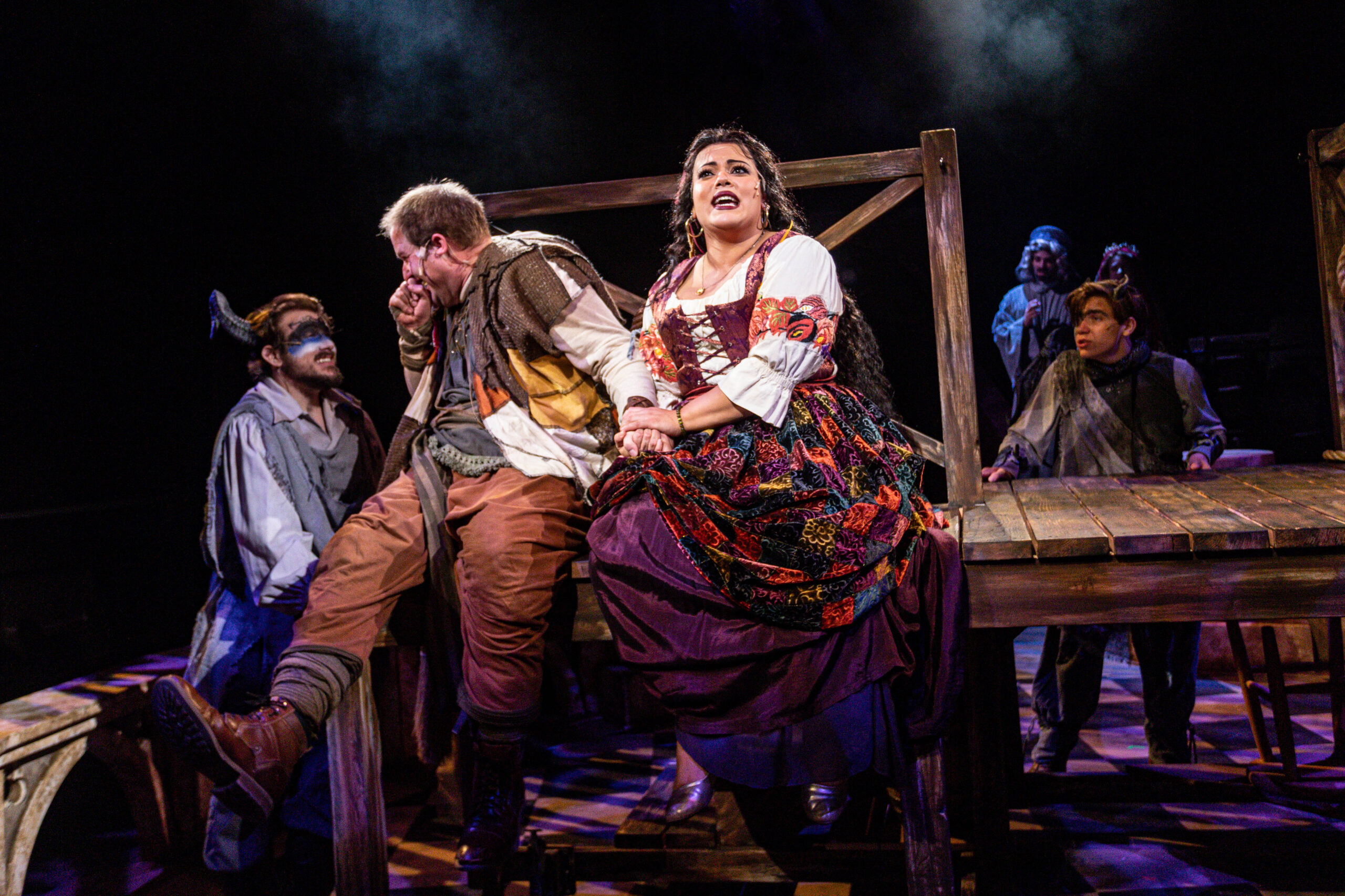
WEST VALLEY CITY – West Valley Arts’ The Hunchback of Notre Dame is an emotional, somber production anchored by profound lead performances, a heartfelt ensemble, and a dedicated production team. Performing under the direction of Kate Rufener, this opening night performance was a shining example of the power and importance of community theatre.
Based on the novel by Victor Hugo and the 1996 Disney film, with book by James Lapine and Peter Parnell, The Hunchback of Notre Dame follows Quasimodo, a deformed bell-ringer isolated in Paris’s famous cathedral by his guardian, Claude Frollo. When Quasimodo ventures out, he meets Esmeralda, a kind dancer who shows him compassion. As Frollo’s obsession with Esmeralda grows, tragedy unfolds, forcing Quasimodo to choose between the only father figure he has known and the woman he loves. With music by Alan Menken and lyrics by Stephen Schwartz, this tragic story highlights the best and worst of humanity—parallels that still resonate today.
Taylor J. Smith was nothing short of miraculous as Quasimodo. Smith’s portrayal of this complex character was gritty and strong, yet soft and childlike. The physicality required for Quasimodo seemed an easy feat for Smith as he seamlessly performed both dialogue and songs while squatting, sitting or hunched over. Breathtaking were all of Smith’s musical performances, including “Out There” in which he held the final, beautiful note for what felt like eternity. As often as possible, I paid close attention to Smith’s facial and eye movements, and it was during those moments I understood how literal Quasimodo was to him. Rarely do I see actors nearly become their characters; however, Smith seemed to embrace this character with all that he had.
Chase Petersen as Claude Frollo gave an outstanding, strong performance with stunningly rich and deep vocals and a commanding dialogue. Like Quasimodo, Frollo is a complicated character and Petersen conveyed well to the audience the internal turmoil his character undoubtedly felt, culminating in what was one of the evening’s most powerful scenes: Frollo expressing his love for Esmeralda and attacking and threatening her when she refused his advances. Petersen’s raw and carnal behavior during this uncomfortably important scene was astounding.
Beatriz Melo shined as the strong, feisty and kind Esmeralda. Melo’s performance felt effortless yet oozed with talent. Tears welled in my eyes as she sang “God Bless the Outcasts” with such depth and beauty. It seemed as though Melo internalized the message of that song and used it for how to portray Esmeralda throughout the evening. One particularly heartwarming scene was Melo’s interaction with Smith as the two meet in the bell tower for the first time. The dialogue flowed between the two organically, putting Esmeralda’s kindness and compassion on full display.
Smith, Petersen and Melo benefited greatly from the superb direction by Rufener, particularly the scenes with two actors conversing. It was these slower moments that really allowed one to understand these three heavily detailed characters in a more intimate way, lending to a more emotional experience as a patron.
Music Director Aioleoge Lesa did stunning work not only with the principal cast but with the entire ensemble. The musical performances were strong vocally and emotionally, and that strength was consistent throughout. Also enjoyable was the work of Lighting Designer Michael Gray. The variety of light to create the feeling of being inside Notre Dame, with the sunlight cascading through the stained-glass windows, was an important detail I noticed the moment I walked into the theatre. I also enjoyed the use of light to add energy and complexity to the ensemble musical numbers.
The evening did include a few minor mishaps that can easily be rectified in future performances. The sound occasionally felt imbalanced with the accompaniment too loud, or the microphones too soft. Most often, however, the sound issues were remedied quickly as is consistent with a show early in the run.
I questioned the use (or non-use) of the circular, moving stage. For example, in every scene with the Virgin Mary, Mary was facing away from those seated in the west section. I also wondered why certain scenes were not held in the center of the room allowing all patrons to watch with ease. This was especially true during a pivotal scene when Quasimodo cradles Esmeralda in his arms moments before she passes away. This scene essentially took place behind me and while I was still able to turn and enjoy it, more consistent use of the rotating stage could have improved sightlines for all sections of the audience.
Lastly, I’d like to mention something I noticed that I don’t believe I’ve ever experienced before: a deep sense of camaraderie among the cast. As Quasimodo was saying goodbye to Esmeralda, I saw cast members visibly crying. It seemed to me these were genuine tears. As the townspeople were welcoming and hugging Quasimodo the embraces seemed so sincere. And finally, after the final bows, Smith encouraged everyone to come back onto the stage with him, a huge smile on his face, acknowledging the work of every actor. I feel fortunate and honored to have witnessed such a brilliant, professional performance, and encourage all to see it.
[box]The Hunchback of Notre Dame plays Thursdays through Saturdays at 7:30 PM, with additional 3:30 PM performances on Saturdays, through August 30, 2025, at West Valley Performing Arts Center (3333 Decker Lane, West Valley City). Tickets are $22–35. For more information, visit wvcarts.org.[/box]