

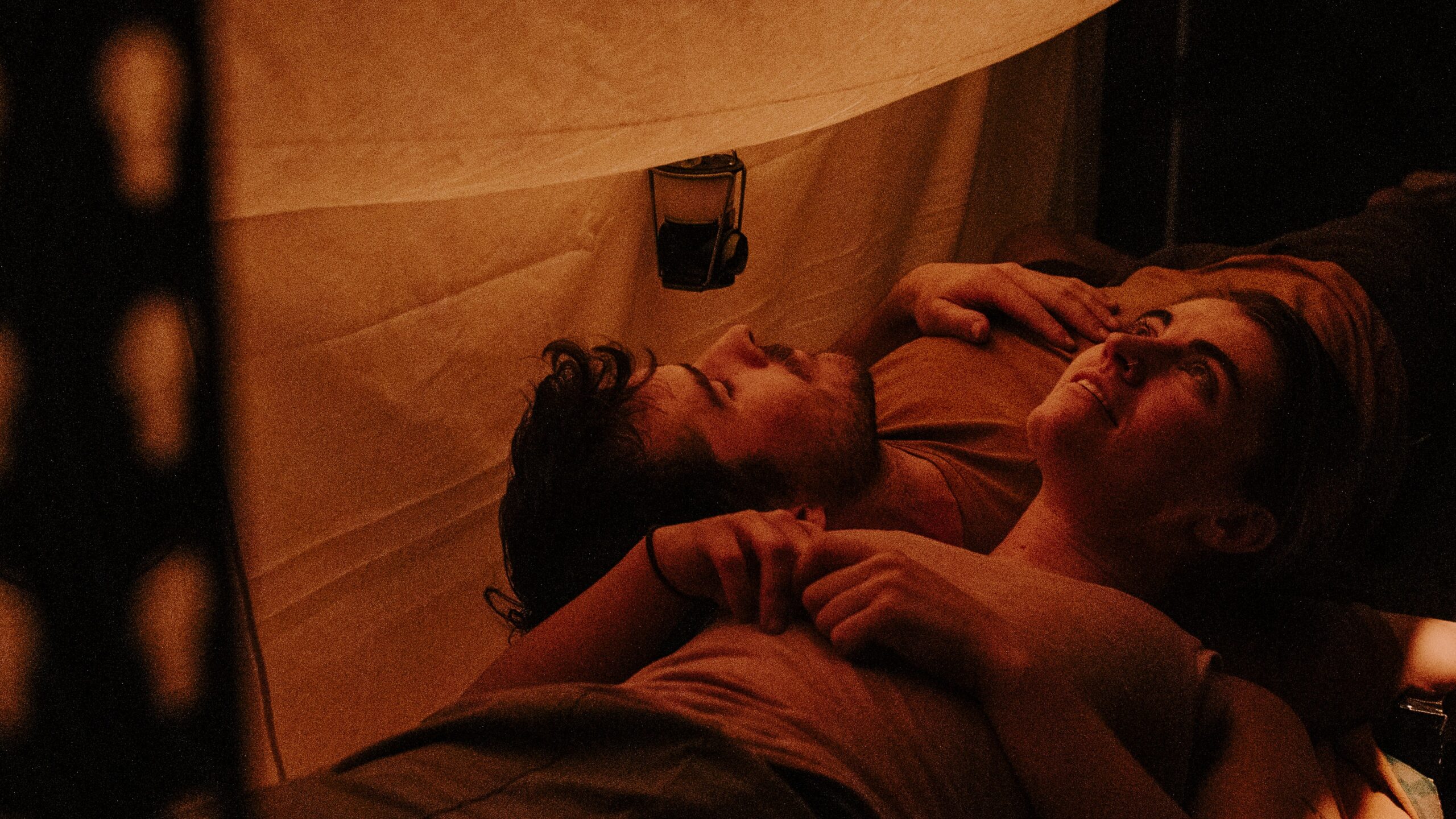
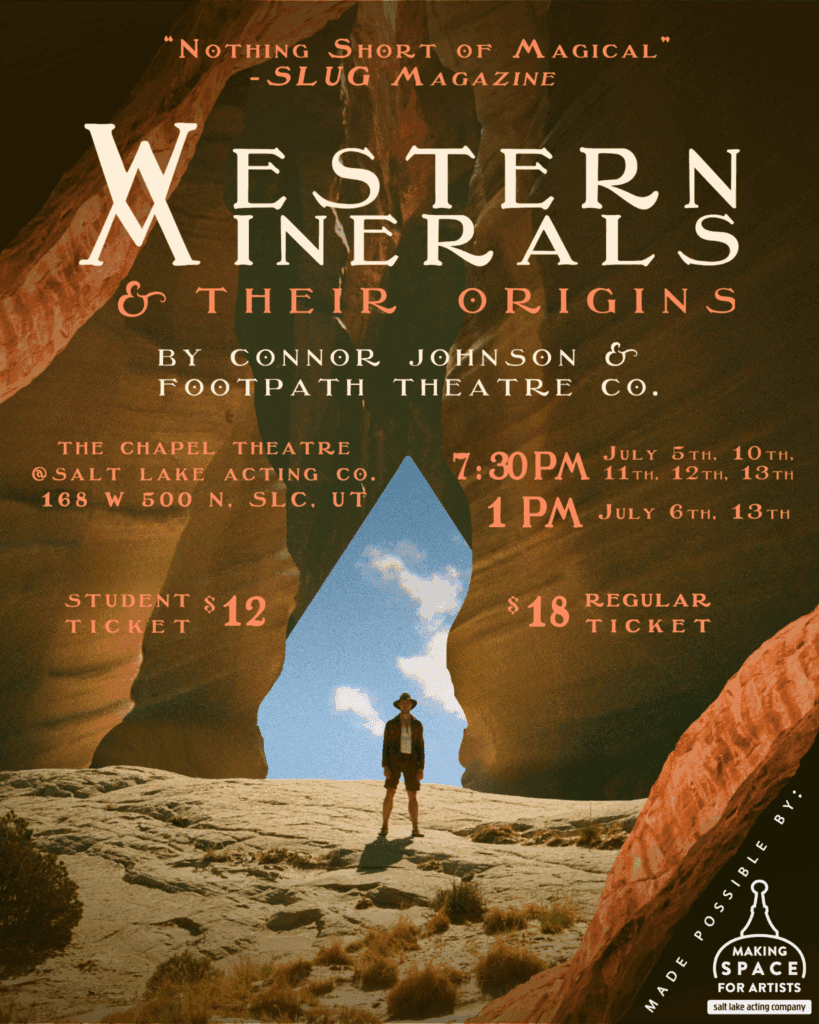
SALT LAKE CITY – Western Minerals & Their Origins is a mouthful of a title for a 60 minute moving piece of theatre. But, much like the sand-packed red-rock of the Southern Utah desert that is the backdrop for the piece, there is a great deal packed tightly into the performance. Presented by playwright Connor Johnson and Footpath Theatre Co. and performed in the Chapel Space at Salt Lake Acting Company, as part of SLAC’s Making Space For Artists program, this is what artistic collaboration and support looks like. The show was a Best of Fringe winner at last year’s Great Salt Lake Fringe Festival, and for good reason.
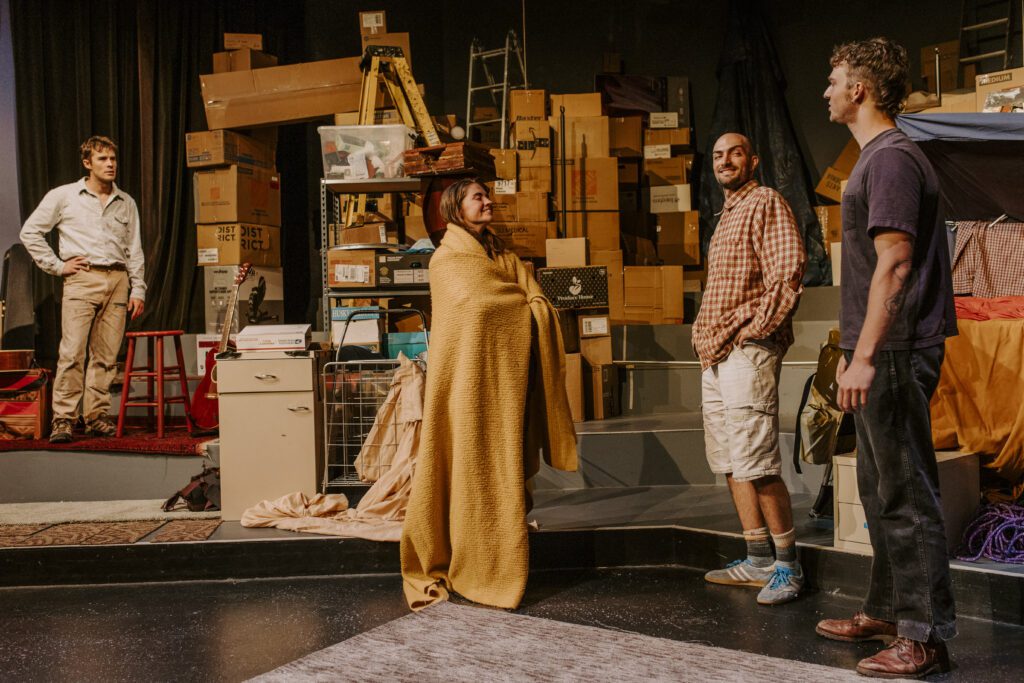
Walking into the theatre I found the stage and performance space had been flipped. Chairs and temporary risers were set up on what is normally the stage, and mountains of cardboard boxes, ladders and junk were piled high on the fixed stepped risers where there is typically seating. Musical instruments and gear were set up on the far left. At first I thought perhaps the company was squatting in the space where SLAC was storing props and costumes for their next production, but it quickly became apparent that the towering boxes and piles of stuff were indeed a carefully crafted set, credited to Jessica Graham in the program as the Set Supervisor, as well as a lead actor and Co-Creator. In addition to Jessica Graham, Director Alexandra Harbold, Connor Johnson, and Harrison Lind are all listed as Co-Creators of both Footpath Theatre Co. and this production, leaving me intrigued about the process they underwent to develop this production.
The show begins abruptly at the end of the story, with Rion, played by playwright Connor Johnson, appearing in a spotlight in the center of the box towers, and calling to his sister Ari before he is enveloped in a blackout. Ari, played by Jessica Graham, then enters carefully from behind the audience, limping, with a cane, carefully picking her way up to the same epicenter to “turn on” the light, illuminating what we come to understand is indeed a garage full of boxes and junk. The juxtaposition of the panicked cry and the limping figure forebodes the tragedy that will unfold. Ari begins to pull items out of the piles, and each time a scene seems to erupt from her memory, related to that item. It is a particularly creative play structure by Connor, conducive to well-paced, non-linear story-telling.
From there, the show expertly winds its way in and out of time and place with simple lighting changes and expert character shifts that take us from the childhood of Rion and Ari, well into young adult-hood. Set in Salt Lake City and the desert landscapes of Southern Utah, it is the story of the relationship of these two siblings, told in bits and pieces across time, and culminating in a tragic loss. As they talk about the desert and mountains that dominate their lives, I began to realize that these two were perhaps themselves the Western Minerals, and this is indeed their origin story. At one point Rion, while describing the layers of rock that forms the landscape and a unique effect where the various layers seem to converge and “all things happen all together, at once”, it seems he is in fact describing this production and the siblings’ relationship. The show indeed feels like so many pieces of the lives, relationship and experiences between these two siblings are converging to a point where all things seem to happen together all at once—each moment affecting the ones before and after. It’s truly a moving and expertly crafted element of the show.
Harbold’s transitions, creative use of space and time and place are truly magical to watch unfold. From the blanket that becomes a tent, to the sheet that becomes a rock wall down which Ari rappels, to the trepidatious hike as Rion and Ari climb up ladders, across the tops of boxes and over and around planks of wood as they traverse the entire stage, is so engaging and imaginative and truly uses the medium of theatre to its fullest. The same standard blue camping tarp turns into an imagined monster, a flash flood in a slot canyon, and a shadow puppet stage all within minutes. At one spectacular moment, warm light by lighting designer Harvey Zach transforms the entire stage full of boxes into the red rock layers of a canyon, complete even with a rock arch. The shadow puppet sequence that crops up in the middle of the terrible climax of the production offers the audience a brief and lovely respite from the tragedy, which then hits all that much harder afterwards. Harbold and the ensemble build stories magically from scraps, inviting the audience to imagine the details in a way that only the theatre can.
The sound design, and especially the live sound effects by Harrison Lind and music by both Lind and Max Bastiani are as marvelous as is the staging. Most Sound effects are done live at the side of the stage by Lind’s vocals, various props and a microphone. It took me a minute to realize the sounds are live and human-generated, as they are so effective and realistic. Lind and Bastiani also perform music with guitar, keyboard and various percussion, mostly as characters in the play (Seth and Ike, friends in Rion’s high school band). The music left me wishing there was more underscoring throughout the production. Costuming by Hannabeth Lind is also effective—with characters clad in worn, rugged clothing that moves easily and believably between the desert landscape and the cluttered garage settings. The only oddity about the costuming are a handful of large sewn on patches on some of the costumes that appear to have a meaning that was unclear to me.
The small cast of four is excellent. The sibling relationship between Ari and Rion at the center of the production is really well done. Johnson and Graham navigate between somewhat distanced adult siblings, to childhood tormentors, to teenage rivals with skill and grace. Scenes like the tender and intimate stargazing of the pretend camping trip of their childhood which transforms into the annoyance of a teenager by his little sister and beyond to a complicated adult relationship, paint a believable picture of a complicated sibling relationship. Ari’s performance as a twelve-year-old giving a presentation on geological land formations is masterful. Beginning as an awkward too-loud rote middle-school recitation, Graham’s performance morphs into a captivating and wonderful story, replete with incredible sound effects by Lind.
Such moments in the production, clearly the result of detailed collaboration between actor, text, director and often musician are really stunning and emotionally provocative. This production is masterful. It is beautifully assembled and presented–visually, auditorily, linguistically, and emotionally. Unfortunately, it is a short piece on a short run (closing this weekend), so don’t miss your chance to see this magical production.
[box]Western Minerals & Their Origins plays Friday and Saturday evening at 7:30 and Sunday at 1pm through 7/13 in the Chapel Space at Salt Lake Acting Company (168 W 500 N, Salt Lake City). Tickets are $12-24. For more information, visit saltlakeactingcompany.org.[/box]