

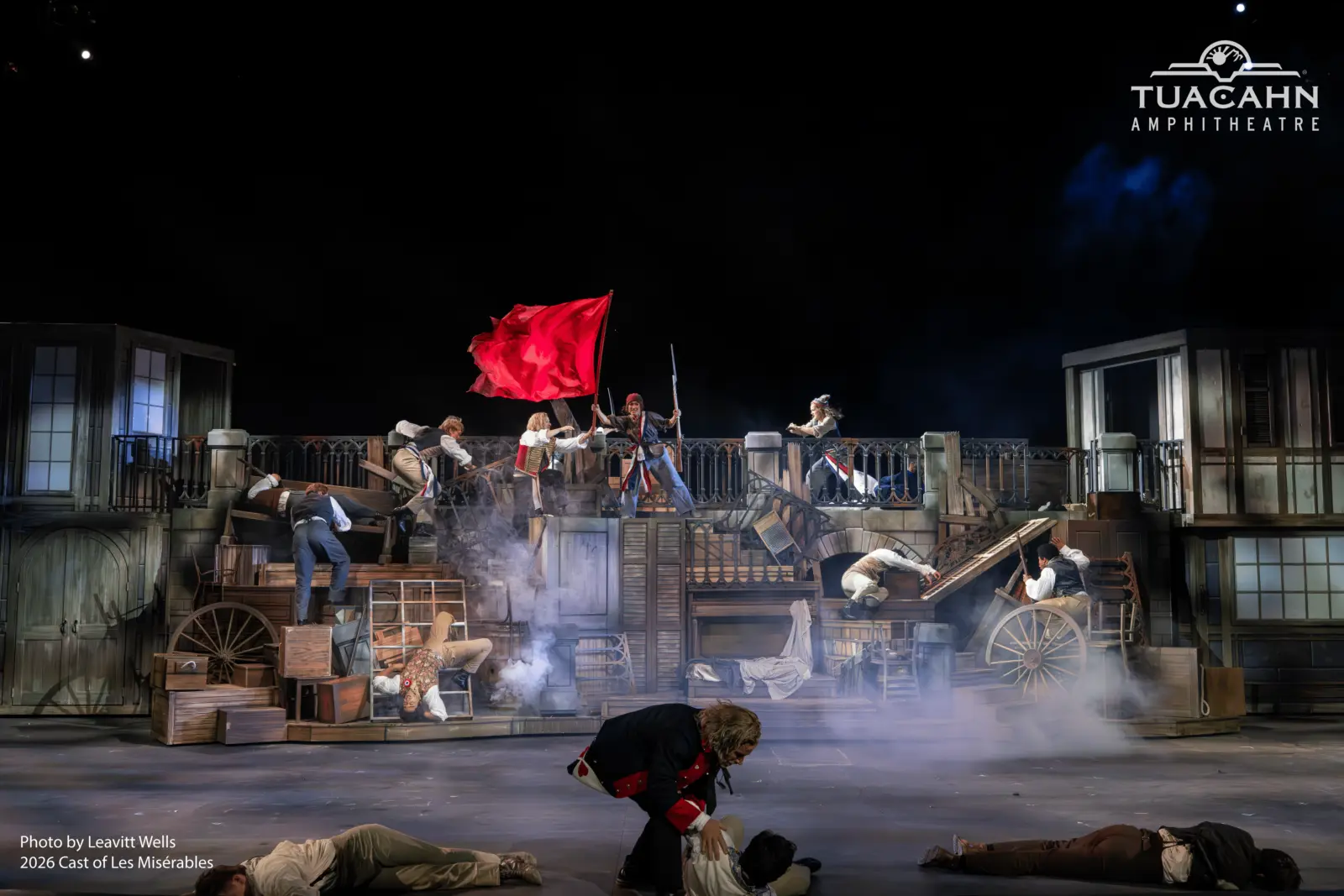
IVINS — Cameron Mackintosh’s Les Misérables has found a breathtaking home in the red rock canyon of Ivins, Utah at Tuacahn Center for the Arts. Under the direction of Sarah Hartmann, with music direction by Christopher Babbage, this sweeping production blends natural beauty, powerful performances, and technical excellence into one of the most unforgettable theatrical experiences I’ve encountered.
From the opening moments, Tuacahn’s iconic outdoor amphitheater proves to be more than just a backdrop—it becomes an active participant in the storytelling. Watching the chain gang hammer against real red rock during the prologue is both visually and emotionally striking. Add in the surprise of live animals on stage, and the production immediately establishes its ambitious scope. Scenic designer Clayton Dombach enhances this grandeur with impressive set pieces—most notably the towering barricade—while the lighting design cleverly employs forced perspective to create remarkable depth across the expansive stage.
With so many principal characters, Les Misérables demands balance, and this production excels in giving each lead their moment to command the stage. Solos are staged with striking simplicity: a single performer, alone on a massive stage, under a focused spotlight. The result is powerful and intimate, allowing each number to land with maximum emotional impact and zero distraction.
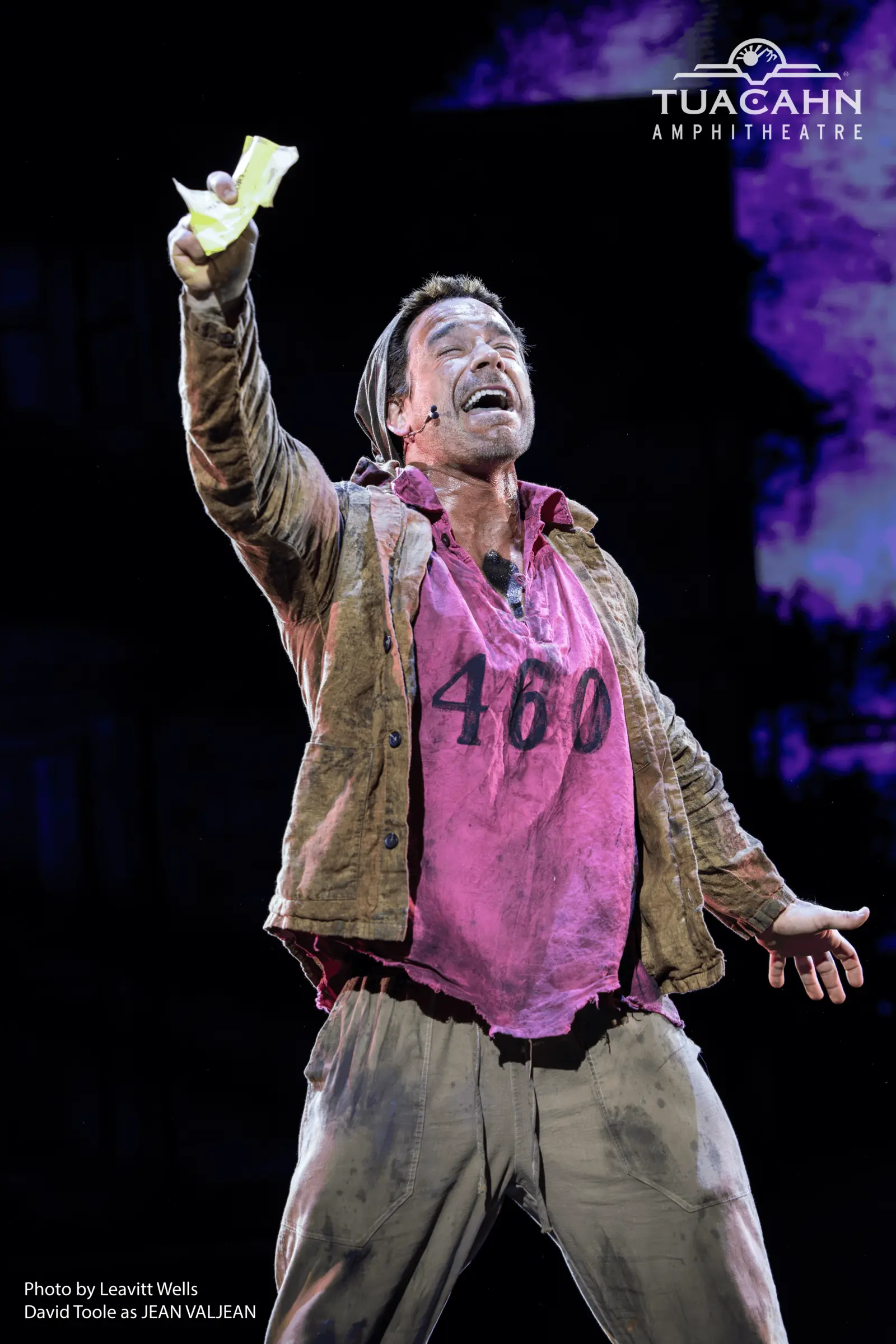
At the center of it all is David Toole (Jean Valjean), delivering a masterclass performance that is nothing short of extraordinary. Toole embodies the role completely, with rich, commanding vocals and deeply expressive physicality. Every interaction—whether with Javert, Fantine, Cosette, or even young Cosette—is infused with authenticity and emotional weight. Toole’s renditions of “Who Am I?” and “Bring Him Home” are breathtaking, each moment holding the audience in rapt silence. Quite simply, he is everything one could hope for in this iconic role—and worth the trip to Ivins on his performance alone.
Randal Keith (Javert) is equally compelling, bringing a commanding presence and vocal power that electrifies the stage. Keith’s performance of “Stars” stands as one of the evening’s most unforgettable highlights—precise, resonant, and filled with intensity. Mindy Smoot Robbins (Fantine) delivers a vocally stunning “I Dreamed a Dream,” portraying a stronger, more defiant interpretation of the character that adds fresh dimension to the role.
The supporting cast shines across the board. J.T. Wood (Marius) and Rachel Schoenecker (Cosette) share delightful chemistry, particularly in “A Heart Full of Love,” which is both playful and sincere. Schoenecker’s Cosette is a standout—imbued with strength and warmth, avoiding the overly delicate interpretations often seen in this role. Kelsey Lee Smith (Eponine) perfectly delivers “On My Own,” one of the most beautiful moments of the evening.
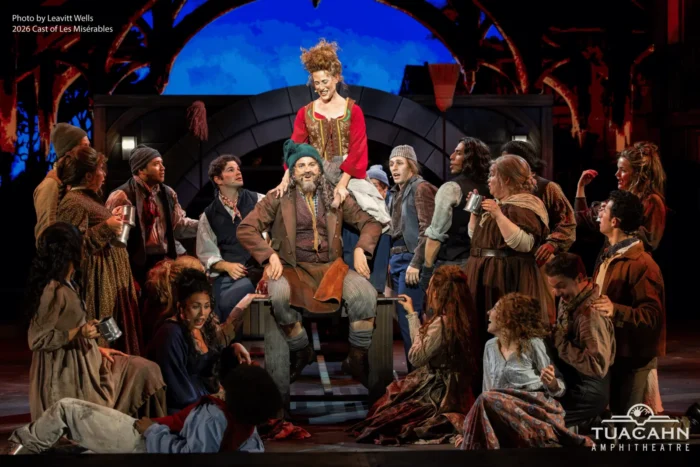
Comic relief is expertly handled by Zach Berger (Thénardier) and Janna Cardia (Madame Thénardier). Berger, in particular, is a revelation—combining sharp comedic timing with impressively strong vocals. “Master of the House” is a true first-act highlight, bursting with energy and clearly beloved by the ensemble, who fully commit to the moment. Cardia complements him perfectly, bringing a delightfully wicked presence reminiscent of a Miss Hannigan-type character.
The ensemble elevates the production to another level. Numbers like “Red & Black,” “Do You Hear the People Sing?,” and the show-stopping “One Day More” are executed with thrilling precision and passion. “One Day More,” in particular, is staged to perfection—each principal occupying their own space across the massive stage, creating a powerful visual and vocal tapestry that fills every inch of the amphitheater.
Tuacahn’s technical team deserves immense praise. Josh Liebert’s sound design ensures that, despite the vast outdoor setting, every lyric is crystal clear—a remarkable achievement. The performers match this with excellent diction and vocal control throughout.
There are a few minor shortcomings. Some wigs—particularly for Enjolras and Jean Valjean in the second act—are noticeably unconvincing and detract from the overall polish. The aging of Valjean could also benefit from more effective hair and makeup. A few transitions feel rushed, and certain emotional beats don’t fully land. Fantine’s decline happens too abruptly, shifting from strength to deathbed without enough transition. Eponine’s death scene is similarly uneven—she remains standing and unattended for far too long, while Marius awkwardly appears hesitant and emotionally disconnected. This weakens what should be one of the show’s most powerful relationships and moments.
Still, these critiques are minor in an otherwise triumphant production. Memorable touches—like the haunting staging at the end of “Empty Chairs and Empty Tables,” and the powerful depictions of key deaths (especially Javert and Gavroche)—demonstrate the creative team’s thoughtful approach to storytelling.
This is not just a show—it’s an experience, and one absolutely worth the journey. Having seen Les Misérables dozens of times over the past 40 years, I can confidently say this production ranks at the very top. With its stellar cast, passionate ensemble, stunning design, and unmatched setting, it may well be the finest show I’ve ever seen at Tuacahn.
MORE INFO: Les Misérables plays at the Tuacahn Outdoor Amphitheatre (1100 Tuacahn Drive, Ivins) through October 23rd, 2026. Tickets range from $53–$156 and can be purchased at https://www.tuacahn.org/.
FOLLOW US ON FACEBOOK and INSTAGRAM!
If you’re a director, producer or marketing contact who would like to have us review your show, please fill out this form.
If you have comments about this article, please fill out this form.